AI Visibility for eCommerce: How to Measure and Win GEO

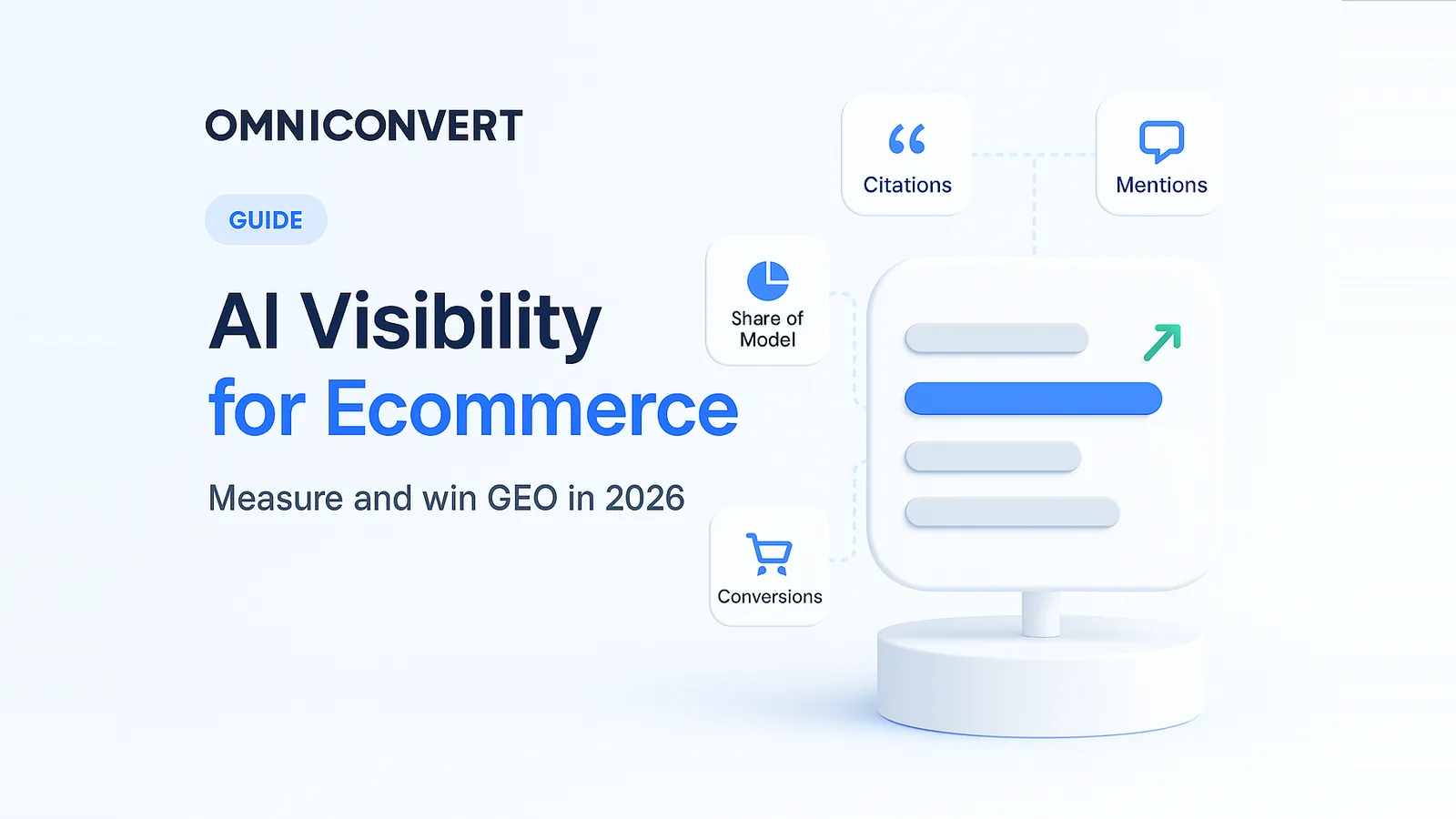
- AI visibility is a means, not an end. Track mention rate and share of model, but grade the channel on AI referral traffic and its conversion rate. Cited without being chosen is vanity.
- GEO measurement productized in 2026: Sprinklr shipped LLM Insights (AI mention rate, share of voice, sentiment) and share of model became a named KPI. The category is real; the discipline of tying it to revenue is not yet.
- Six signals form a complete GEO scorecard: mention rate, share of model, citation source coverage, sentiment, AI referral traffic, and referral conversion rate. The first four are leading; the last two are the outcome.
- Four levers move the numbers: get into third-party listicles, lift review volume, publish citable proprietary data, and structure answer-first content with named definitions and schema.
- Attribution hooks are load-bearing. Strip the tags that tell an engine whom to credit and citations can collapse even while the page stays indexed and crawled. Citation coverage is the leading indicator, and it drops days before referral traffic reflects it.
Quick answer. AI visibility measures how often, and how favorably, an answer engine surfaces a brand when buyers ask category questions. Measure it with six signals: AI mention rate, share of model, citation source coverage, sentiment, AI referral traffic, and the conversion rate of that traffic. The last two decide whether the first four are worth anything: a brand cited in AI answers but never chosen by a qualified buyer has a vanity metric, not a channel.
Buyers increasingly ask an answer engine "what's the best CRO tool for Shopify?" instead of Googling and clicking through ten listicles. The engine returns a synthesized answer with a short list of named tools and a handful of cited sources. If your brand is in that answer, you were considered. If it is not, you were never in the room. Measuring which of those happened, across engines and prompts, is what AI visibility is, and in 2026 it stopped being a curiosity and became a budget line.
This guide gives you the working definitions, a six-signal scorecard you can stand up this quarter, and the four levers that actually move it, grounded in Omniconvert's 13 years and 70,000+ experiments across 7,000+ ecommerce sites. [CROBenchmark Report 2026, Omniconvert] But it starts with a warning the new measurement tools quietly skip: visibility is a means, not an end.
What is generative engine optimization (GEO)?
GEO is the successor discipline to SEO, and the difference is structural, not cosmetic. SEO competes for a ranked position on a results page a human then scans and clicks. GEO competes to be the answer, or to be one of the two or three sources the answer is built from. Engines synthesize those answers from sources they trust: third-party review sites, "best of" and "alternative" roundups, structured product data, and answer-first content they can extract verbatim. A blue-link ranking and an AI citation are earned by overlapping but distinct signals, which is why a brand can rank on page one of Google and be invisible in Perplexity for the same query.
The practical consequence for an ecommerce operator: GEO is won mostly off your own domain. Owned comparison pages help, but the durable wins are third-party listicles you appear in, review-site authority you accumulate, and proprietary data specific enough that an engine quotes your number instead of a competitor's estimate.
Why did AI visibility measurement become a category in 2026?
The trigger was a wave of productization. In June 2026, Sprinklr introduced LLM Insights, giving marketing teams real-time visibility into how their brand and competitors appear in AI-generated search, tracking AI mention rate, share of voice, and sentiment across the major answer engines. In parallel, "share of model" was formalized as a marketing KPI, with dedicated trackers pitching AI visibility as the metric to own for 2026. Semrush, Profound, and others added AI-visibility tracking to their suites. Measurement is now a category, and that is genuinely useful: you cannot improve what you cannot see.
But every one of these tools grades the top of the funnel. They answer "does the engine name us, and in what tone?" and stop there. That is share of voice with a new denominator. The question that decides whether GEO is a growth channel or a dashboard, "did that mention reach a qualified buyer who converted?", sits outside the frame of most of these products. That gap is the whole argument of this article.
Nexus by Omniconvert is built to read AI referral traffic by segment against predicted lifetime value, so you can see which AI mentions surface you to buyers worth keeping, not just which mentions exist. See how it works.
What is share of model, and where does it mislead?
Measuring share of model is mechanical: define 20 to 40 buyer prompts that represent your category ("best CRO tools for Shopify", "Triple Whale alternative", "how to measure true profit in ecommerce"), run them across ChatGPT, Perplexity, Gemini, and Copilot on a fixed cadence, and record for each whether you are named, whether you are cited, and who is named instead. Aggregate to a percentage and you have your share of model, plus a competitor leaderboard for the prompts you lose.
Here is the trap. Share of model is a presence metric, and presence is not preference. An engine can name you in an answer that frames you as the budget option a buyer skips, cite you in a list your ideal customer never reads, or surface you for a prompt that pulls the wrong segment entirely. Being cited without being chosen is the AI-era version of a billboard on an empty highway. The lens we bring from CVO work is simple: the metric worth optimizing is not how often an engine mentions you, but the yield of the traffic that mention produces. Other tools are starting to tie visibility to conversion. The distinction worth holding is tying it to predicted lifetime value and profit, so a mention is graded on whether it brings a buyer worth keeping, not just a buyer who checks out once.
What is the six-signal GEO scorecard?
Track these six, and read every leading signal against its outcome. AI referral traffic often arrives with higher intent, because the buyer asked a question and was handed a short list, which is exactly why its conversion rate is the signal worth watching. Most 2026 tools give you the top four and stop; the discipline is refusing to celebrate row one until row six moves.
| Signal | What it tells you | The vanity trap | CVO correction |
|---|---|---|---|
| AI mention rate | How often engines name you across your prompt set | Counts mentions in answers no buyer reads | Weight prompts by buyer intent, not volume |
| Share of model | Your presence vs competitors on category prompts | Presence is not preference | Segment by which prompts pull your ICP |
| Citation source coverage | Which third-party sources the answer cites, and if you are in them | Being cited on low-authority sources | Prioritize the sources that convert (G2, top roundups) |
| Sentiment / framing | Whether you are framed as the right choice or the cheap one | A positive mention that mis-positions you | Fix the framing at the source content |
| AI referral traffic | Sessions arriving from answer engines (GA4) | Traffic that bounces or is off-ICP | Read it by landing page and segment |
| AI referral conversion rate | Whether that traffic converts and at what value | No trap. This is the check on the other five. | The metric that grades the whole channel |
The ecommerce brands that plateau on GEO consistently share one pattern: they instrument the top four signals, watch share of model climb, and never connect it to a single line of revenue. The gap closes fastest when operators treat AI referral conversion rate as the primary unit of measurement, not mention count as the vanity metric. A dashboard that shows a rising share of model beside flat qualified conversions is not a success story; it is a brief to change the answer the engine is giving.
Which four levers move AI visibility for ecommerce?
- Get into third-party listicles. Engines cite "alternative" and "best of" articles you do not own, so being included in them is the highest-impact, most durable win. Pitch a differentiated, honest angle an editor can use, and supply proprietary data (lever three) so the inclusion is sticky rather than a courtesy mention.
- Lift review volume and recency. Answer engines lean on review-site authority: G2, Capterra, and the Shopify App Store. Volume and recency both signal trust, so a steady cadence of fresh reviews, and a reply to every one within a day, moves the needle more than a one-time push.
- Publish citable proprietary data. Specific numbers from a credible dataset are exactly what engines quote. Answer-first benchmark pieces built on CROBenchmark's 70,000+ experiments across 7,000+ sites give an engine a number to attribute to you. [CROBenchmark Report 2026, Omniconvert]
- Structure content answer-first. Lead each section with a 40 to 60 word direct answer, use named definitions ("X is defined as..."), tables, and FAQ schema, and keep attribution hooks intact so a citation credits your URL.
On that last point, a caution. Attribution hooks are load-bearing. Strip the tags that tell an engine whom to credit and citations can collapse even while the page stays indexed, crawled, and otherwise unchanged. The engine still reads the page; it no longer has a tag telling it whom to credit. GEO is undone as easily as it is won, and citation coverage is the leading indicator: it drops days before referral traffic reflects it.
How is Nexus by Omniconvert built to close the AI visibility loop?
The measurement tools that launched in 2026 answer "are we visible?" Nexus by Omniconvert is built for the next question, "is that visibility worth anything?" The design intent is to read behavioral and transactional data across the store against the sessions that arrive from answer engines, and to score those sessions by predicted lifetime value. The scorecard then does not stop at the two outcome signals; it grades them by the quality of the customer behind them. That is the AI eCommerce growth engine view: visibility is an input to profitable, retainable demand, never the deliverable itself.
AI visibility for ecommerce FAQ
Generative engine optimization (GEO) is the practice of shaping how AI answer engines such as ChatGPT, Perplexity, Gemini, and Copilot represent and recommend your brand when buyers ask category questions. Unlike SEO, which competes for a ranked blue link a user clicks, GEO competes to be the synthesized answer itself, or one of the few sources that answer cites. It leans on third-party mentions, review authority, structured data, and answer-first content the engine can extract verbatim.
Share of model is the percentage of AI answers, across a representative set of category prompts, in which your brand appears, relative to competitors. To measure it, define 20 to 40 buyer prompts ("best CRO tools for Shopify", "Triple Whale alternative"), run them across the major engines on a fixed cadence, and record whether you are named and cited. It is the AI-era equivalent of share of voice, and like share of voice it says nothing about whether the mention converted.
Answer engines synthesize from third-party sources they trust: G2 and Capterra reviews, Shopify App Store listings, and "best of" roundups on high-authority blogs. If your brand is absent from those listicles, thin on recent reviews, or missing structured data and answer-first content, the engine has nothing to cite. Absence compounds: a brand that is never surfaced generates no discovery, no third-party discussion, and stays absent from future answers.
Work four levers in priority order. Get included in third-party "alternative" and "best of" listicles, because engines cite articles you do not own. Lift review volume and recency on G2, Capterra, and the Shopify App Store. Publish proprietary, citable data with specific numbers an engine can quote. And structure every page answer-first, with named definitions, tables, FAQ schema, and correct attribution hooks so a citation credits your URL rather than a competitor's.
It becomes one the moment it is measured in isolation. Mention rate and share of model tell you the engine can see you; they say nothing about whether the buyer chose you or converted. The fix is to pair every visibility metric with its downstream outcome: AI referral traffic from GA4 and the conversion rate of that traffic. A rising share of model with flat qualified conversions is a signal to change the answer, not celebrate the mention.
Nexus by Omniconvert is built to connect AI-visibility signals to what happens after the click, reading AI-sourced sessions against predicted lifetime value so effort goes to the prompts that surface you to profitable buyers, not just any buyer. Other tools now tie visibility to conversion. The distinction worth holding is grading a mention on the lifetime value and profit of the buyer it brings, so you optimize for a buyer worth keeping rather than one who checks out once.
The 2026 rush to measure AI visibility solved the easy half of the problem: you can now see how often an answer engine names you. The hard half is unchanged. A mention that never reaches a qualified buyer, or reaches one and does not convert, is share of voice for a channel that has not been asked to sell anything. Build the six-signal scorecard, grade it on AI referral traffic and its conversion rate, then go one step further and grade a mention on whether it brings a buyer worth keeping, not one who checks out once. Let the four levers move the numbers that map to profit. See how Nexus by Omniconvert grades AI visibility by lifetime value.
Measure AI visibility the way it earns profit
Nexus by Omniconvert is built to read AI referral traffic by segment against predicted lifetime value, so you can see which AI answers bring buyers worth keeping. Built on 13 years and 70,000+ experiments across 7,000+ ecommerce sites.