Agentic Commerce Statistics 2026: Every Figure Sourced

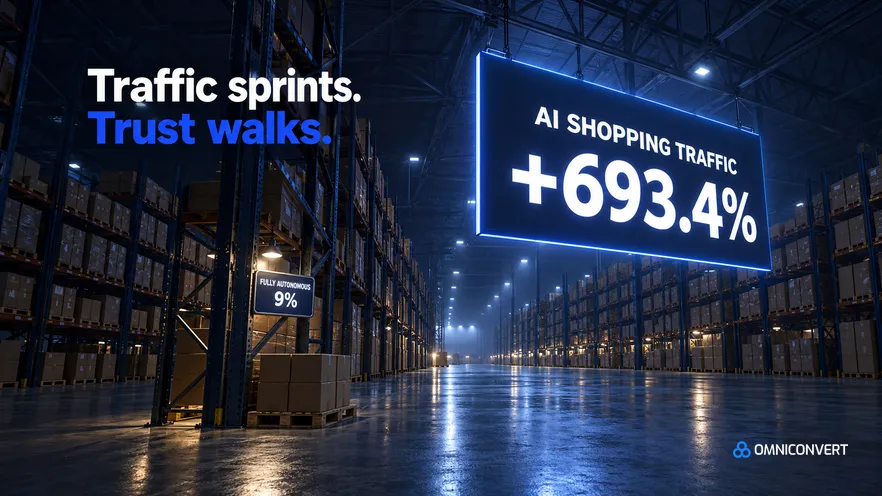
- Generative AI traffic to US retail sites grew 693.4% year over year across the 2025 holiday season, from a base Adobe itself calls modest [Adobe, 2026].
- Salesforce says AI and agents influenced 20% of global Cyber Week orders in 2025, a figure built from first-party and third-party data plus market assumptions [Salesforce, 2025].
- 2030 forecasts range from $300 billion to $5 trillion because the publishers count different things, so compare the definitions before the sizes [Bain, 2025; McKinsey, 2025].
- Shoppers trust agents in principle (74%) and delegate payment rarely (9% open to fully autonomous shopping) [Accenture, 2026].
- 89% of merchants in one UK and US survey say they are preparing for agentic commerce, and 72% expect shoppers to move faster than merchants are ready for [Checkout.com, 2026].
- Protocols such as the Agentic Commerce Protocol and the Universal Commerce Protocol decide whether an agent can transact with a store, not whether it chooses it.
Agentic commerce statistics come from consultancies, platforms and payment vendors, and they rarely agree because each one counts something different. This page gathers the figures worth citing. I opened each primary source myself, quote it as the publisher words it, and left out any number I could not trace. Last updated: 21 October 2026. I refresh this page quarterly.
I have spent 13 years in eCommerce, and people ask me how much of the agent story is real. Omniconvert Commander (formerly Nexus) is the AI eCommerce growth engine for Shopify brands: it reads your store, ad and customer data, ranks growth opportunities by profit impact, and builds the campaigns to act on them, and you approve what goes live. That job starts with honest numbers, so this page is about the evidence.
Our own CROBenchmark dataset covers 7,000+ websites in 15+ industries, assessed against 248+ audit criteria [CROBenchmark Report 2026, Omniconvert]. It does not measure agent traffic, so I do not use it as agentic evidence here. For what the field is, start with the agentic commerce guide.
What do the latest agentic commerce statistics show?
Agentic commerce statistics is defined as published measurements of how AI agents find, recommend or complete purchases for shoppers, counted as traffic, orders, revenue or attitudes. In its forecast, Bain says agentic commerce is defined as "purchases that are initiated, influenced, or completed by third-party AI agents" or by "retailer-hosted agents", and it leaves out "shopping journeys that only use AI-assisted search or discovery" [Bain, 2025].
| Figure | What it measures | Source |
|---|---|---|
| +693.4% | Year-over-year growth in generative AI traffic to US retail sites, 1 November to 31 December 2025 | [Adobe, 2026] |
| $67 billion | Cyber Week 2025 sales that Salesforce says AI and agents drove | [Salesforce, 2025] |
| $900 billion to $1 trillion | US B2C retail revenue that agents could orchestrate by 2030 | [McKinsey, 2025] |
| $3 trillion to $5 trillion | The same opportunity worldwide by 2030, goods only | [McKinsey, 2025] |
| $300 to $500 billion | US agentic commerce by 2030, roughly 15% to 25% of e-commerce | [Bain, 2025] |
| 74% | Consumers who would trust a personal AI agent more than their best friend to buy for them | [Accenture, 2026] |
| 9% | Consumers open to fully autonomous shopping | [Accenture, 2026] |
Agentic commerce trends: how fast is AI shopping growing?
Adobe's analytics cover "over 1 trillion visits to U.S. retail sites, 100 million SKUs and 18 product categories". They show generative AI traffic "increased by 693.4% compared to the year prior" from 1 November to 31 December 2025 [Adobe, 2026]. Adobe adds its own caveat: "While the base of users remains modest, the uptick shows the value AI can deliver as a shopping assistant." [Adobe, 2026]
McKinsey reports the attitude behind the traffic: "Half of all consumers now use AI when searching the internet." [McKinsey, 2025]
Salesforce reports that over Cyber Week 2025, from 25 November to 1 December, AI and agents were "driving $67 billion in sales" [Salesforce, 2025] and "influenced a staggering 20% of all global orders", within global sales of $336.6 billion [Salesforce, 2025]. Salesforce says its calculations "blend together first-party and third-party data, as well as several market assumptions" [Salesforce, 2025]. I found no definition of "influence" in the release. Read the $67 billion as AI present in the journey, not as revenue AI sold [Salesforce, 2025].
How big could agentic commerce get by 2030?
McKinsey says that by 2030 "the US B2C retail market alone could represent an opportunity to orchestrate revenue" "in the range of $900 billion to $1 trillion", and "Globally, this opportunity is projected to range from $3 trillion to $5 trillion" [McKinsey, 2025]. The ranges rest on moderate assumptions about merchant readiness, cover physical goods rather than services, and leave out B2B marketplaces.
Bain's number is smaller. It says the US market "could reach $300 to $500 billion by 2030, making up roughly 15% to 25% of overall e-commerce" [Bain, 2025]. My reading is that the gap between the two is a difference in scope, not a disagreement about direction. If you quote one, quote its definition with it. Our piece on what agentic commerce changes for merchants covers what to do with the direction.
How much do consumers trust AI agents to buy for them?
Accenture surveyed 25,590 consumers across 16 countries online between 7 and 22 January 2026. "Nearly three in four (74%) would trust a personal AI agent more than their best friend to make a purchase on their behalf" [Accenture, 2026], yet "one in three (32%) are ready to hand over purchase decisions" and "9% are open to fully autonomous shopping" [Accenture, 2026]. Stated willingness is defined as what a respondent says they would do in a survey, and observed behaviour is defined as what shoppers do in real orders. Every consumer figure on this page is the first kind.
Checkout.com's June 2026 release adds the objections. "One in four (24%) consumers say they will never delegate purchases to AI" [Checkout.com, 2026], and "27% trust no organization to operate an AI shopping agent" [Checkout.com, 2026]. The release states no sample size or survey date, so treat it as directional.
Are merchants ready for agentic commerce?
In the same Checkout.com release, which covers merchants in the UK and US, "89% of merchants overall are actively preparing for agentic commerce" [Checkout.com, 2026]. 72% say "consumers will adopt agent-led shopping faster than most merchants are prepared for" [Checkout.com, 2026], and 75% say "giving customers the real-time ability to revoke permissions will be critical" [Checkout.com, 2026]. For the readiness work itself, see our agentic commerce readiness FAQ and the guide to optimizing for AI shopping agents.
Preparing is not measuring. A merchant who switches on an AI channel still has to learn whether those visits earn a profit, and that is an experiment question. Across Omniconvert Explore, the average conversion uplift is 23.2% across 70,000+ experiments [Omniconvert Explore, 70,000+ experiments], which is why I trust a test on your own store over any borrowed benchmark.
AliveCor used Omniconvert to run a structured A/B testing programme and achieved +21% conversion rate, +5% revenue per visitor, and 94% statistical relevance across their experiments. [Omniconvert, AliveCor case study]
Which protocols and platforms carry agentic commerce?
Stripe describes the Agentic Commerce Protocol as "a new, merchant-friendly open standard co-developed by Stripe and OpenAI". At launch on 29 September 2025, "ChatGPT users in the US can buy goods from US-based Etsy businesses", with "over a million Shopify merchants" listed as coming next. Payment runs through a Shared Payment Token, which Stripe says is "scoped to a specific merchant and basket total" [Stripe, 2025].
Google announced the Universal Commerce Protocol on 11 January 2026 as "a new open standard for agentic commerce that works across the entire shopping journey", "co-developed with industry leaders including Shopify, Etsy, Wayfair, Target and Walmart", and says more than 20 additional companies endorsed it [Google, 2026].
A protocol decides whether an agent can buy from you, not whether it picks you. That second part is a catalogue, review and visibility question. Our explainers on the agentic storefront and zero-click commerce take it from there, and AI visibility for eCommerce covers how stores get recommended.
How should you read agentic commerce statistics?
The failure I see most is the growth-rate transplant. A team reads that AI traffic to US retailers grew 693.4% [Adobe, 2026], applies the multiple to its own AI-referred sessions, and builds a channel budget on the result. It looks reasonable because the number is real and the source is credible. It costs them twice: a percentage on a small base says little about orders, and Adobe itself says the base "remains modest". The budget moves before anyone checks what those sessions earn after ad spend and returns.
- Pair figure and definition. "Influenced", "orchestrated" and "initiated" are three different counts.
- Separate attitude from behaviour. Survey willingness is a ceiling, not a forecast.
- Check profit, not traffic. Measure AI-referred sessions on POAS and True Profit, not on visits.
The last step is where Omniconvert Commander fits. It unifies store, ad and customer data and measures results in True Profit, not ROAS, and you approve what goes live.
Agentic commerce statistics: FAQs
What are agentic commerce statistics?
Agentic commerce statistics are published measurements of how AI agents find, recommend or complete purchases for shoppers. They cover traffic, orders, forecasts and consumer attitudes. The useful ones name the publisher, the date and what was counted.
What counts as agentic commerce in these figures?
Each publisher counts something different, which is why forecasts differ. Bain counts purchases that AI agents initiate, influence or complete, and excludes journeys that only use AI-assisted search [Bain, 2025]. Salesforce counts orders AI and agents influenced, and does not define influence [Salesforce, 2025].
How do I find out whether AI shopping traffic matters for my store?
Start with your own data, not the headline rates. Segment sessions that arrive from AI assistants, then compare orders, return rates and profit per session against your other channels. Only your analytics can say whether that traffic earns a profit.
How do the 2030 agentic commerce forecasts compare?
McKinsey projects $900 billion to $1 trillion of US B2C retail revenue that agents could orchestrate by 2030, and $3 trillion to $5 trillion globally [McKinsey, 2025]. Bain projects $300 to $500 billion of US agentic commerce, roughly 15% to 25% of e-commerce [Bain, 2025]. The scopes differ, so the numbers are not rivals.
Do consumers trust AI agents to buy for them?
In principle, yes. In practice, only to a point. Accenture found 74% would trust a personal AI agent more than their best friend to buy for them, but only 9% are open to fully autonomous shopping [Accenture, 2026]. Checkout.com found 24% would never delegate purchases to AI [Checkout.com, 2026].
How does Omniconvert Commander fit with agentic commerce?
Omniconvert Commander is the AI eCommerce growth engine for Shopify brands. It unifies your store, ad and customer data, ranks opportunities by profit impact and measures results in True Profit, not ROAS, and you approve what goes live. It does not manage product feeds or make a catalogue readable to agents.
What to cite, what to test
Agentic commerce is growing fast from a small base, and the best-sourced figures show traffic up, forecasts wide and consumer trust narrow. Cite each number with its publisher and definition, and keep forecasts, influenced-order shares and survey willingness apart. Then test. Your own AI-referred sessions, measured in profit, will tell you more about your next quarter than any 2030 projection. I drop any figure whose primary source I cannot open.