Best AI Marketing Tools for eCommerce in 2026: Compared

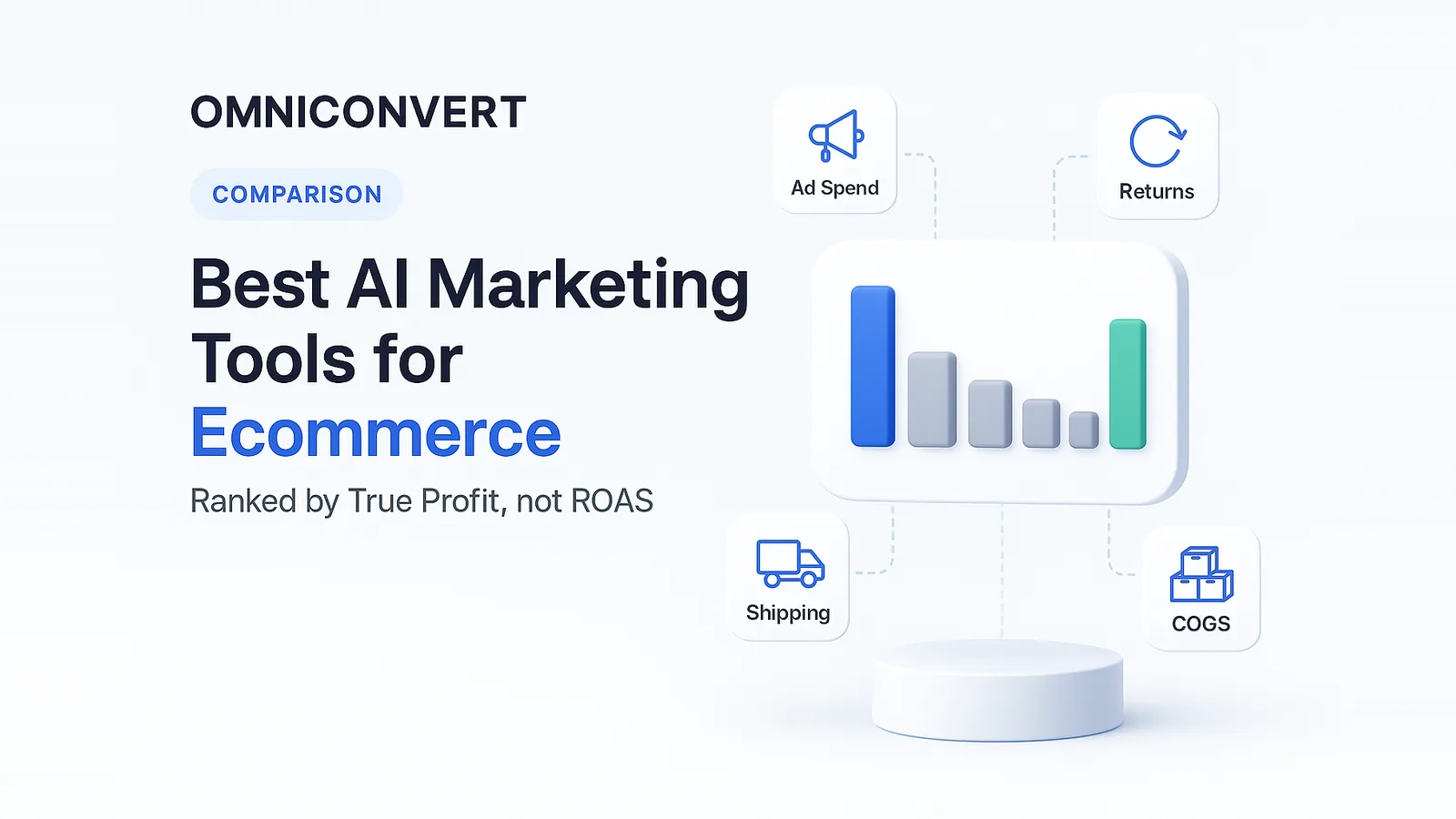
- Judge AI marketing tools on True Profit and customer value, not ROAS or creative volume. ROAS can rise while margin falls; profit per customer cannot lie in the same way.
- Profit analytics tools (Triple Whale, Lifetimely, Polar Analytics) measure the money; ad tools (Madgicx, AdRoll, Pencil) spend it; email tools (Klaviyo AI) sequence it. Most brands own three of these and still cannot answer which customer is worth acquiring.
- The gap in every rival listicle: they rank on ad-creative automation. Almost none judge whether a tool optimizes the profit a customer leaves behind after returns, discounts, and fees.
- Customer Value Optimization treats profit per customer segment as the primary unit of measurement. That is where retention, acquisition, and margin decisions reconcile into one number.
- Match the tool to your bottleneck: analytics if you cannot see profit, creative if production is slow, orchestration if every tool already produces recommendations nobody has time to act on.
The best AI marketing tools for ecommerce in 2026 are the ones that optimize True Profit and lifetime customer value, not vanity ROAS or ad-creative volume. True Profit is the revenue a customer leaves after COGS, shipping, returns, payment fees, and ad spend. Most listicles rank tools on creative automation. A tool that lifts ROAS 30% while returns and discounts erase the margin has optimized the wrong number, so the right question for every tool is: does it connect a campaign to the profit that campaign actually produces?
Updated August 2026 · By Valentin Radu, Founder and CEO, Omniconvert
Every "best AI marketing tools for ecommerce" listicle you will read in 2026 ranks tools on the same axis: how fast they generate ad creative and how much they lift ROAS. That is a fair way to compare ad platforms and a poor way to run a business. ROAS measures revenue against ad cost and ignores the other four cost lines that decide whether a sale is worth making. This guide ranks tools on a harder question: do they optimize the profit a customer actually leaves behind? It also names who each tool is genuinely best for, including the cases where the answer is not us.
How did we judge the best AI marketing tools for ecommerce?
We scored each tool on one axis the rival listicles skip: does it optimize True Profit and customer value, or does it optimize a proxy (ROAS, cost per acquisition, creative volume) that can move the opposite way from profit? A tool can be excellent at its job and still be pointed at the wrong number. That distinction, not feature counts, is what separates a stack that compounds from a stack that just produces more dashboards.
The reason this matters is measurable across the market. In our customer value optimization work with ecommerce brands through 2026, we consistently see that the top 20% of customers by lifetime value drive the majority of profit, while acquisition budgets are still allocated by last-click ROAS that treats every buyer as equal [Omniconvert, 2026]. A tool that cannot tell those two customers apart will spend the same to acquire both. This benchmark view is drawn from Omniconvert's data across 7,000+ ecommerce stores and 15+ industries [CROBenchmark Report 2026, Omniconvert].
What are True Profit and Customer Value Optimization?
True Profit is defined as the revenue remaining after cost of goods sold, shipping, returns, payment and platform fees, and ad spend are all subtracted from an order or a customer cohort. It matters in ecommerce because ROAS and even contribution margin routinely flatter a campaign that discounting and returns have quietly made unprofitable. True Profit is the only number that survives all five cost lines at once.
Customer Value Optimization (CVO) is defined as the practice of treating profit per customer segment, not per transaction, as the primary unit of measurement, and allocating acquisition and retention spend to the segments with the highest predicted lifetime value. It matters in ecommerce because it reconciles the three decisions most brands make in separate tools (who to acquire, who to retain, and what margin to protect) into one metric a team can actually optimize.
Hold these two definitions next to a standard AI marketing stack and the gap is obvious: ad tools optimize toward ROAS, email tools optimize toward open and click rates, and analytics tools report the profit number after the fact. Almost none of them decides the next action on the basis of profit per customer segment. That is the axis this comparison uses.
2026 AI marketing tools comparison table
The eight tools below cover the three jobs an AI marketing stack actually does: measure the money, spend it, and sequence it. The final column is the one the other listicles omit: whether the tool natively optimizes toward True Profit and customer value, or reports a proxy that a human still has to translate into a profit decision.
| Tool | Primary job | Optimizes toward | Best for | True-Profit / CVO native? |
|---|---|---|---|---|
| Triple Whale | Profit & attribution analytics | Blended ROAS, profit, attribution | Operators who want one fast DTC dashboard across channels | Partial: reports profit; does not act on it |
| Lifetimely | LTV & profit tracking | Cohort LTV, contribution margin | Shopify brands focused on lifetime value and P&L clarity | Partial: measures LTV; reporting, not orchestration |
| Polar Analytics | Customizable BI dashboards | Whatever you model; raw data access | Data-savvy teams that want to build their own metrics | Partial: profit if you build it; not opinionated |
| Madgicx | AI Meta ad optimization & creative | ROAS, creative performance | Meta-heavy brands scaling paid social | No: optimizes ad-platform proxies |
| AdRoll | Cross-channel retargeting | Reach, retargeting ROAS | Brands running display + retargeting across channels | No: reach and ROAS, not margin |
| Pencil | AI ad creative generation | Creative volume & predicted performance | Teams bottlenecked on creative production speed | No: creative throughput, not profit |
| Klaviyo (AI) | Email & SMS with predictive AI | Send timing, predicted CLV, open/click | Brands whose retention runs on owned channels | Partial: predicts CLV; acts within email only |
| Nexus by Omniconvert | Customer-value & True-Profit orchestration | Profit per segment, predicted LTV | Brands whose tools already advise but nobody acts | Yes: native CVO and True-Profit layer |
Which AI marketing tool is best for whom?
Each of these tools is good at the job it was built for. The honest version of a listicle says so, and says plainly when that job is not the same as optimizing profit.
Triple Whale positions itself as the AI operating system for ecommerce, and for a fast, operator-friendly view of blended ROAS, profit, and attribution across channels, it earns that. It is best for founders and media buyers who want one dashboard instead of five tabs. Its limit for our axis is that it reports profit rather than deciding the next action from it. The translation from number to move still happens in a human's head.
Lifetimely is the cleanest answer if your first problem is lifetime-value and P&L visibility on Shopify. It surfaces cohort LTV and contribution margin natively, which most ad tools cannot. It is a measurement layer, not an execution one; it tells you which cohort is worth more, and leaves the acting to you.
Polar Analytics is the right pick for a data-savvy team that wants to model its own metrics and reach the raw data underneath. That flexibility is also its tradeoff: it is deliberately not opinionated about profit, so you get True Profit only if you build the model for it.
Madgicx is a strong AI Meta-ads platform: campaign optimization, audience work, and an AI layer that reviews the ad account and generates creative. It is best for Meta-heavy brands scaling paid social. It optimizes toward ROAS and creative performance because those are the signals Meta exposes; it does not see your COGS or return rate unless another tool hands it that data.
AdRoll earns its place for cross-channel retargeting and display reach. If your gap is re-engaging visitors across the open web, it does that well. It optimizes reach and retargeting ROAS, not margin. That is the same caveat as any ad-side tool.
Pencil is best when creative production is the literal bottleneck: it generates ad variations fast and predicts performance before spend. It optimizes creative throughput, which is upstream of profit but not the same as it. More variations do not fix a stack pointed at the wrong number.
Klaviyo brings genuine predictive AI to owned channels: predicted CLV, churn risk, and send-time optimization inside email and SMS. It is best for brands whose retention engine is owned-channel-first. Its predictions are customer-value aware, but it acts on them only within email and SMS, not across paid and on-site.
Nexus by Omniconvert connects the profit signals these tools produce to your customer-value segments, so you can act on the highest-profit move without stitching seven dashboards together first.
See how it worksNexus by Omniconvert is the layer above the stack. It ingests behavioral and transactional data across the store, maps each segment to predicted lifetime value, and reconciles profit and customer-value signals into one prioritized action queue. It is best for brands that already own an analytics tool, an ad tool, and an email tool, and whose real bottleneck is that all three produce recommendations nobody has bandwidth to execute. It is not the pick for a pre-$1M store still building its data layer; orchestration needs clean data and real test velocity underneath it to be worth the investment.
What gap do other AI marketing tool listicles leave open?
The ecommerce brands that plateau at a fixed revenue ceiling consistently share one pattern: every tool in the stack optimizes a proxy, and no tool optimizes profit per customer. The ad platform chases ROAS, the creative tool chases volume, the email tool chases opens, and the profit number arrives weeks later in a dashboard nobody uses to change tomorrow's spend. The benchmark gap closes fastest when operators treat True Profit per segment as the primary unit of measurement, not ROAS.
This is not a hypothetical failure mode. AliveCor used Omniconvert to run a structured experimentation program and achieved a +21% conversion rate, +5% revenue per visitor, and 94% statistical relevance across their tests [Omniconvert, AliveCor case study]. The lift was not from generating more creative; it came from testing against the metric that actually moves margin, then acting on the result. That is the difference between a stack that produces activity and one that produces profit. Omniconvert works with publicly named brands including Decathlon, Heineken, and Avon on the same principle: optimize the customer, not the click.
How do you choose AI marketing tools for your stage?
The right tool is the one that removes your current constraint, and the constraint changes as you grow. Buying an orchestration layer before you can see profit is as wasteful as buying a fifth ad tool when you already cannot act on the four you own.
- If you cannot see profit per customer: start with an analytics layer (Lifetimely, Triple Whale, or Polar Analytics). You cannot optimize a number you cannot measure.
- If creative production is your ceiling: a generator (Pencil) or a Meta-ads AI (Madgicx) closes the gap between a test idea and a live variation.
- If retention runs on owned channels: Klaviyo's predictive layer targets the customers most likely to churn or convert.
- If every tool already advises and nobody acts: the missing layer is orchestration that decides the next move from profit and customer value (Nexus by Omniconvert).
How does Nexus by Omniconvert fit?
Nexus by Omniconvert is the customer-value and True-Profit layer in this stack, not a replacement for the analytics, ad, or email tools you already run. It reads across the behavioral and transactional data those tools generate, maps every segment to predicted lifetime value, and produces one ranked action queue ordered by profit impact. The ad tool's ROAS win is then checked against the margin it actually produced, and the email tool's send is aimed at the cohort worth retaining.
The practical test for readiness is three yeses: is your first-party customer data centralized rather than siloed across app databases; are you running enough tests per quarter to have a signal worth prioritizing; and is your growth ceiling execution bandwidth rather than any single tool's quality? If all three are yes, the orchestration layer compounds because it has clean data to read and a real bottleneck to remove. It is built on Omniconvert's 13 years and 7,000+ ecommerce stores of benchmark data, which is what lets it rank actions by profit rather than by proxy [CROBenchmark Report 2026, Omniconvert].
AI marketing tools for ecommerce FAQ
There is no single best tool, because the tools do different jobs. For profit and lifetime-value analytics: Triple Whale, Lifetimely, and Polar Analytics. For AI ad creative and Meta optimization: Madgicx and Pencil. For cross-channel retargeting: AdRoll. For AI-assisted email and SMS: Klaviyo. For connecting profit and customer-value signals into one prioritized action queue: Nexus by Omniconvert. The right choice depends on whether your bottleneck is seeing profit, producing creative, or acting on what the data already tells you.
True Profit is the revenue a customer leaves after COGS, shipping, returns, payment and platform fees, and ad spend are subtracted. It matters more than ROAS because ROAS measures revenue against ad cost only, so a campaign can post a healthy ROAS while discounts, returns, and shipping quietly erase the margin. Two campaigns with identical ROAS can have opposite True Profit. Optimizing the metric that ignores four of your five cost lines is how profitable-looking brands run out of cash.
Most AI ad tools optimize for ROAS, cost per acquisition, or creative performance, because those are the signals the ad platforms expose. Madgicx optimizes Meta campaigns and ad creative; AdRoll runs cross-channel retargeting. Both are strong at their job, but neither sees your COGS, return rate, or repeat-purchase value unless you feed it a separate profit source. That is why pairing an ad tool with a profit-analytics layer, or an orchestration layer that reconciles both, changes what the ad tool is allowed to call a win.
For lifetime-value tracking, Lifetimely and Polar Analytics surface cohort LTV and contribution margin natively, and Triple Whale reports profit and attribution across channels. To act on lifetime value, you must decide which segments to retain, win back, or stop over-acquiring. That needs customer value optimization, which maps behavioral and transactional data to predicted value per segment. Analytics tells you the LTV number; a customer-value layer decides what to do about it before the high-value cohort churns.
Nexus by Omniconvert ingests behavioral and transactional data across your store and connects profit signals to customer-value segments, so it surfaces which cohorts are at risk, growing, or ready for upsell in real time, ranked by predicted lifetime value. Rather than adding another dashboard, it produces a single prioritized action queue so budget targets the customers worth retaining, not the ones easiest to reach. It is built on Omniconvert's benchmark data across 7,000+ ecommerce stores and 15+ industries.
The best AI marketing tool for your ecommerce brand is the one that removes your current constraint and reports back in True Profit, not ROAS. If you cannot yet see profit per customer segment, start with an analytics layer. If production is your ceiling, start with creative. If every tool you own already produces recommendations nobody executes, the missing layer is orchestration that acts on customer value. Nexus by Omniconvert is the customer-value and True-Profit layer built on 7,000+ stores of benchmark data. See how Nexus connects profit to customer value →
See the AI layer that optimizes True Profit, not vanity ROAS
Nexus by Omniconvert reads across your behavioral and transactional data, maps every segment to predicted lifetime value, and surfaces the highest-profit action next. It is built on 13 years and 7,000+ ecommerce stores of Omniconvert benchmark data.