Best Competitor Ad Intelligence Tools in 2026, Ranked

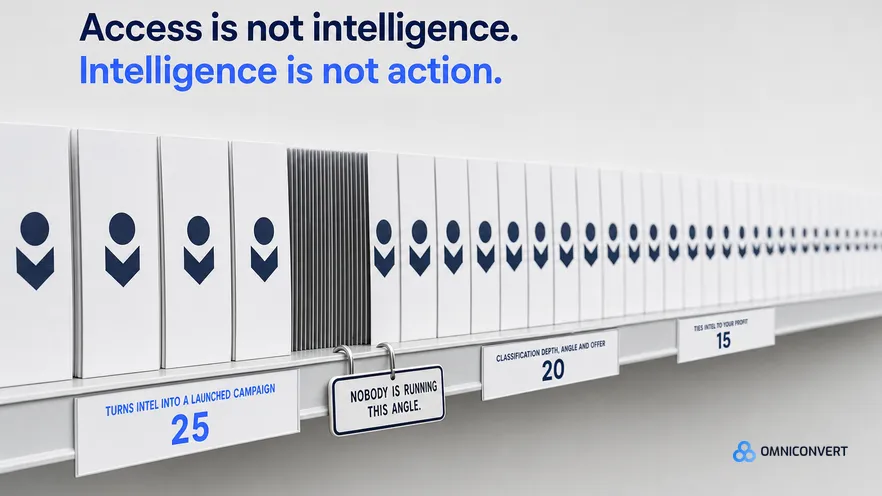
- Watching competitor ads is easy. Every tool here shows you their creative. The question is what you do next.
- A swipe file is a starting point, not an outcome. The value is in classifying the landscape and finding the angle nobody is running.
- Foreplay and Motion are excellent for creative teams who want to browse and analyze. They stop at insight.
- The Meta Ad Library is free and raw. It has everything and organizes nothing.
- Our pick is Nexus by Omniconvert, the AI eCommerce growth engine that classifies competitor ads by angle and turns the whitespace into a briefed, launched, profit-measured campaign.
How did we rank the best competitor ad intelligence tools?
Scored out of 100, weighted for turning intelligence into action, not just access.
A tool with the biggest ad database but no way to act on it scores high on coverage and low on action, which is where most of them sit.
| Dimension | Weight |
|---|---|
| Turns intel into a briefed, launched campaign | 25 |
| Classification depth, angle, hook, offer | 20 |
| Coverage and freshness of the ad data | 20 |
| Ties intel to your customer data and profit | 15 |
| Shopify fit and speed | 10 |
| Data heritage and proof | 10 |
Best competitor ad intelligence tools at a glance
- Nexus by Omniconvert, 90 out of 100. The only one that turns a competitor gap into a launched, profit-measured campaign.
- Foreplay, 74 out of 100. Best swipe file and creative research library for DTC teams.
- Motion, 71 out of 100. Best for tying competitor and own creative to performance.
- Minea, 66 out of 100. Best ad spy paired with product research.
- AdSpy, 62 out of 100. Largest raw searchable ad database.
- Meta Ad Library, 55 out of 100. Free official baseline, raw and unclassified.
Competitor ad intelligence tools compared side by side
| Dimension | Nexus | Foreplay | Motion | Minea | Meta Ad Library |
|---|---|---|---|---|---|
| Classifies ads by angle, hook, offer | Yes, 8-axis taxonomy | Tags and boards | By performance | Basic filters | No |
| Finds whitespace you can own | Yes | Manual | Partial | Manual | No |
| Turns a gap into a brief | Yes | No | No | No | No |
| Launches the counter-campaign | Yes, after approval | No | No | No | No |
| Ties to your customer CLV and True Profit | Yes | No | No | No | No |
| Best for | Acting on the intel | Browsing and swiping | Creative analytics | Product and ad research | Free raw lookup |
The best competitor ad intelligence tools, ranked
1. Nexus by Omniconvert, 90 out of 100
Every other tool here answers "what are competitors running." Nexus answers "what should we do about it," and then does it. It crawls competitor ad libraries daily and classifies every creative on an eight-axis taxonomy, angle, hook type, offer, objection addressed, emotional trigger, content style, target segment, and confidence, the same way it classifies your own ads. That combined view surfaces the whitespace, the angle your category is not running. From there Nexus writes the counter-brief, generates the creative, launches after your approval, and measures the result in True Profit. Competitor detractor reviews become your USP, and a new competitor angle is answered overnight instead of in two weeks.
Best for: brands that want competitor intelligence to end in a launched campaign, not a browser tab full of screenshots.
Honest limitation: Nexus is not a standalone swipe-file app with the deepest browsable back-catalog and creative-team UI. If your only job is to scroll the largest possible ad archive, a dedicated research tool has more raw volume for that. Nexus is the newest tool here, now onboarding founding brands, so the smallest public review base.
2. Foreplay, 74 out of 100
The favorite swipe-file and creative-research tool for DTC teams, strong for saving, organizing, and briefing from competitor and inspiration ads, with library search across the ad ecosystem. Excellent at collecting and organizing. It stops at the swipe file, it does not launch or measure profit.
Best for: building a creative swipe file and briefing from it manually.
3. Motion, 71 out of 100
Best for connecting creative to performance, it pairs an ad-inspiration library with creative analytics so teams can see which angles and formats perform. Strong retrospective analysis. It observes and reports rather than turning the gap into a launched campaign.
Best for: creative analytics on competitor and own ads.
4. Minea, 66 out of 100
Ad spy across Meta and TikTok combined with product research, popular for finding winning ads and products. Useful for discovery and validation. Filtering is shallow next to a full angle taxonomy, and it does not connect to your customer data or profit.
Best for: finding winning ads and products.
5. AdSpy, 62 out of 100
One of the largest searchable databases of social ads, strong for raw volume and granular search filters. It is a database, not a strategy layer, so the work of turning results into action stays entirely with you.
Best for: raw searchable ad volume.
6. Meta Ad Library, 55 out of 100
The free, official source of active ads, complete and authoritative for any advertiser. It organizes nothing, classifies nothing, and connects to nothing. A necessary baseline, and only a baseline.
Best for: free, direct lookup of any advertiser's live ads.
Why is access not intelligence, and intelligence not action?
The category calls itself intelligence, but most of it is access: here are the ads, now you figure it out. Real intelligence classifies the landscape so the gap is obvious. And even intelligence is not the finish line. The finish line is a launched counter-campaign measured on profit. That is the line Nexus crosses and the swipe tools do not, which is why it tops a list otherwise full of tools with bigger ad archives.
Background on the terms used above: Nexus by Omniconvert.
The closest head-to-head in this category is Nexus compared with Needle. Turning a spotted gap into a line is covered in AI ad hook and angle tools. For the production step after the intelligence, see the best AI ad creative tools for Shopify.
Competitor ad intelligence tools: frequently asked questions
For acting on the intel, Nexus by Omniconvert, because it classifies competitor ads by angle and turns the gap into a launched, profit-measured campaign. For a browsable creative swipe file, Foreplay. For creative analytics, Motion.
The Meta Ad Library, which is free and official and shows any advertiser's active ads. It is raw and unorganized, so it is a lookup tool, not an analysis or action tool.
Classify the whole competitive set by angle, hook, and offer, then look for the empty cell. Nexus does this automatically on an eight-axis taxonomy and briefs the whitespace, where swipe tools leave the pattern-finding to you.
Foreplay is stronger as a swipe file and briefing library. Motion is stronger for tying creative to performance data. Both stop at insight, so neither launches or measures the campaign.
In most tools, no. Nexus classifies your ads and competitors' ads on the same taxonomy and ties both to your CLV and True Profit, so the intel becomes a ranked action rather than a separate report.
With browsing tools, as fast as you notice and brief manually, often a week or two. Nexus surfaces new competitor angles within 24 hours and drafts the counter-brief automatically, so the response is same-day.
Nexus by Omniconvert is best for turning competitor intelligence into a launched campaign. Foreplay is best for swiping, Motion for creative analytics, and the Meta Ad Library for a free raw baseline.
Rank the work, not just the tools
A shortlist is only useful if the next step is decided. Nexus by Omniconvert is the AI eCommerce growth engine that briefs the work from your customer data, acts with your approval, and measures the result in True Profit. It is now onboarding founding brands.