How Long Do Ads Last? Why Some Ads Refuse to Die

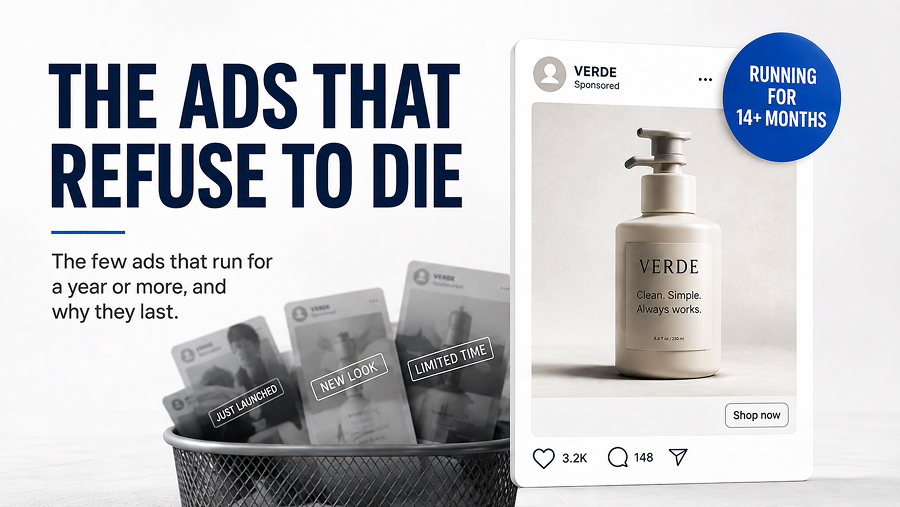
- The typical eCommerce ad has been live for only about a month, and roughly one in three active ads already show creative fatigue [eCommerceBenchmark Ad Library, 2026].
- Static image ads run several times longer than video, UGC, or carousels, because a still image does not go out of style [eCommerceBenchmark Ad Library, 2026].
- The longest-running ads almost always belong to brands that leave a proven winner untouched instead of refreshing everything monthly.
- Trend-tied formats (memes, trend clips, heavy UGC) have the shortest lifespans; founder-to-camera is the one talking-head style that ages slowly.
- Longevity signals durability, not proven profit, but because brands usually kill weak ads fast, multi-year survival is a strong hint an ad earns its place.
- Match creative investment to customer value: Nexus by Omniconvert identifies high-LTV segments so evergreen creative is built for the customers worth keeping.
Here is a fact most brands do not want to hear: the average ad dies young. The typical online-store ad has been live for only about a month, and roughly one in three ads running right now already show creative fatigue [eCommerceBenchmark Ad Library, 2026]. A small group breaks the rule and runs for a year or more, quietly working while everything around it gets swapped out. We read the whole market to find out what those survivors share. Three things kept showing up.
What is creative fatigue and why do most ads hit it?
When an audience sees the same ad repeatedly, response rates fall and cost per result rises. That is normal. The mistake is treating fatigue as inevitable for every format at the same speed. It is not. Some formats fatigue in days. Others barely fatigue at all. The brands that win the longevity game know which is which, and they build their account around it. For the full picture, read our guide to creative fatigue.
That leads to a second term worth defining plainly. Ad longevity is the number of days an ad stays continuously live. It is the cleanest available proxy for durability, because brands rarely leave a losing ad running. Read longevity as a signal of staying power, not as a profit number.
What three traits do long-running ads share?
1. They are static images, not trendy video
This was the biggest surprise. Across the market, plain static-image ads run several times longer than video, UGC, or carousels [eCommerceBenchmark Ad Library, 2026]. A still image does not go out of style, so brands leave it up. Video and trend-style clips age fast, so they get cycled out much sooner. If you want an ad that lasts, a clean evergreen still image beats a trend-chasing video for staying power.
2. Their brands leave winners alone
Brands split into two camps. Some refresh almost all of their ads every month. Others find one that works and never touch it. The ads that refuse to die almost always belong to that second camp. In fashion, the middle store swaps ads about once a month, but the top brands keep a winner running for a year or more, and a handful far longer [eCommerceBenchmark Ad Library, 2026]. If an ad is working, resist the urge to kill it. The longest runners are winners left alone. For the rest of your account, see how often to refresh ad creative.
3. They avoid formats tied to a trend
Meme ads, trend clips, and heavy UGC have the shortest lives. They ride a moment, and when the moment passes, they look dated. The one talking-to-camera style that does last is founder-to-camera. A founder explaining the product ages slowly, because it is about the person, not the trend. Trend formats are great for a quick spike, not for the long haul, so build a couple of evergreen ads on purpose.
How long does each ad format last?
| Format | Staying power | Best for |
|---|---|---|
| Static image | Longest | Evergreen workhorse |
| Text-only | Very long | Simple, always-on |
| Founder to camera | Long | Trust, over time |
| Product image + text | Medium | Steady seller |
| Studio video | Short | Big launches |
| UGC | Short | Quick, cheap reach |
| Carousel | Short | Showing a range |
| Meme / trend clip | Shortest | A moment, not a month |
Why do brands launch the ad formats that fade fastest?
Here is the pattern that separates brands stuck on a creative treadmill from the ones that compound. The eCommerce teams that plateau share one habit: they pour every dollar and every production hour into new video and UGC, then wonder why they are always rebuilding from zero. The gap closes fastest when a team treats evergreen static creative as a deliberate asset to protect, not as the boring option to skip. One or two calm still images, left alone, can carry a baseline while the trend-led work spikes and fades on top.
Nexus by Omniconvert shows which customer segments actually drive your revenue, so you can point your longest-lived creative at the customers worth keeping instead of spreading budget evenly across everyone.
See how it works →What does ad durability look like when you test on purpose?
AliveCor ran a structured A/B testing programme with Omniconvert and achieved a 21% lift in conversion rate, a 5% lift in revenue per visitor, and 94% statistical relevance across their experiments [Omniconvert, AliveCor case study]. The lesson that maps to creative longevity is simple: a winner you can trust is a winner you measured, not one you guessed at. Once a test names a clear winner, that is the ad you protect and let run.
How do we know this, and what can't we say?
- Based on the eCommerceBenchmark ad library (Meta and Google ads) across dozens of industries in the US and UK [eCommerceBenchmark Ad Library, 2026].
- "Lasts" means how many days an ad stays live. We report the order of formats, not exact ages, because the data leans toward long-running ads.
- Honesty note: there is no sales or profit data here. "Still running" means long-lived, not proven to make money. That said, brands usually kill weak ads fast, so an ad that survives for years is a strong hint it is pulling its weight.
- Longevity is a rolling measure, so it cannot be tied to a single month. This is a snapshot of the market as it stands now.
Ad creative lifespan FAQ
Creative fatigue is the point at which an ad stops performing because its audience has seen it too many times. Response drops, cost per result climbs, and the ad no longer earns its budget. Across the market, roughly one in three active eCommerce ads already show fatigue signals, which is why most ads are replaced within weeks of launch.
The typical online-store ad has been live for only about a month. A small group of survivors runs for a year or more, and a handful far longer. Because ad longevity is a rolling measure, it reflects the market as it stands now rather than any single calendar month.
Static image ads last the longest, followed by text-only ads and founder-to-camera video. Product image plus text sits in the middle. Studio video, user-generated content, carousels, and meme or trend clips have the shortest lives because they age fastest and get cycled out sooner.
Usually not. The longest-running ads almost always belong to brands that leave a proven winner untouched instead of refreshing everything on a monthly schedule. Rotate your trend-led creative, but protect the evergreen ad that keeps performing. Killing a winner to chase novelty is the most common self-inflicted wound in ad accounts.
Not directly. This analysis measures how long ads stay live, not sales or profit. There is no revenue data behind it. That said, brands usually kill weak ads quickly, so an ad that survives for a year or more is a strong signal that it is pulling its weight, even though survival alone is not proof of profit.
Nexus by Omniconvert ingests behavioral and transactional data across your store to show which customer segments are high value, at risk, or ready for upsell in real time. It maps those segments to predicted lifetime value, so you can point your longest-lived evergreen creative at the customers worth keeping instead of spreading spend evenly across everyone.
Audit your account for one evergreen static ad you can leave running while everything else rotates. Then decide who it is for: point your longest-lived creative at the customer segments worth retaining, not just the cheapest to reach. That single habit closes the gap between the formats brands keep launching and the formats that actually last.
Point your evergreen creative at the customers worth keeping
An ad that runs for a year is only valuable if it reaches the right people. Nexus by Omniconvert unifies purchase and behavior data into one customer view, segments by value, and predicts lifetime value, so your longest-lived creative works for the customers who actually drive revenue.