Creative Mix Audit: How to Read Your UGC Share and Format Split

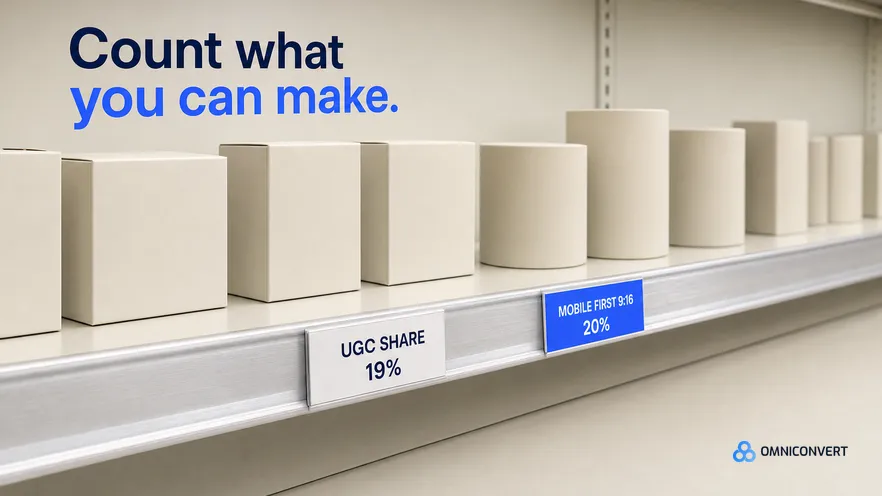
- Creative mix is a production signal: it shows what a team can make, which is more stable than what any single ad claims.
- One audited brand ran 19% UGC and 20% genuinely mobile-first 9:16 creative.
- Reformatting a 16:9 video into a 9:16 frame is not mobile-first, and the audit counts the two separately.
- There is no universally correct mix. The benchmark is the category, and the useful number is your gap against it.
- A skewed mix caps your ceiling quietly, because the formats you never make cannot appear in your results.
Your creative mix is the split of your live advertising across formats: user generated content against produced content, static against video, and how much of it is genuinely composed for a vertical 9:16 frame rather than reformatted into one. That split is a structural signal on its own, readable without any performance data, and most audited stores sit a long way from what the winners in their category run. Last updated: September 2026.
Omniconvert has measured how storefronts acquire and convert customers across the CROBenchmark dataset of 7,000+ websites in 15+ industries, against 248+ audit criteria, over 13 years in eCommerce, and reads live advertising through the eCommerceBenchmark ad library. Mix is the reading teams find easiest to accept and hardest to act on, because the answer is almost never "brief more of that format". It is usually "you cannot currently make that format".
This piece uses the layer vocabulary from hook versus concept versus angle, because format is a property of the concept layer and gets confused with the angle more often than it should.
What is the creative mix?
The audit treats the library as one object. It is not asking whether a given ad is good. It is asking what kinds of things this advertiser makes, and in what proportions, which is a different and more stable question.
Stability is the reason it earns a place in the diagnostic order. Individual ads come and go weekly, and a mix moves slowly, because a mix reflects a production pipeline: who shoots, what they can shoot, which agencies are on retainer, whether anybody has a creator relationship. Those things change over quarters, not over weeks.
The classification is deliberately mechanical. Was this shot by a creator or produced? Does it move or not? Is it composed vertically or horizontally? A consistent answer to three plain questions across every live ad produces a mix, and consistency matters far more than sophistication in the taxonomy.
Why is the creative mix a signal on its own?
This is the whole argument for measuring mix, and it is a claim about search rather than about quality.
Creative work is a search across a space of possible ads. The mix defines which parts of that space you are actually searching. A team producing only polished video is searching one corner of it very thoroughly, and any winner living elsewhere is not merely unfound, it is unreachable. No amount of iteration inside the corner reaches outside it.
The effect is quiet, which is what makes it dangerous. Nothing on a dashboard says "the format that would have worked was never produced". The account simply plateaus, every individual ad looks reasonable, and the reviews stay focused on the ads that exist.
The mix is also the most honest description of a team you can get from outside. What an advertiser says about itself is marketing. What it produces, in what proportions, week after week, is capability.
What did one creative mix audit find?
The table below is the mix reading from that audit.
| Mix dimension | Found in this audit | What the reading means |
|---|---|---|
| UGC share of creative mix | 19% | A creator pipeline exists but is not a main channel |
| Shot mobile-first in 9:16 | 20% | Most of the library is reformatted into the feed, not built for it |
| Remaining creative | The balance | Produced, largely horizontal, adapted after the fact |
The pattern behind both numbers is the same, and it is the common one. This is a brand with a strong traditional production capability that added mobile and creator formats at the edges, rather than a brand that built for the feed and adds produced work when it needs it.
Neither figure is a failing grade, and the audit does not present it as one. Both are facts about a pipeline, and both explain results that would otherwise look like a creative quality problem.
What is UGC share in ads, and what is it not?
The distinction is worth defending, because UGC share is the number most often quoted as though it were a scoreboard.
A brand at 19% UGC has a creator pipeline. Somebody has solved sourcing, briefing, rights and turnaround, which is not trivial, and the format is therefore available to it. A brand at zero has none of that, and the gap between zero and any positive number is far larger than the gap between 19% and 40%, because the first is a capability and the second is a dial.
What the share does not tell you is whether the UGC is any good, whether it is on a sensible angle, or whether it earned its budget. Those are separate readings, and one of them is longevity: creator content that never survives past a few weeks is a pipeline producing volume rather than winners, which is visible in days active rather than in the mix.
The useful comparison is always against your named category. UGC behaves differently in supplements than in furniture, and a share that would be low in one is high in the other, so a single cross-industry benchmark is worse than no benchmark at all.
Mobile-first vs reformatted creative: what is the difference?
This is the reading that tends to produce the sharpest disagreement in a debrief, because most platform reporting counts both as vertical.
The practical difference shows up in the first second. A vertical composition puts the subject where the eye lands in a vertical frame. A cropped horizontal asset puts it wherever it happened to be, then trims the sides, which frequently removes the product, the face or the type that carried the point. The ad is technically 9:16 and structurally a horizontal ad with its edges missing.
A brand at 20% genuinely mobile-first is producing most of its creative for one context and serving it in another. That is not a small inefficiency: the feed is where the impressions are, and four fifths of the library is arriving there as an adaptation.
Nexus by Omniconvert is the AI eCommerce growth engine: it unifies customer data, segments buyers by behavior and value, predicts churn, and ranks the next-best action, so the audience seeing a given format can be described rather than assumed. Knowing which segments live in which surface is what turns a format decision into a targeting one.
Static vs video ads: how should you split them?
The static and video shares are where mix analysis is most often distorted by fashion. Video is assumed to be the serious format and static the leftover, and libraries drift toward video without anybody deciding to.
The argument for keeping real static capability is iteration speed. Testing an angle in static costs days rather than weeks, so a team with a live static pipeline can find out whether an argument lands before it commissions a shoot around it. Teams that lose that capability start testing angles in video, which is slow enough that far fewer angles get tested at all.
The honest question is not what the right split is. It is whether anybody chose. A split that nobody chose is a description of staffing, and it will hold for years while being reported as a strategy.
How do you read your own creative mix?
Four steps, in order.
- Classify mechanically. Creator or produced. Moving or still. Composed vertically or adapted. Three questions, applied identically to every live ad, and no quality judgement anywhere in the pass.
- Count shares, and note the sample. A library of a dozen ads gives percentages that move with one addition. Say the sample is thin when it is thin, rather than reporting a confident number.
- Compare against a named category. The same taxonomy on both sides, against a competitor list somebody could argue with. The gap in points is the finding, exactly as in saturation versus edge.
- Fix capability before volume. A missing format is usually missing because nobody can make it. Add the pipeline at small volume, see whether the format earns a place, and rebalance only then.
The fourth step is where most mix findings die. A debrief that ends with "we should do more UGC" produces a quarter of nothing, because the constraint was never the brief. It was sourcing, rights, turnaround and somebody's time, and none of those change because a slide said the share was low.
FAQ: the creative mix audit
What is a creative mix audit?
A creative mix audit classifies every live ad by format and counts the shares: UGC against produced, static against video, and how much is genuinely composed for a 9:16 frame. It reads the library as a description of what the team can produce, rather than as a set of individual ads to be judged on quality.
What is a good UGC share?
There is no universal number, and any source offering one is guessing. The useful figure is your share against what the winners in your named category run, because UGC works very differently in supplements than in furniture. In one audited brand, UGC accounted for 19% of the creative mix, which is a fact about that brand rather than a target for yours.
What counts as mobile-first creative?
Creative composed for a vertical 9:16 frame from the start: shot vertically, with the subject and any type placed for that frame. A 16:9 asset cropped or letterboxed into a vertical slot is reformatted rather than mobile-first, and an audit counts the two separately because they behave differently in feed.
Why does the format split matter if the creative is good?
Because the mix describes what you are able to make, and you cannot get results from a format you never produce. A team with no UGC pipeline will never discover a UGC winner, however good its produced work is. The mix caps the ceiling quietly, and it does so without any single ad looking wrong.
Is static creative obsolete?
No. Static creative remains cheap to produce, fast to iterate and strong in several categories, and libraries that abandon it entirely tend to lose their ability to test angles quickly. The reading that matters is whether your static and video shares are a decision or an accident of who happens to work on the team.
Does more UGC always mean better performance?
No, and this is where mix analysis is most often misused. Mix is a structural signal about production capability, not a performance claim, so a higher UGC share is not evidence of a better outcome. It tells you the option exists in your library, which is a precondition for a UGC winner rather than a cause of one.
How large a sample does a mix audit need?
Enough live creative that a share is not moved by two or three ads. A library of a dozen ads produces percentages that swing wildly with one addition, so treat a small sample as directional and say so. The classification consistency matters more than the size: one taxonomy applied the same way to you and to your category.
How do I fix a skewed creative mix?
Treat it as a production problem rather than a briefing problem. A missing format is usually missing because nobody can make it on the current pipeline, so briefing more of it produces nothing. Add the capability first, at small volume, and measure whether the format earns a place before rebalancing the whole library toward it.
The bottom line
The creative mix is the least glamorous reading in a creative audit and one of the most predictive, because it describes capability rather than opinion. A brand at 19% UGC and 20% genuinely mobile-first is not making bad ads. It is making a particular kind of ad extremely well and reaching the feed as a visitor. That shows up eventually as a plateau nobody can explain from the individual ads, because the explanation is not in any of them. Count the shares, compare them against a category you are willing to name, and treat every gap as a production question before it becomes a briefing one. The formats you cannot currently make are not a gap in your plan. They are results that were never available to you, and no review of the ads you did make will ever mention them.