Closing the Loop: From Customer Insight to Deployed Campaign

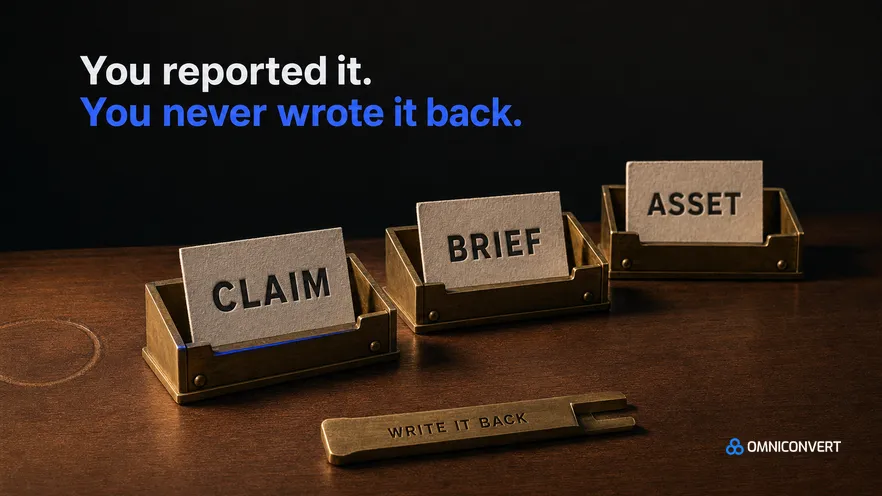
- A loop is closed only when a campaign result changes what the organisation believes, not when it is reported.
- Insights recorded as observations cannot be tested; only a claim someone could disprove survives the handoffs.
- If a deployed asset does not name the claim it carries, its result cannot be attributed to anything but itself.
- Performance reporting and evidence are different artefacts, and most teams produce only the first.
- The loop breaks in the gaps between teams, which is exactly where nobody's dashboard is looking.
Closing the loop is the practice of making a customer insight traceable forward into a deployed campaign, and that campaign's result traceable back into what you believe about the customer. Almost every company has both ends. Research happens. Campaigns run. What is missing, with remarkable consistency, is the connection between them, and its absence is invisible because both ends look healthy on their own. Last updated: September 2026.
Omniconvert has measured how growth programmes operate across the CROBenchmark dataset of 7,000+ websites in 15+ industries, against 248+ audit criteria, over 13 years in eCommerce. The finding that has held longest is uncomfortable: a company can run several hundred campaigns in a year and finish it knowing no more about its customers than it started with. Not because the campaigns failed. Because nothing that happened was written back anywhere.
This piece is about the four handoffs between an insight and a deployed campaign, what leaks at each, and how to close them. It is the operational companion to CRO, creative and AI visibility tie into one growth system, which argues that the three disciplines share one input. This one is about what happens to that input as it travels.
Related reading: point tools plateau and systems compound.
What does closing the loop between insight and campaign mean?
The distinction is easy to miss because reporting feels like the closing move. A campaign runs, numbers arrive, a deck is produced, someone presents it. Everybody has done their job. Yet ask what the company now believes that it did not believe three months ago, and the honest answer is usually nothing, because the deck described performance rather than evidence.
Performance and evidence are different artefacts with different half-lives. Performance is about an asset: this creative earned attention at this cost. Evidence is about a customer: people in this segment care more about delivery certainty than about price. The first expires the moment the campaign ends. The second compounds for years, and it is only produced when somebody deliberately converts one into the other.
So the test for a closed loop is not whether results are measured. It is whether anything upstream changed as a result of measuring them.
What are the four handoffs from insight to campaign?
The reason this is worth decomposing is that teams usually try to fix the loop as a whole, which produces a workshop and a new template and no change. The breaks are specific, they occur at boundaries between functions, and each has a cheap and unglamorous fix.
Note where they sit. Every one of the four is a gap between two teams, which is precisely the territory no dashboard covers. Research reports on research quality. Creative reports on production. Media reports on performance. All three can be excellent while the material passing between them degrades at every step.
Handoff one: how do you turn an observation into a claim?
Consider what a research output typically contains. Customers mention delivery cost. Several reviewers found sizing confusing. There is interest in sustainability. All true, all supported, and none of them can be wrong, which means none of them can be tested.
Now the claim version. Delivery cost stops more purchases than product doubt does. Sizing confusion is concentrated in first-time buyers rather than across the base. Sustainability language changes consideration but not conversion. Each of these could be false. That is exactly what makes them useful, because a campaign built on one produces a result that means something either way.
The conversion takes minutes and is skipped because it feels like editing rather than thinking. It is not editing. Choosing which claim an observation supports is the single most consequential act in the whole loop, and leaving it undone means it happens by default, inside somebody's head, at the brief stage, unrecorded.
Handoff two: how do you turn a claim into a creative brief?
Watch what a brief does to a claim. The claim was that delivery certainty matters more than delivery speed to repeat buyers. By the time it reaches the brief it has become a bullet reading emphasise reliability. That is not the same statement. It has lost the comparison, lost the segment, and lost the fact that it was a hypothesis rather than a direction.
The person producing the work then makes reasonable decisions against the summary, and the resulting asset may well perform. What it cannot do is test the claim, because the claim is no longer present in the instructions.
The repair is trivial and rarely made: put the claim verbatim at the top of the brief, labelled as the claim, alongside a line saying what result would count as evidence against it. Two sentences. They convert a brief from a set of instructions into an experiment with instructions attached.
Handoff three: how do you turn a brief into a deployed asset?
This is the most mechanical break and the easiest to fix. Assets are labelled by variant, format, channel and campaign, which is entirely sensible for trafficking and useless for learning. Nothing in the naming records what the asset was arguing.
The consequence appears later. When results come in, they can be attributed to a creative execution and to nothing above it. Two assets carrying the same claim through different executions cannot be read together, and two assets carrying different claims through similar executions get compared as though they were the same test.
Recording a claim identifier against each asset costs one field. Once it exists, results roll up to claims automatically, and a question that was previously unanswerable becomes routine: across everything we ran this quarter, what does the evidence say about this belief?
Handoff four: how do you turn results into evidence?
Everything upstream can work and this handoff will still fail, because it requires somebody to go back to a document after the interesting part is over. The campaign is finished, the deck is delivered, attention has moved on. Updating the claim register is nobody's deadline.
What makes it worth enforcing is compounding. Baymard Institute's checkout research has accumulated over many years into a body of evidence far more valuable than any single study, and roughly 70% average cart abandonment is a figure that means something precisely because it has been tested repeatedly rather than observed once. A company's own claim register works the same way. The tenth update is worth more than the first because the pattern only becomes visible with volume.
Bain and Company's work with Fred Reichheld holds that a five percent improvement in retention can raise profits by twenty-five to ninety-five percent, and retention improvements come almost entirely from understanding customers better rather than from reaching them more often. That understanding is what an updated register contains and what an unclosed loop discards every quarter.
Where does the value of insight actually leak?
| Handoff | What should pass | What usually passes | The one-line fix |
|---|---|---|---|
| Observation to claim | A testable statement | A true, unfalsifiable observation | Write it as a sentence that could be wrong |
| Claim to brief | The claim, unedited | A tone note or an audience line | Put the claim verbatim at the top |
| Brief to asset | A claim reference on the asset | Format, channel and campaign names | Add one claim identifier field |
| Result to evidence | An updated claim status | A performance report, filed | Update the register before the deck |
| Register to next cycle | Planning that starts from evidence | Planning that starts from opinion | Open the register in the planning meeting |
| Across all four | One named owner of the loop | Four teams each owning their own step | Name someone accountable for the register |
The last row is the structural one. Every other fix in the table is a habit, and habits at organisational boundaries do not survive without somebody whose job includes them. The loop crosses four functions, so it belongs to none of them by default, and that is the actual reason it stays open in companies where every individual team is competent.
Where should you start closing the loop this quarter?
- Run the traceability test. Take a campaign from six months ago and ask which customer claim it tested and what its result changed. The handoff it fails at is the one to fix first, and the exercise takes ten minutes.
- Write ten claims down. Your ten most important beliefs about your customers, as sentences that could be false, each with a status. Most of the raw material already exists in research decks and support tickets.
- Add two lines to the brief template. The claim, verbatim, and what result would count as evidence against it. This is the cheapest of the four fixes and it changes the quality of the work immediately.
- Name an owner for the register. Before buying anything. An unowned shared document decays within a quarter, and no tool prevents that.
Where the practical obstacle is that customer, experiment and campaign data live in systems that never meet, Nexus by Omniconvert is an AI for eCommerce growth engine that unifies commerce data, ranks experiments by True Profit, and generates campaigns and creative you approve before they go live. For the testing half of the loop, Omniconvert Explore averages a 23.2% conversion uplift across 70,000+ experiments, and every one of those experiments is only worth what somebody wrote down about it afterwards.
FAQ: closing the loop between insight and campaign
What does closing the loop actually mean?
That a customer insight can be traced forward into a deployed campaign, and that the campaign's result can be traced back to the insight and change its status. Reporting a campaign's performance is not closing the loop, because performance says how an asset did without saying what it proved. The loop is closed when what you believe about the customer is different afterwards.
Why do insights stop being useful between research and campaign?
Because they are usually recorded as observations rather than as claims. An observation such as customers mention delivery cost is true, unfalsifiable and unusable. A claim such as delivery cost stops more purchases than product doubt is testable, and a campaign built on it produces a result that means something. The conversion from one to the other is where most of the loss happens, and it takes minutes.
Who should own the loop?
One person who owns the claim register itself, not a committee and not whichever team currently holds the work. The loop crosses research, creative, media and analytics, so every individual team can do its part well and the loop can still be open. Ownership of the artefact that spans them is the only structural fix, and it is usually the cheapest role to create.
Does closing the loop require new software?
It requires shared definitions before it requires tooling. A claim register can be a spreadsheet for its first year, and most companies that buy a platform first end up with a well-instrumented version of the same open loop. Tools help enormously once everybody agrees what a claim, a test and a result are, and entrench the confusion when bought before that.
How do you tell whether your loop is open?
Pick a campaign that ran six months ago and ask which customer claim it was testing and what its result changed. If nobody can name the claim, the loop was open at the third handoff. If they can name the claim but nothing was updated afterwards, it was open at the fourth. The exercise takes ten minutes and is uncomfortably clear.
What is the first thing to fix?
Write down your ten most important claims about your customers, as sentences that could be wrong, with a status against each. Almost nobody has this document, most of what goes in it already exists scattered across research decks and support tickets, and it is the artefact every other part of the loop attaches to.
The bottom line
The loop between insight and campaign does not break in any one place, which is why it survives so much attention. It leaks a little at four handoffs, and each leak looks acceptable from inside the function that causes it. Research delivers true observations. Briefs summarise. Assets are named for their format. Results are reported and filed. Nobody has done anything wrong, and at the end of the year the company knows exactly what it knew at the start. The repairs are almost embarrassingly small: write the observation as a claim someone could disprove, put that claim at the top of the brief in its own words, record which claim each asset carries, and update the claim before you write the deck. Then give the register to one person, because work that lives between four teams belongs to none of them. Do that for a year and you will have something no campaign can buy, which is a written and tested account of what your customers actually want.