Autonomous Growth for DTC: The Manual-to-Autonomous Shift

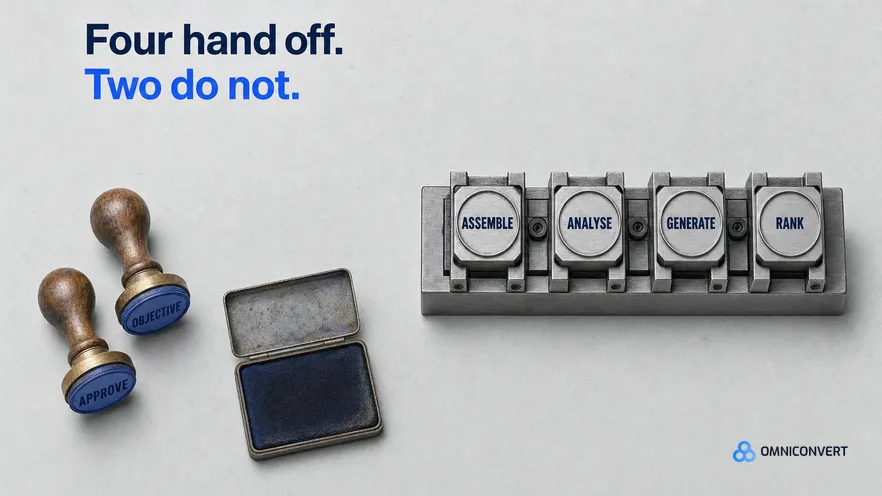
- Four things hand off to software, in a fixed order: assembling the data, analysing it, generating options, ranking them.
- The order is a dependency chain rather than a preference, because each handoff consumes the output of the one before it.
- Two things never hand off: the objective, and the approval to deploy.
- You are located by where your team's hours went last week, not by which tools you own.
- The three recurring failures are all sequence errors, which is why buying a better tool rarely resolves any of them.
The manual-to-autonomous growth shift is usually discussed as a question of degree: how much AI a team has adopted, how advanced it is, how far along some curve. That framing is comfortable and it does not help anyone decide anything on a Monday. A more useful description is that specific decisions hand off from people to software, in a reliable order, and that two of them never do. Last updated: August 2026.
The reason to be precise about this is that the order is not optional and getting it wrong is expensive. Omniconvert has worked on growth measurement and experimentation across the CROBenchmark dataset of 7,000+ websites in 15+ industries, against 248+ audit criteria, over 13 years in eCommerce, and the teams that stall almost always stalled by skipping a handoff rather than by choosing the wrong vendor. They automated the analysis while the numbers still disagreed, or handed over prioritisation before anyone had written down what they were prioritising for.
So this is the umbrella framework rather than another maturity model. Four handoffs, in order. Two responsibilities that stay. And a short test for working out which stage you are actually in, which is frequently not the stage your software licences imply. For how the individual disciplines connect once the shift is underway, CRO, creative and AI visibility tie into one growth system covers the horizontal view that sits beneath this vertical one.
What is the manual-to-autonomous growth shift?
Write the chain out and the argument becomes concrete. Six links: assembly, analysis, generation, prioritisation, decision, deployment. Every growth team performs all six every week, whether or not anyone has named them.
In a fully manual team, people do all six. Someone exports from three systems and reconciles them, someone reads the result and finds what moved, someone proposes what to try, someone argues about what to try first, someone decides, and someone ships it. That is not an inefficient version of a modern team. It is what a growth team was, and the sequence is sound.
What has changed is that the first four links are now genuinely tractable to software, and the last two are not. Assembly is a data engineering problem. Analysis is pattern-finding. Generation is combinatorial. Prioritisation is scoring against a stated objective. None of those require a view about what the business is for. The last two do, and no advance in capability changes that, because the constraint is accountability rather than intelligence.
The word autonomous is doing a lot of work in the industry's language, and it is worth being careful with it. A growth system that assembles, analyses, proposes and ranks, then waits for a person, is dramatically more capable than a manual team and is not unsupervised. The interesting destination is not an absent human. It is a human whose whole job is the two decisions that matter.
What are the four handoffs, in order?
- Data assembly. The largest time cost in most growth teams and the smallest judgement content. Managers spend around three hours a day assembling data, which is an extraordinary allocation of senior attention to clerical work. The prerequisite is unification: one figure with one value across your platform, your analytics, your ads and your support system. Automating the export before the reconciliation just produces a faster route to numbers that disagree.
- First-pass analysis. Once the numbers agree, finding what moved is a machine task. Segments, anomalies, cohort drift, which channel changed. The human job compresses from producing the analysis to deciding which findings matter, which is a genuine promotion in the nature of the work. This handoff is where teams first feel the shift as relief rather than threat.
- Option generation. Software proposes experiments, segments, audiences and creative variants. This is the handoff that generates the most anxiety and deserves the least, because a proposal is not a decision and generation was never the scarce resource. Most teams have always had more ideas than capacity. What changes is that the ideas now arrive attached to the evidence that produced them, which makes the next step possible.
- Prioritisation. Ranking proposals by expected value. This is the handoff with the highest return and the strictest precondition: it is only safe once the objective is written down. A ranking is a function of a goal, and a system ranking against an unstated goal will infer one from whatever is measurable. That inference is almost always short-term revenue, which is rarely what anyone would have chosen deliberately.
Each handoff makes the next one worth doing. Analysis on unreconciled data is confident nonsense. Generation without analysis produces ideas untethered from evidence. Prioritisation without a stated objective optimises the wrong thing efficiently. The dependency runs one way and skipping a link does not save the time it appears to save.
Which two handoffs never hand off?
These are the two that make the whole framework safe, and they are the two most often surrendered by accident rather than by decision.
The objective is not an optimisation target. Deciding to grow repeat purchase among high-value customers rather than first orders among discount-seekers is a choice about what kind of business you are building. Both raise revenue. They produce different companies in three years. Bain and Company's retention research holds that a five percent improvement in retention can raise profits by twenty-five to ninety-five percent, and Marketing Metrics puts the probability of selling to an existing customer at roughly sixty to seventy percent against five to twenty percent for a new prospect. A system optimising last-click revenue will not surface either fact, because they are arguments about which objective to hold rather than answers within one.
Approval is accountability. When a campaign goes wrong, somebody answers for it, and that somebody has to have had the opportunity to say no. This is why the deployment step stays human even when everything upstream is automated, and it is a design principle rather than a transitional caution. A system that ships without approval has not become more advanced; it has become unaccountable, which is a different property and a worse one.
This is the principle behind how we built our own system. Omniconvert Commander (formerly Nexus) is an AI for eCommerce growth engine that unifies commerce data, prioritises experiments by True Profit and generates campaigns and creative, and then stops: you approve what goes live. The stopping is the point. It is what keeps the four handoffs a gain in capability rather than a loss of control.
How do you work out where you actually are?
The test takes ten minutes and it is uncomfortable in a useful way. Take last week and account for where your growth team's hours went across the six links.
Most teams who believe they are two or three handoffs in discover that assembly still consumes the majority of their week, because the tools they bought sit downstream of a reconciliation nobody automated. The dashboard is real, and someone still spends Monday morning explaining why it disagrees with the platform.
That gap explains a great deal of the disappointment in this category. A tool bought to accelerate analysis cannot accelerate a team still stuck in assembly, and the failure gets attributed to the tool rather than to the sequence. The remedy is not a better analysis tool. It is finishing the handoff underneath it.
What changes at each stage?
| Handoff | Time moves from | New failure mode | The manager's question |
|---|---|---|---|
| None yet | Everything is manual | Too slow to learn | Where do the hours go? |
| Assembly | Exporting to interpreting | One agreed number, still unread | Do our systems agree? |
| Analysis | Finding to judging | Findings nobody acts on | Which findings mattered? |
| Generation | Inventing to selecting | More proposals than capacity | What did we decline, and why? |
| Prioritisation | Arguing to deciding | Optimising an unstated goal | What are we ranking against? |
| Approval, if surrendered | Deciding to discovering | Nobody can answer for outcomes | Who said yes to this? |
The last row is included as a warning rather than a stage. It is what happens when the fifth and sixth links drift across without a decision being made, usually gradually, usually because approving everything became a formality nobody had time for. The question in that row is the one asked afterwards, and by then it is a post-mortem rather than a control.
What goes wrong, and in what order?
The first failure is the most common and the least dramatic. A team buys an analytics or AI layer while its underlying sources still disagree, and receives faster, more confident, still-wrong answers. The tool is usually blamed. The reconciliation was the missing step, and it is unglamorous work that no vendor demonstration features.
The second is subtler. Generated proposals arrive in volume, and volume creates its own pressure to act. A team that has not maintained a clear distinction between a proposal and a decision will find its roadmap quietly written by whatever the system surfaced most often. The defence is procedural rather than technical: record what you declined and why, which takes minutes and preserves the boundary.
The third is the expensive one. Prioritisation handed over before the objective was agreed produces months of efficient movement in a direction nobody chose. It is usually discovered when someone examines the customer mix and finds the business has been growing a segment it does not want. Recovering from this takes longer than the automation saved, which is why the order of the handoffs is a rule rather than a suggestion.
Where should you start this quarter?
- Account for last week's hours across the six links. Ten minutes, and it locates you honestly. Most teams find they are a stage behind where they assumed.
- Reconcile one number that disagrees. Pick the metric your team argues about most and make the sources agree. This is the whole first handoff in miniature, and it is usually the highest-value week available.
- Write the objective on one page. Which customers, which margin, over what horizon. If prioritisation is going to be handed over eventually, this page is what makes that safe, and writing it while the question is calm is much easier than writing it under pressure.
- Start recording what you decline. One line per declined proposal. It is the cheapest available defence against a roadmap written by whatever the system surfaced most.
None of that is technology adoption. It is the preparation that makes technology adoption pay, and teams that skip it tend to buy the same category of tool twice.
For the operating model this shift is moving toward, rather than the transition itself, the unified growth loop sets out how the stages connect once the handoffs are working.
Manual-to-autonomous growth shift FAQ
What is the manual-to-autonomous growth shift?
It is the sequence in which growth work moves from being produced by people to being produced by software and reviewed by people. Four things hand off in a reliable order: assembling the data, analysing it, generating options, and ranking those options. Two things do not hand off, which are the objective and the approval to deploy.
Which handoff should a team do first?
Data assembly, without exception. It is the largest time cost, the lowest judgement content and the prerequisite for the other three. A team that automates analysis before assembly gets faster analysis of numbers that disagree with each other, which is worse than the manual version because it arrives with more confidence.
What should never hand off to software?
Two things. The objective, because deciding which customers and which margin you are growing is a statement about the business rather than an optimisation problem. And the approval to deploy, because accountability cannot be delegated to a system that cannot be held responsible for the outcome.
How do you know which handoff you are actually in?
Ask where your team's hours go this week. If most are spent gathering numbers, you are pre-handoff regardless of what tools you own. Tool ownership and handoff completion are different things, and most teams are one or two stages behind where their software licences suggest they are.
Does this mean smaller growth teams?
It means differently occupied ones. The work that disappears is assembly and first-pass analysis. The work that grows is deciding what to optimise, judging which proposals are worth deploying, and reading results honestly. Those are more senior activities than the ones being displaced, which is why the shift tends to raise the skill floor rather than lower the headcount.
What goes wrong most often during this shift?
Handing off prioritisation before agreeing the objective. A system ranking proposals against an unstated goal will optimise something, usually the most measurable thing available, and the team discovers months later that it has been growing a segment it did not want. The order of the handoffs is not a preference.
What is the bottom line?
Stop asking how autonomous your growth operation is and start asking which handoffs you have completed. Assembly, then analysis, then generation, then prioritisation, in that order, because each consumes the output of the one before it. Keep the objective and the approval, permanently and deliberately, because those two are what make the rest safe rather than merely fast. The end state worth wanting is not a team that has been replaced. It is a team that spends its whole week on the two decisions nobody else can make, supported by a system that has already done the assembling, the reading, the proposing and the ranking, and is waiting for a yes.