Point Tools vs Integrated Systems: Why Point Tools Plateau

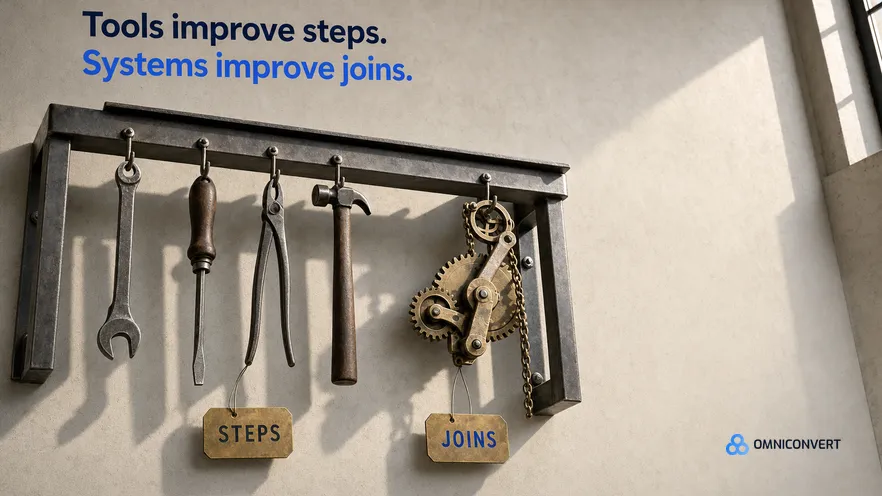
- A point tool's ceiling is set by everything outside it, which is why improvement stops rather than slows.
- Compounding happens at the joins between steps, and the joins are unmeasured by design.
- Twelve good tools can produce a flat year with every dashboard showing green.
- A system needs one customer definition, machine-usable outputs, and a shared record of what happened.
- Before buying, ask whether the thing adds a step or joins two that already exist.
Point tools plateau for a reason that has nothing to do with their quality. A tool that improves one step of a process inherits a ceiling from every step it does not touch, and once it has taken that step as far as the surrounding process allows, it stops. Not slows. Stops. Meanwhile a system improves the connections between steps, and connections multiply rather than add, which is the entire mechanical difference between a plateau and a compound curve. Last updated: September 2026.
I have spent 13 years in eCommerce watching teams respond to a flat quarter by buying a twelfth tool, and the CROBenchmark dataset of 7,000+ websites in 15+ industries, assessed against 248+ audit criteria, says the same thing the conversations do. The brands that pull away are rarely the ones with the best individual tools. They are the ones where the tools hand things to each other without a person in between.
This is the structural argument underneath two pieces I have written before: how CRO, creative and AI visibility tie into one growth system, and what it takes to get from a finding to a live campaign in closing the loop.
What ceiling can a point tool not pass?
Take a testing tool. It can run experiments beautifully, and the value it produces is bounded by the quality of the hypotheses it receives and by whether anything is done with the results. Improve the tool and neither bound moves. The tool has no access to either.
Or take a creative platform. It can produce more variations faster, and what it can produce is bounded by how well the brief describes the customer. A better platform with the same brief produces more of the same misunderstanding, at speed.
This is what makes the plateau so confusing in practice. The tool did not degrade. It is working exactly as it did in the first quarter, when it produced a large gain. It has simply exhausted the improvement available within its own boundary, and every remaining constraint sits outside it.
The tell is a specific conversation. Somebody says the tool was transformative last year and has not moved anything since, and the response is to evaluate a replacement. The replacement will produce the same curve, because the curve was never about the tool.
Where does compounding growth actually come from?
Consider a concrete join. Your on-site survey learns that the most common reason people hesitate is a question about compatibility. That finding is worth something on the product page, more in the ad creative, and more again in whatever content an answer engine reads about you.
If the finding travels, one piece of work has now improved three surfaces, and each of those surfaces produces its own further findings. That is compounding, and it is not a metaphor. The return on the survey rose because of something that happened outside the survey tool.
If the finding does not travel, the survey tool still reports a healthy response rate, the creative team still reports a decent cost per click, and nothing has compounded. Nobody has failed. The value simply never left the first tool.
Joins are unmeasured by design, because every measurement system is built around a step. There is no report anywhere in a normal stack whose subject is the handoff, which is why these losses read as a mediocre quarter rather than as a specific failure with an owner.
Why does the tool stack keep growing anyway?
I want to be fair to the people making these purchases, because the incentives are genuinely lopsided. A tool arrives with a demo, a case study, a price and an implementation date. It can be evaluated, approved and pointed at. A join has none of that.
A join also has no natural owner. It sits between two teams, and the work of fixing it makes both of their jobs slightly harder in the short term for a benefit that will show up in neither dashboard. That is the least rewarding shape a piece of work can have.
And each individual purchase is defensible. The tool really does improve its step. The problem only exists in aggregate: a dozen defensible decisions produce a stack where every step is instrumented, every step is improving, and the business is flat.
Gartner has publicly forecast that traditional search volume will decline as AI assistants absorb a growing share of queries, and that shift makes the joins matter more rather than less. When what gets quoted about you is assembled from many surfaces at once, a claim that lives in one tool and reaches none of the others is invisible in exactly the place decisions are now being made.
What are the three conditions for compounding?
- One definition of a customer. A high-value segment has to mean the same thing in the email platform, the testing tool and the advertising account. Where it does not, every cross-tool comparison is quietly wrong, and nobody discovers this until two reports disagree in a meeting.
- Outputs that are inputs. A finding has to leave the tool that produced it in a form the next step can act on. A survey result that exists only as a chart in a slide has not left the tool, whatever the integration diagram says.
- A shared record of what happened. What was tried, what changed, what resulted. Without it, each step relearns the same lessons, and institutional memory decays at the rate people change jobs.
Notice that only the second is technical. The first is an agreement and the third is a habit, which is why buying a platform does not deliver any of this on its own. Tools can make the second condition easy and cannot make the other two happen.
Are you buying a point tool or a system?
| Dimension | Point tool | System |
|---|---|---|
| What it improves | One step | The handoffs between steps |
| Shape of the gain | A step change, then flat | Slower to start, then accumulating |
| Where the ceiling comes from | Everything it does not touch | The weakest join remaining |
| Who has to agree | One team | Two or more, on definitions |
| What removing it costs | That step gets worse | Every step gets slightly worse |
| How it fails | Visibly, in its own report | Quietly, as a mediocre quarter |
The last row is the uncomfortable one and the reason this argument is hard to make internally. A point tool that stops working announces itself. A missing system never announces anything at all, so the case for building one has to be made in advance, on reasoning rather than on evidence of a failure.
What question should you ask every software vendor?
Ask it plainly, and listen for whether the answer stays inside the tool's own boundary. If the benefits described are all improvements to the step being sold, you are buying a point tool, which may still be the right purchase.
Then ask the second question: what does this need from us that we do not currently have. An honest answer usually names a definition that has to be agreed or a data source that has to be reliable, and that answer is the real implementation cost.
Baymard Institute's checkout research puts average cart abandonment near seventy percent, and it is worth holding that figure next to any purchase decision. The scale of what is being lost in ordinary commerce is large enough that the question is never whether a tool can help. It is whether the help can reach the place where the loss occurs.
This is the discipline behind how we built Omniconvert Commander (formerly Nexus), which is an AI for eCommerce growth engine: it unifies commerce data, segments customers by behaviour and value, ranks what to do next by True Profit, and generates campaigns and creative you approve before they go live. The load-bearing part of that sentence is the unification, not the generation. Omniconvert Commander exists to remove the person in the middle of the join, and the approval step stays human on purpose.
Where should you start this quarter?
- Trace one journey end to end. From the signal that a customer has a problem to the change that addresses it. Write down every handoff, including the ones that happen in a meeting.
- Mark the manual joins. Anywhere a human exports, retypes or summarises. Most teams find three or four, and they are usually the same three or four.
- Fix the one that carries the most meaning. Not the easiest. Usually it is whatever connects what customers say to what gets built or written.
- Agree one definition before automating anything. If a high-value customer means different things in two systems, connecting them faster propagates the disagreement.
- Postpone the next tool by one quarter. Then compare what the fixed join produced against what the tool promised. This comparison is rarely close, and it changes how the next budget conversation goes.
The related reading across the network sits at each end of these joins: the Human Middleware Problem covers what happens when the coordination cost is paid in people's time, and the Manual-to-Autonomous growth shift is the longer argument about where this ends up.
Point tools vs systems: FAQs
What is the difference between a point tool and a system?
A point tool improves one step of a process and treats everything around it as fixed. A system improves the connections between steps, so an improvement in one place raises the return on work done elsewhere. The practical test is whether the thing you are buying adds a step to your process or joins two steps that already exist. Both can be worth buying, and only the second one compounds.
Why does a stack of good tools produce a flat year?
Because each tool optimises its own step against its own metric, and the value leaks at the handoffs, which no tool owns and no dashboard measures. Every report can show improvement while the business does not move. The loss does not look like a failure anywhere; it looks like a mediocre quarter, which is why it can continue for years without being identified.
Does this mean point tools are a bad purchase?
No. A point tool is the right purchase when one step is genuinely the constraint and the improvement is worth the integration cost. The mistake is expecting compounding from something that improves one step. Buy it for the step, budget for the join, and be honest that the gain will arrive once and then stop rather than accumulating.
What actually makes a system compound?
Three things. One definition of a customer that every step agrees on, so a segment means the same thing everywhere. Outputs from each step that are usable as inputs to the next without a person retyping them. And a shared record of what was tried and what happened, so later decisions start from evidence rather than from memory. Without all three, connected tools are still separate tools.
How do I tell whether a purchase will compound?
Ask what becomes easier elsewhere once it is in place. If the honest answer is nothing, it is a point tool, however capable it is. If the answer names two other steps that get cheaper or faster because this thing exists, it is joining something, and that is where compounding comes from.
Where should a team start if the stack is already large?
Not by buying anything. Pick one customer journey and trace it across every tool, writing down each point where a human moves information from one place to another. That list is your joins. Most teams find three or four, and the first one is usually cheaper to fix than the next licence they were about to sign.
Bottom line: point tools or systems?
The flat year is not a tooling problem and it will not be solved by the next licence. It is the predictable result of a process where every step has been optimised and none of the handoffs have, because handoffs are the one part of the work that nobody owns and no report describes. So before the next purchase, spend an afternoon tracing a single customer journey across everything you already run, and mark every place a person carries meaning from one system to another by hand. That short list is where your compounding is, sitting unclaimed. Fix the join that carries the most meaning, agree the definitions it rests on, and keep a record of what happened so the next decision starts further along than the last one did. The tools you own are almost certainly good enough. What they are not is connected.