Supervisor Operating Model: From Executor to Supervisor in the AI Era

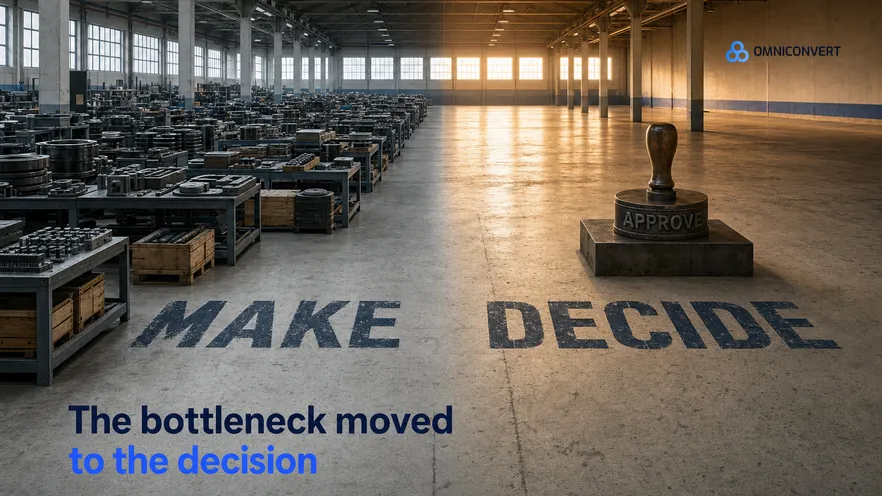
- Executor output is capped by production capacity; supervisor output is capped by decision quality and speed.
- The four control surfaces are the objective, the constraints, the approval threshold and the review loop.
- Approving item by item is the failure mode, not the model. Approve policy in advance and review the exceptions.
- Keep hands-on anything expensive, irreversible, novel, or carrying legal exposure.
- Measure decision latency and reversal rate. Volume alone will flatter a badly constrained system.
The executor to supervisor shift is the move from a team that produces eCommerce work to a team that decides which work runs. It is being described everywhere as a technology change, and it is not. It is a change in where decision authority sits, and every team that has attempted the first without the second has ended up busier than it started. Last updated: September 2026.
Omniconvert has worked alongside eCommerce teams for 13 years in eCommerce, running Omniconvert Explore across 70,000+ experiments and auditing stores against 248+ audit criteria. The pattern in teams that stall is consistent enough to be diagnostic: proposals became cheap to generate, the approval path stayed exactly as it was, and a queue formed at the person who had always signed things off. Nobody planned that. It is simply what happens when supply increases and the gate does not move.
This piece sits above the two frameworks that describe the surrounding change. The Manual-to-Autonomous growth shift describes the trajectory, and how CRO, creative and AI visibility tie into one growth system describes the surfaces it touches. What follows is the operating model itself: what a supervisor controls, what stays in human hands, what happens to the team, and how to tell whether the transition is working.
What is the executor-to-supervisor shift?
Consider what governs the throughput of a marketing team in the executor model. Somebody writes the brief, somebody produces the asset, somebody builds the campaign, somebody checks it. Output rises by adding people or hours, and the quality ceiling is set by the skill of whoever does the making. That model is legible, well understood, and it has been the shape of the function for two decades.
Now change one thing: assume proposals can be produced at near-zero marginal cost. The bottleneck does not disappear, it relocates. It moves to whoever must decide which proposals are worth running, and that person's capacity was never designed for the new volume. This is the whole mechanism, and it explains why teams often experience the transition as a workload increase rather than a relief.
The response that works is to stop deciding items and start deciding policies. Instead of approving each campaign, a supervisor approves what a campaign may say, which audiences it may address, what it may offer and what it must never claim. Individual items then proceed inside those boundaries, and only exceptions reach a person. This is an ordinary management pattern, familiar from how any large organisation delegates spending authority, and it is unfamiliar in marketing operations mainly because production cost has never before been low enough to require it.
What are the four control surfaces of the supervisor model?
| Control surface | The question it answers | Set by | Failure when missing |
|---|---|---|---|
| Objective | What is being optimised, in one metric | Commercial owner | Optimisation toward whatever is easiest to measure |
| Constraints | What must never happen, at any performance | Brand, legal and finance together | A profitable action nobody would have sanctioned |
| Approval threshold | What may proceed without a person | The supervising manager | Item-by-item review, and the old bottleneck returns |
| Review loop | How often the three above are revisited | The supervising manager | Rules that were right last quarter quietly going stale |
| Escalation path | Who decides when something falls outside | The supervising manager | Exceptions queue behind whoever is least busy |
| Reversal procedure | How something live is undone, and how fast | Operations | Thresholds set too tight because mistakes feel permanent |
The last row is the one that unlocks the others in practice. Teams set conservative approval thresholds when they are uncertain how quickly a mistake can be undone, and the fear is rational. Establishing that a live campaign can be stopped in minutes changes what it is reasonable to let through unattended, so investing in reversal speed is usually the cheapest way to raise throughput without raising risk.
The constraints row deserves its own emphasis because it is where the model earns trust. A constraint is not a preference expressed strongly. It is an absolute: a claim that may never be made, a discount depth that may never be exceeded, an audience that may never be targeted, regardless of how well it would perform. Constraints are the reason a supervisor can stop reading every item, and a team that has not written them down has not earned the right to delegate anything.
How do you set the approval threshold?
Most teams set thresholds by category, which produces poor results because categories mix reversibility. A discount code and a homepage claim might both be labelled promotional work, while one can be withdrawn in a minute and the other is quoted back at you for a year.
The two variables that matter are how much of the audience an item touches and how quickly it can be undone. Plot the four combinations and the policy writes itself. Reversible and narrow proceeds automatically. Reversible and broad proceeds with a notification and a monitoring window. Irreversible and narrow needs sign-off, but only from one person. Irreversible and broad needs the full path, and should be rare enough that the full path costs little in aggregate.
There is a second-order benefit that teams discover late. Because this framing makes the cost of the approval path explicit, it creates a real incentive to make things reversible. Work that was irreversible only because nobody had built an undo becomes reversible once someone does, and the whole system speeds up without any loosening of standards.
What work stays hands-on?
A model that claims to cover everything gets rejected by the people whose judgment it appears to replace, and they are right to reject it. The honest scope is narrower and more defensible: high-volume, reversible, well-measured decisions where the objective is agreed and the feedback arrives quickly.
That still covers a great deal of eCommerce operations, including most campaign assembly, creative variation, audience selection within agreed boundaries, merchandising order and experiment prioritisation. It is worth keeping the prize in view while drawing that boundary: Bain and Company's retention research with Fred Reichheld holds that a five percent improvement in retention can raise profits by twenty-five to ninety-five percent [Bain and Company], and decisions of that kind are exactly the ones a supervisor should be freed up to make. It excludes what the strategic part of the job always was. Deciding what the brand means, what the pricing architecture should be, which market to enter and how to respond to a regulator are not throughput problems, and speeding them up is not a goal.
This is also where value concentrates as the executing work is delegated. When production stops being the constraint, the differentiated part of the job becomes choosing the right objective and writing constraints that hold. Those are harder skills than producing assets, they are less evenly distributed, and they are what the role becomes. The related discipline of deciding which customers the objective should serve is covered in the CLV-Weighted growth model.
What happens to the team in the supervisor model?
It would be dishonest to describe this as a change with no losers. Roles defined primarily by production volume are diminished by it. Being straightforward about that is more useful than the reassurance usually offered, because teams can tell when a change is being oversold and they discount everything else said alongside it. Gartner's work on marketing organisations has repeatedly found that technology investment outruns the operating-model change needed to use it, with governance and skills cited as the binding constraints [Gartner]. That is this problem stated at the level of a whole function.
What actually happens in teams that navigate it well is a redistribution rather than a reduction. The work of specifying, constraining, reviewing and diagnosing expands considerably, and it is more interesting work than assembling the fortieth variant of a campaign. People who understood why the assets worked tend to move into it easily. People whose expertise was the mechanics of production find the transition harder and need explicit retraining rather than encouragement.
The organisational failure to watch for is a supervisor with responsibility and no authority: someone accountable for output who cannot change the constraints, adjust the threshold or stop the system. That configuration produces exactly the queue the model was supposed to remove, and it is depressingly common because it is what happens when the tooling is bought by one part of the business and the decision rights belong to another.
How do you measure whether the transition is working?
- Decision latency. The time between a proposal existing and a decision being made about it. This is the direct measure of whether the bottleneck moved. If it has not fallen, the threshold is set too low and a person is still in the path of every item.
- Reversal rate. The share of approved items later undone. Stable reversal rate alongside rising volume is the signature of a working model. Reversals climbing with volume means the constraints were written too loosely and need tightening before anything is scaled further.
- Exception share. How many items fall outside the threshold and require a person. Rising exception share means the boundaries no longer describe the work, which is a signal to revisit the constraints rather than to add reviewers.
- Constraint age. How long since each constraint was last examined. This sounds bureaucratic and catches a real failure: rules written for one product range or one season quietly governing a business that has moved on.
What none of these measure is whether the output is any good, which still requires the ordinary discipline of experimentation. A supervisor model changes who decides what runs; it does not tell you whether what ran was better than the alternative, and teams that stop testing because the system is producing more will lose the ability to know.
This is the operating model Nexus by Omniconvert is built around. It is an AI for eCommerce growth engine that unifies commerce data, prioritises experiments by True Profit, and generates campaigns and creative you approve before they go live. The last clause is the part that matters here: the system proposes inside boundaries a person sets, and a person approves what goes live. That is the supervisor model expressed as software rather than as a memo, and the memo has to exist first.
Supervisor operating model FAQs
It is the change from a team that produces the work to a team that decides which work runs. In an executor model, output is limited by how much the team can personally make. In a supervisor model, output is limited by how well the team sets constraints, reviews proposals and approves what goes live.
The scarce resource moves from production capacity to judgment.
No, and a model that requires it has failed. Item-by-item approval reproduces the original bottleneck with extra steps, because a person is still in the path of every unit of output.
A working supervisor model approves policies and boundaries in advance, then reviews individual items only where they fall outside what was already agreed.
Four things: the objective, the constraints, the approval threshold and the review loop. The objective says what is being optimised. The constraints say what may never happen regardless of performance.
The threshold says what can proceed without a person. The review loop says how often the first three are revisited against results.
Anything where a mistake is expensive and hard to reverse, and anything genuinely novel. Pricing architecture, brand positioning, a first entry into a market and any decision with legal or regulatory exposure stay hands-on.
The model suits high-volume, reversible, well-measured decisions, which is most of campaign and creative operations and very little of strategy.
Stopping halfway. A team adopts tools that generate proposals but keeps every previous approval step, so it now reviews more items than before with the same number of people.
Throughput falls, the team concludes the approach does not work, and the real cause was leaving the decision rights exactly where they were.
Measure decision latency and reversal rate, not volume. Latency is how long a proposal waits for a decision, and it should fall. Reversal rate is how often an approved item is later undone, and it should stay low.
Volume rising while reversals rise with it means the constraints were set too loosely, not that the model is succeeding.
Most teams attempting this shift buy tooling and change nothing about who decides what, which is why so many report the same disappointing outcome: more proposals arriving, the same people reviewing them one at a time, and less throughput than before. The tooling was never the constraint. The constraint is that approval authority still sits where it sat when a person had to make each item by hand, and until it moves the team is supervising in name and executing in practice. Start by writing down the four control surfaces for one workflow: what is being optimised, what must never happen, what may proceed without a person, and how often you will revisit those answers against results. That document is the operating model. Everything else is implementation.
Set the constraints, approve what goes live
Nexus by Omniconvert unifies commerce data, prioritises experiments by True Profit, and generates campaigns and creative for your team to approve. The supervisor model needs a system that proposes inside boundaries you set, and never publishes on its own.