One Ecommerce Growth System: CRO, Creative and AI Visibility

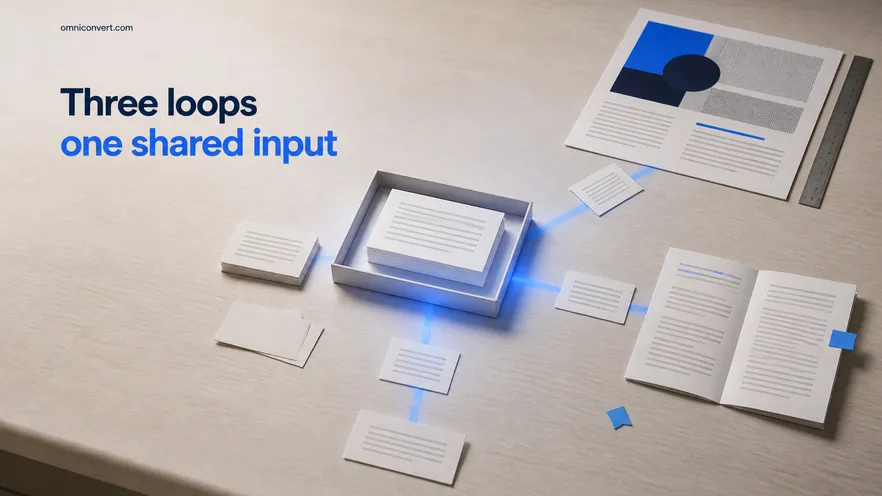
- Creative, CRO and AI visibility are three surfaces of one activity: making a specific, true claim available where the decision happens.
- All three run on the same input, a written set of customer claims, and that input is the artefact nobody owns.
- Each loop returns something the others need: what earns attention, what survives scrutiny, what external sources treat as credible.
- Value leaks at the joins, and the joins are unmeasured by design, so the loss reads as a mediocre month rather than a failure.
- Start with one objection and trace it through all three loops. One of the three is usually missing.
Most brands of any size run these three as separate disciplines. There is a performance owner buying attention, a CRO owner improving the on-site experience, and someone responsible for organic presence who is now also worrying about whether ChatGPT mentions the brand. Three owners, three toolsets, three definitions of a good month. Last updated: August 2026.
That separation is not stupid. It is how the specialisms actually developed, and each of the three genuinely rewards depth. What it costs is harder to see, because the cost does not appear in any of the three dashboards. It appears in the gaps between them: a promise made in an ad that the landing page never answers, an objection that support hears daily and creative has never addressed, a fact that would settle a purchase and exists nowhere a machine can read it.
I have spent 13 years in eCommerce watching this pattern, and the CROBenchmark dataset of 7,000+ websites in 15+ industries assessed against 248+ audit criteria says the same thing the anecdotes do. The brands that pull away are rarely the ones with the best individual function. They are the ones where the three functions are working from the same evidence.
Each of those threads is developed in depth elsewhere: the competitor & market intelligence hub, the ai search visibility hub, the ai + ecommerce trends hub, the multi-market strategy hub, the multi-market ops hub, the ai-powered cro hub.
How do three disciplines become one growth system?
Start with what each is actually doing, stripped of its vocabulary. Creative takes a claim about your product and puts it where attention is. CRO takes the same claim and makes sure it survives the moment of doubt on the page. AI visibility takes the same claim and makes sure it is stated in a form a machine can extract and repeat. Three delivery mechanisms, one payload.
That framing is not a semantic trick, it has an operational consequence. If the payload is shared, then improving the payload improves all three outputs at once, and it is the only kind of work that does. Better ad production makes ads better. Better page design makes pages better. Better customer evidence makes ads, pages and citations better simultaneously, which is why it is the highest-return work available and why it is almost nobody's job.
The reason it is nobody's job is structural. Customer evidence sits in reviews, support tickets, survey responses and sales conversations, none of which belong to the three functions that need it most. It is everybody's input and nobody's output, so it never gets produced deliberately. Each team then improvises its own version, which is how you end up with an ad promising something the page contradicts.
What shared input drives CRO, creative and AI visibility, and why does nobody own it?
Ask three people in a growth team what the main reason customers do not buy is, and you will usually get three answers, all confident and all partly right. That is the diagnostic. The evidence exists in the business; it is simply not written down anywhere the three loops can share it.
What the artefact needs to contain is short and specific. The constraint your product resolves, in the words a customer would use rather than the words a positioning deck would use. The two or three objections that most often stop a purchase, ranked by frequency rather than by how interesting they are. The facts that settle those objections. And the language customers actually use for the problem, which is nearly always plainer than the language the brand uses.
None of that requires research spend. It requires reading what you already collect. Review text, support ticket themes, post-purchase survey answers and exit survey responses will produce the whole document in a week of attention, and the exercise usually surprises people who have worked on the brand for years.
The most valuable line in the artefact is normally the objection ranking, because it is the one thing all three loops need and none of them measures. Baymard Institute's long-running checkout research makes the general version of the point: abandonment concentrates in a small number of recurring causes, and average cart abandonment sits near seventy percent. Your specific version of that list is worth more than the industry average, and you can obtain it for the cost of reading your own inbox.
How do the three growth loops work?
The word loop is doing work here. These are not three channels that consume a brief. Each of them generates evidence as a byproduct, and that evidence is exactly what the other two need.
The creative loop tests claims against attention at high volume and low cost. A month of running four angles tells you which framing of your product makes a stranger stop, which is genuinely difficult information to obtain any other way. Most organisations discard it, recording only which ad won rather than which claim won, and the distinction is the entire value.
The conversion loop tests claims against scrutiny. A visitor who arrives interested and leaves anyway has encountered a specific unresolved doubt, and on-site testing, session behaviour and exit surveys locate it precisely. This loop is the one with the best instrumentation and the narrowest audience: it only sees people who already arrived.
The visibility loop tests claims against verification. An answer engine cites what it can check and corroborate, so this loop tells you which of your claims are independently supported and which exist only on your own site. That is uncomfortable and useful information, and it is invisible to the other two loops entirely.
The visibility loop is also the one whose importance is changing fastest, which is worth stating plainly rather than breathlessly. Gartner has publicly forecast that traditional search engine volume will decline as AI assistants absorb a growing share of queries. Whether the timing proves right matters less than the direction, because the direction determines who your claims have to convince. A claim that persuades a person browsing and cannot be verified by a machine reading was always slightly weak. It is becoming measurably weaker.
Note how the three cover different failure modes. A claim can be attention-earning but unverifiable, verifiable but boring, or persuasive on the page and never seen by anyone who did not already arrive. You need all three readings to know whether a claim is actually good, which is the strongest practical argument for running them as one growth system rather than three.
Where do handoffs between CRO, creative and AI visibility leak?
The specific failure worth naming is the promise gap. An ad makes a claim, a visitor arrives holding that claim as an expectation, and the page addresses something else. The performance dashboard sees a healthy click rate. The CRO dashboard sees a normal conversion rate for that page. Nobody sees the mismatch, because seeing it requires looking at the two together and no report does.
The second leak runs in the other direction. CRO teams routinely discover, through surveys and testing, exactly which objection is blocking purchases. That finding is worth a great deal to creative, which could address the objection before the click and arrive with it pre-answered. In most organisations the finding stays in the CRO backlog, gets fixed on the page, and is never told to the people buying the attention.
The third leak is newer and growing. The claims a brand can defend publicly, corroborated by sources outside its own domain, are now a competitive asset, because that is what determines whether an answer engine repeats them. Almost no organisation routes that information anywhere. The person checking AI visibility reports a score to a marketing meeting, and the fact that two of the brand's three main claims cannot be corroborated anywhere, which is a serious commercial finding, is never treated as one.
Each leak has the same shape: information generated by one loop that another loop needed and never received. That is a coordination problem, not a capability problem, and coordination problems do not get solved by buying better tools for the individual functions. They usually get worse, because better tools deepen each function's own view.
What does each loop do with the same evidence?
| Shared evidence | Creative loop uses it to | Conversion loop uses it to | Visibility loop uses it to |
|---|---|---|---|
| The top purchase objection | Pre-answer it before the click | Resolve it on the page | State it plainly enough to be quoted |
| Customer language for the problem | Write hooks people recognise | Label and structure the page | Match how the question is asked |
| The fact that changes a mind | Carry it as the angle | Place it near the decision | Publish it as a checkable claim |
| Which claims are corroborated | Lead with the defensible ones | Cite the source on the page | Earn the citation |
| Which claims won attention | Scale the winning angle | Match the page to the promise | Prioritise what to substantiate |
| Where doubt actually stops people | Address it earlier in the funnel | Remove the friction | Answer the constraint question |
Read any row across and the point makes itself. The top objection is not a CRO concern that creative may find interesting. It is the single most important input to all three, and in most companies exactly one of the three has it.
How do you run CRO, creative and AI visibility as one system?
The instinct on reading the above is to reorganise, and I would advise against it. Merging the functions loses the depth that makes each one good, and creates a generalist team that does three things adequately. The connection you need is informational, not managerial.
Three changes do most of the work. The first is to make the shared evidence a real artefact with a named owner and a review date, rather than a set of assumptions each team maintains privately. It is one document. It changes slowly. Someone has to own it, and it matters less who than that it is somebody.
The second is one recurring session, monthly is usually right, where each loop brings what it learned rather than what it shipped. Which claim earned attention. Which objection blocked purchases. Which claim could not be corroborated. Thirty minutes of that exchange consistently generates more actionable insight than the three separate status meetings it partially replaces.
The third is to measure at least one join. The simplest is promise-to-page consistency: for your top five ads, does the landing page address the specific claim the ad made? It is a manual check, it takes an hour, and the first time a team runs it they typically find at least one significant mismatch that had been running for months.
Tooling comes after that, not before. Once the definitions are shared, a platform that holds the customer data, ranks what to test, and generates the creative against your own results stops being three tools bolted together and becomes one loop. That is what Omniconvert Commander (formerly Nexus) is built to do: unify commerce data, prioritise experiments by True Profit, and generate campaigns and creative you approve before they go live. But a tool purchased to fix a coordination problem that has not been diagnosed will simply automate the disconnection, and that is a more expensive version of the same issue.
Where should you start this quarter?
- Find the objection. Read a month of support tickets, exit survey responses and one-star and three-star reviews. Rank the reasons by frequency, not by how fixable they seem. Take the top one.
- Check the creative. Do any of your live ads address that objection before the click? Usually not, because ads are written from benefits and objections are written from doubt.
- Check the page. Is it resolved above the point where people leave, or is it in a policy page, an FAQ accordion, or an image? Location matters more than presence.
- Check the machine reading. Ask an answer engine the constraint question a buyer would ask in your category. Are you named? Is the answer to that objection findable as plain text on your site?
- Fix the missing one, then measure all three. The point is not to fix the objection once. It is to see the three surfaces move together, which is what makes the case internally far better than any argument does.
Working through that exercise is also the fastest way to see how much the three functions currently know that the others do not. In my experience it is the finding rather than the fix that changes how a team operates, because it is difficult to go back to running three separate plans after watching one objection travel through all three and find a gap in each.
For the deeper mechanics of the individual loops, our guide to AI visibility and GEO for eCommerce covers the measurement side of the third loop, and the Human Middleware Problem covers what happens when the coordination cost is paid in people's time rather than solved in the system.
Each loop also has a practical entry point elsewhere in the network: the ad creative & testing hub for the creative side, the reviews & ugc hub for what customers say in public, the cro fundamentals hub for the on-site work, and the conversion rate optimization hub for where your own numbers ought to sit before you judge any of it. The longer argument all three serve is the Manual-to-Autonomous growth shift.
CRO, creative and AI visibility FAQs
How are CRO, creative and AI visibility connected?
They run on the same input: what you know about your customer, stated as specific, verifiable claims. Creative uses those claims to earn attention, CRO uses them to remove doubt on the page, and AI visibility depends on them being published plainly enough for a machine to quote. One piece of customer evidence feeds all three, which is why improving it moves all three at once.
Why does running them as separate teams cap growth?
Because each team optimises a metric the others do not share, and the handoffs lose the evidence. Creative optimises click cost, CRO optimises on-site conversion, and organic optimises rankings. A promise made in an ad and not answered on the page is invisible to all three dashboards, and it is exactly where the money leaks.
What is the shared input in practice?
A written set of claims about your product and customer that are specific, true and checkable: the constraint your product resolves, the objection that most often stops a purchase, the fact that changes a mind. Most brands have this knowledge distributed across reviews, support tickets and survey responses, and have never written it down as one artefact.
Where should a brand start if the three are separate today?
Start with the objection. Find the single most common reason people do not buy, then check whether your creative addresses it, whether your page resolves it, and whether it is stated plainly enough for an answer engine to quote. Most brands find one of the three is missing, and fixing that one is the cheapest compounding work available.
Does this require new tooling?
It requires shared definitions before it requires tooling. Tools help once everyone agrees what an objection, a claim and a result mean, and they entrench the separation when bought before that agreement. The first version of this operating model is a written document and one recurring meeting, not a platform.
What is the bottom line on one growth system?
CRO, creative and AI visibility are not three disciplines that ought to talk more. They are three loops running on one input, and the input is the thing almost nobody owns: a written, honest account of what your customers want, doubt and believe. Assemble that document, give it an owner, and route what each loop learns back into it. The three functions can stay exactly where they are on the organisation chart. What changes is that they stop guessing separately at the same question, and start compounding on the same answer.