Ecommerce Discount Strategy: Protect Margin Without Killing Sales

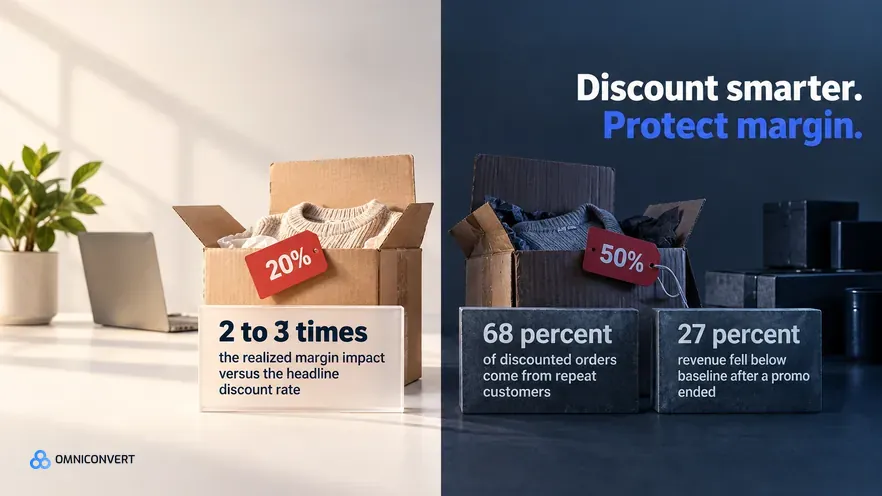
- A discount's realized margin impact runs roughly 2 to 3 times its headline rate, because the cut comes off revenue while cost of goods, shipping, and fees stay fixed.
- Discounts largely reward existing demand: about 68 percent of discounted orders come from repeat customers versus only 11 percent of full-price orders, so most of the money lands on people who would have bought anyway.
- Low-discount brands grew GMV about 2x faster than deep discounters over the past year, with a 19-point margin edge, and revenue fell about 27 percent below baseline in the weeks after a promo.
- Chronic discounting resets the customer's reference price, so full price reads as a loss and demand becomes dependent on the next sale.
- The margin-safe move is conditional, targeted discounting measured against True Profit, revenue minus cost of goods, shipping, returns, ad spend, and fees, not against top-line revenue.
A discount is money you give back to buyers to change what they do. The trouble is that most ecommerce discount programs never measure whether the behavior changed, only that revenue moved. Across the CROBenchmark dataset of 7,000+ websites in 15+ industries, against 248+ audit criteria, and 13 years of conversion rate optimization work, the brands that treat a discount as a cost against profit consistently out-earn those that treat it as a lever pulled off the top line [CROBenchmark Report 2026, Omniconvert]. That single reframe is the whole strategy.
Nexus by Omniconvert is the AI eCommerce growth engine that ranks every promotion by True Profit rather than revenue, so you discount on purpose instead of by reflex. This guide covers what a discount actually costs, who really redeems your codes, why dependency compounds, a margin-first framework, what to run instead of a sitewide sale, and how to measure it all. Each section answers its question directly, then goes deeper.
What does an ecommerce discount strategy really cost?
The reason discounting feels cheaper than it is comes down to where the money leaves. When you cut 20 percent off the price, you lose 20 percent of revenue, but none of your costs move: the product still costs the same to make, pick, pack, and ship. So the cut lands entirely on the thin slice of margin sitting on top, and that slice is a fraction of the price. This is why realized margin impact runs about 2 to 3 times the headline rate [Phoenix Strategy Group, 2026].
Run the arithmetic on a single product to see it. Take an item that sells for $100 at a 30 percent gross margin, so $30 of profit per unit before overhead:
| Headline discount | Price to customer | Profit per unit | Profit lost |
|---|---|---|---|
| 0% (full price) | $100 | $30 | — |
| 10% | $90 | $20 | 33% |
| 20% | $80 | $10 | 67% |
| 30% | $70 | $0 | 100% |
A 20 percent discount does not cost 20 percent of profit; it costs two-thirds of it, and a 30 percent cut on this product wipes profit out entirely [Syncost, 2026]. The picture gets worse when codes stack. A welcome offer, an email code, and free shipping combined can strip 30 to 40 percent off an order's margin, often without anyone deciding that was the intended depth [Saras Analytics, 2026]. The first job of a margin-safe strategy is simply to see this number before the promo runs, not after.
Who actually redeems your discount codes?
The most expensive assumption in discounting is that a code creates a sale that would not have happened. The redemption data says otherwise. When about 68 percent of discounted orders come from repeat customers but only 11 percent of full-price orders do, the discount is flowing to the base you already own [Klaviyo, 2026]. You are not buying new demand; you are subsidizing existing demand.
This is where Byron Sharp's work in How Brands Grow earns its place in a pricing discussion. Sharp shows that growth comes from reaching many light and new buyers, not from extracting more from your heavy buyers. A sitewide sale does the opposite: it concentrates the giveaway on the loyal, high-frequency customers who redeem promptly, while doing little to reach the light buyers who actually drive growth. The 68 percent figure is that principle showing up on your P&L.
Then there is the hangover. A promotion pulls demand forward, so the weeks after a sale come in below normal, not just below the sale peak. One study found revenue in the two to four weeks after a promo ran about 27 percent below baseline [Klaviyo, 2026]. If you only compare the sale week to a quiet week, the promo looks like a triumph. Measured across the full cycle, a large share of it was demand you already had, moved earlier and sold cheaper.
None of this means discounts never work. About 88 percent of consumers say an offer encourages them to try a new brand, and 57 percent say they would not have bought without a code [Omnisend, 2026]. That is real incremental demand, but it lives with new and hesitant buyers, not your loyal base. The strategic implication is precise: aim discounts at acquisition and rescue, not at the people already buying.
Why does discount dependency compound?
The mechanism here is prospect theory, from Kahneman and Tversky. Every buyer carries a reference price, the number they consider normal for your product. Discount repeatedly and you move that reference point down: the sale price becomes the anchor, and full price now feels like a penalty rather than the real price. Loss aversion does the rest, because a perceived loss stings more than an equivalent gain pleases, so the customer waits for the discount to return rather than pay what now feels like too much.
This is also a price-quality signal problem. Chronic markdowns teach the market that the product is "worth" the sale price, eroding both brand equity and future pricing power. The emotional cost and the accounting cost point the same way: the more you discount, the less your full price means.
The dependency is genuinely sticky, which is why it deserves respect rather than a cold-turkey quit. Brands that cut discounting grew only about 4.8 percent, versus roughly 10.1 percent for those that held their promotional cadence steady, because pulling back mid-habit suppresses demand in the short term before it recovers [Retail World, 2026]. The lesson is not "never discount"; it is "do not build a demand base that only shows up on sale," and if you already have one, exit it gradually.
The ecommerce brands that plateau at single-digit growth almost always share one pattern: they reach for a sitewide sale the moment a month runs soft, so every soft month teaches their base to wait for the next one. The benchmark gap closes fastest when operators treat margin per order as the primary unit of measurement, not gross revenue for the promo window. A brand that manages its reference price protects the one asset a discount quietly spends: the customer's belief that full price is fair.
What is a margin-first discount framework?
The difference between a margin-safe discount and a margin-leaking one is not the percentage; it is the condition attached. A conditional offer is a form of price discrimination in the economic sense: it lets buyers who need a lower price self-select into it, while buyers willing to pay full price never see it. That is why targeting matters so much on the P&L. Broad public coupons cannibalize 20 to 60 percent of orders that would have happened anyway, while targeted offers like abandoned-cart and new-customer-only codes cannibalize only 10 to 25 percent [Saras Analytics, 2026]. Four rules keep a program on the safe side:
-
Condition every offerAttach a job to each discount: first purchase, minimum threshold, cart recovery, subscription start, or win-back. A discount with no condition is a discount to your whole base, including everyone who would have paid full price.
-
Target by segment, not sitewideUse RFM to aim offers at the segments that need a nudge, cart abandoners and lapsing customers, and hold full price for loyal, high-frequency buyers who convert without one.
-
Cap the stackStop welcome, email, and free-shipping codes from combining. Set one code per order and model the worst-case stack before launch, because 30 to 40 percent margin strips happen by accident, not by decision.
-
Set a margin floorDefine the minimum True Profit per order the promotion may reach, and let that floor, not a round percentage, set the discount depth. A 15 percent cap on a thin-margin SKU can still cross the floor.
The benchmark context helps calibrate depth: the median ecommerce discount is about 15 percent and the average around 19.5 percent across roughly 93,000 merchants, with wide vertical spread, fashion at 20 to 30 percent, electronics at 5 to 15 percent [Opensend, 2026]. But the framework's whole point is that a targeted 15 percent beats a sitewide 15 percent on margin every time, because the sitewide version pays people who never needed paying.
Nexus by Omniconvert segments customers by RFM and ranks every offer by True Profit, so you can aim conditional discounts at the buyers who need them and hold full price for the ones who don't.
See how it works →This is not theory. AliveCor used Omniconvert to run a structured A/B testing programme and achieved a +21% conversion rate, +5% revenue per visitor, and 94% statistical relevance across their experiments [Omniconvert, AliveCor case study]. The growth came from testing what actually moved buyers, not from cutting price, which is the same discipline a margin-first discount strategy applies: change behavior on purpose, and measure whether it worked in profit.
What can you do instead of a sitewide sale?
When a month runs soft, the sitewide sale is the reflex, but it is rarely the highest-return move. The brands winning on margin replace price cuts with value that does not touch the reference price:
- Loyalty on non-transactional actions: Reward reviews, referrals, and content, not just spend, so you build engagement without discounting the next order.
- Category expansion: Design the second purchase into an adjacent product line, lifting frequency and lifespan rather than shaving margin on the first.
- VIP tiers and early access: Give your best customers status and first look rather than the deepest coupon, which protects both margin and their sense that full price is fair.
- Act on customer feedback: Fixing the reason people hesitate often converts more than a code would, and it does not recur every month.
- Cross-sell and bundle: Raise average order value with bundles and cross-sells so each order is worth more without a price cut.
The payoff is visible in the aggregate data. Low-discount brands grew GMV about twice as fast as deep discounters over the past year, 12 percent versus 6 percent, and carried a 19-point margin edge, plus 8 percent versus minus 11 percent for brands running 11 or more promotional events a year [Klaviyo, 2026]. That gap is not luck; it is what happens when growth comes from acquisition and retention rather than markdowns. These levers all feed customer lifetime value, which is the number a discount strategy should ultimately serve.
How do you measure discounts against true profit, not revenue?
Every failure mode above traces to one measurement error: judging discounts by revenue. Revenue counts the sale you would have made anyway at full price as if the discount created it, and it says nothing about the profit that survived. The fix is to measure against True Profit and against incremental new-customer acquisition, the only two things a discount can legitimately claim to add.
Two questions separate a working promotion from a costly one. First, what was the True Profit of the discounted cohort versus a comparable non-discounted one, once cost of goods, shipping, returns, ad spend, and fees are subtracted? Second, how many of those orders were genuinely new customers rather than existing demand redeemed early? A promo that scores well on revenue and badly on both of these is not a win; it is a subsidy you have not noticed yet. This is exactly why measuring on ROAS or gross revenue misleads, and why True Profit is the sounder north star.
Nexus by Omniconvert does this ranking automatically: it ingests transactional and behavioral data, subtracts the real costs to compute True Profit per order and per promotion, and shows which offers add profit and new customers versus which quietly erode margin. Combined with RFM segmentation, it lets you aim the next discount at the segment that needs it and prove, in profit, whether the last one worked.
What is a 30-day plan to wean off blanket discounting?
Because dependency is sticky, the move off blanket discounting is a taper, not a cliff. A practical sequence over one month:
- Week 1, measure: Compute True Profit per order and identify which discounts are conditional versus sitewide. Find the worst-case code stack and cap it.
- Week 2, segment: Build RFM segments and separate the buyers who need a nudge (abandoners, lapsing) from the loyal base that converts at full price.
- Week 3, replace one sale: Swap a planned sitewide promo for a conditional offer to a target segment, and hold full price everywhere else. Set a margin floor per order.
- Week 4, prove it: Compare the conditional offer's True Profit and new-customer count against your usual sitewide result. Keep what pays; retire what does not.
Done this way, demand does not fall off a cliff, because you are not removing offers, you are aiming them. Over a few cycles the reference price recovers and full-price orders climb, which is the entire point: growth that does not depend on the next sale.
Ecommerce discount strategy FAQs
Yes, and disproportionately. Because the price cut comes off revenue while cost of goods, shipping, and fees stay fixed, realized margin impact runs roughly 2 to 3 times the headline discount rate. A 20 percent discount on a product at a 30 percent margin can erase about two-thirds of its profit. That is why a discount should be modeled as a cost against profit, not counted as a lift on the top line.
The median ecommerce discount is about 15 percent and the average around 19.5 percent across roughly 93,000 merchants, but the right number is vertical-specific: fashion often runs 20 to 30 percent, electronics 5 to 15 percent. More important than the size is the condition attached. A targeted 15 percent offer aimed at cart abandoners or first-time buyers protects far more margin than a sitewide 15 percent that everyone, including full-price buyers, can take.
The data favors it. Low-discount brands grew GMV about twice as fast as deep discounters over the past year, 12 percent versus 6 percent, with a 19-point margin edge. That growth came from acquisition and retention levers rather than markdowns. Discounting less does not mean promoting less; it means reaching new and light buyers and rewarding loyalty with value rather than price, so you are not training your base to wait for a sale.
Two mechanisms combine. A promo pulls demand forward, so buyers who would have purchased later buy during the sale instead, leaving a hole afterward. Studies found revenue fell about 27 percent below baseline in the weeks following a promotion. The discount also resets the customer's reference price, so full price now reads as a loss and they wait for the next sale. The dip is not random; it is the bill for the spike.
Value-based levers lift lifetime value without training buyers to wait for a sale: loyalty tied to non-transactional actions like reviews and referrals, category expansion into a second product line, VIP tiers with early access, faster service, and acting visibly on customer feedback. These raise average order value, frequency, and lifespan, the three inputs to customer lifetime value, without leaking margin to people who would have paid full price anyway.
Measure it against True Profit, revenue minus cost of goods, shipping, returns, ad spend, and fees, and against incremental new-customer acquisition, not top-line revenue. Revenue hides cannibalization and margin leak: broad public coupons cannibalize 20 to 60 percent of orders that would have happened anyway, versus 10 to 25 percent for targeted offers. The right question is not how much a promo sold, but how much profit and how many genuinely new customers it added.
Nexus by Omniconvert ingests your transactional and behavioral data and ranks every promotion by True Profit, revenue after cost of goods, shipping, returns, ad spend, and fees, so you see the margin a discount actually costs rather than the revenue it appears to add. It segments customers by RFM so you can aim conditional offers at the abandoners and win-back segments that need a nudge, and hold full price for the loyal buyers who would have converted anyway.
The number that changes the decision is not how much a sale sold; it is the roughly 2 to 3 times multiplier on margin that a discount carries, and the 68 percent of discounted orders that go to customers who would have bought anyway. Treat every promotion as a cost against True Profit, aim it only at the buyers who need a nudge, and you keep the growth without the hangover. That is the shift Nexus by Omniconvert is built for: rank promotions by profit, not revenue, and discount on purpose instead of by reflex.
Measure discounts against True Profit with Nexus
Nexus by Omniconvert ranks every promotion by True Profit, revenue after cost of goods, shipping, returns, ad spend, and fees, and segments customers by RFM so your discounts reach only the buyers who need them. Stop discounting off the top line and start protecting margin.