First-Click vs Last-Click vs Data-Driven Attribution: Which Wins?

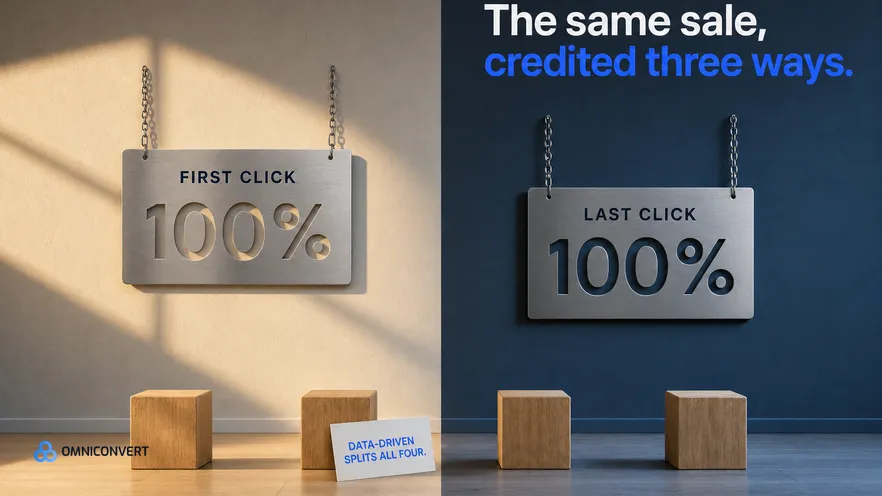
- The three models are not competing measurements of one truth. They answer three different questions.
- First-click over-credits demand creation; last-click over-credits demand interception, especially branded search.
- Data-driven is usually more realistic than either, but it needs volume and cannot be audited.
- Run one journey through all three before choosing. The spread between the answers is the real finding.
- Every model is blind to untracked touchpoints, allocates revenue rather than profit, and stops at the first order.
- Match the model to the decision instead of declaring one of them the company truth.
Two people can look at the same month of sales and disagree completely about which channel earned them. Neither is lying. They are reading different attribution models, and the models were built to answer different questions. Here is what each of the three actually does, what happens when you run one real customer journey through all of them, and how to stop the choice of model from quietly deciding your budget for you.
What is each attribution model?
The word that matters in the first two definitions is recorded. A single-touch model does not credit the first or last thing that happened. It credits the first or last thing your tracking managed to see, which is not the same claim at all.
How do first-click, last-click and data-driven attribution compare?
| First-click | Last-click | Data-driven | |
|---|---|---|---|
| Credit given to | First recorded touch | Final touch | Split across touches |
| Question it answers | What created demand? | What closed the sale? | What moved it along? |
| Systematic bias | Over-credits awareness | Over-credits interception | Toward high-volume paths |
| Channels it flatters | Paid social, display, content | Branded search, retargeting, email | Whatever appears most often |
| Volume needed | None | None | Substantial |
| Can you audit it? | Yes, trivially | Yes, trivially | Rarely |
| Reacts to tracking loss | Severely | Mildly | Severely |
Notice the last row. Single-touch models degrade differently when tracking breaks. Last-click usually still catches the final session, because it happens closest to the purchase. First-click and data-driven both depend on seeing the earlier part of the journey, which is exactly the part that consent banners, cross-device switching and blocked cookies remove first.
How does one customer journey produce three different winners?
Take an ordinary two-week path to purchase:
| Touchpoint | First-click | Last-click | Data-driven |
|---|---|---|---|
| Paid social video | €120 | €0 | €48 |
| Organic article | €0 | €0 | €12 |
| Shopping ad | €0 | €0 | €42 |
| Branded search | €0 | €120 | €18 |
Three plausible readings follow from one order. First-click says the video ad bought the customer and everything after it was admin. Last-click says branded search did the work and the video was an expense. Data-driven says the video and the shopping ad shared most of the load, and the branded search was the customer telling you they had already decided.
Where does each attribution model break?
First-click breaks on long journeys and lost tracking. It credits the earliest touch it can see, so as soon as cookie lifetimes shorten or the customer switches device, "first" quietly becomes "first one we still have", and the model keeps reporting with full confidence.
Last-click breaks on demand it did not create. Branded search, retargeting and abandoned-basket email all appear at the end of journeys by design. They intercept intent rather than build it, so last-click makes them look like the most efficient spend you have, and cutting the channels that fed them looks free until sales fall.
Data-driven breaks on thin data and closed doors. It needs enough converting and non-converting paths to model anything meaningful, so smaller stores get unstable answers. Worse, most implementations cannot be inspected, so when the model is wrong there is no way to notice from inside the report.
Which attribution model should you use, and when?
| Decision | Use | Why |
|---|---|---|
| Does this channel create new demand? | First-click | It is the only one that asks who arrived first |
| Is our retargeting or checkout flow working? | Last-click | Closing mechanics happen at the end |
| How do we split a large budget across many channels? | Data-driven | Distribution is the whole point of the model |
| Should we cut a top-of-funnel channel? | All three, then a holdout test | This is the decision single-touch models get most wrong |
| Is a channel actually profitable? | None of them | They allocate revenue, not margin |
The last row is not a rhetorical flourish. A channel can win on attributed revenue and still lose money once discounting, returns and fulfilment are counted, which is the argument in ROAS vs true profit vs contribution margin.
What do all three attribution models miss?
Every model here divides credit among touchpoints it can see. Word of mouth, a colleague's recommendation, a conversation in a shop and any session where tracking was refused all contribute to sales and appear in none of the reports. The models do not flag this. They simply distribute the sale among whatever remains, which makes the visible channels look more responsible than they are.
The second blind spot is that all three allocate revenue. A channel that attracts heavy discount users can top the attributed-revenue table while contributing less true profit than a smaller channel with full-price orders.
The third is the one that costs the most over time: attribution stops at the order. It cannot tell you whether the customer it credited came back.
Omniconvert Commander (formerly Nexus) unifies purchase and behavior data into one customer view, segments customers by value, and predicts lifetime value, so acquisition sources can be judged on the customers they produce, not only the checkouts.
See how it works →What happens beyond the first order?
Imagine two sources that each get credited with the same attributed revenue this month. One brings buyers who purchase once on a discount and never return. The other brings buyers who come back three times at full price. Every attribution model in this article scores them identically, because every one of them closes the books at the first order.
Reading acquisition beside lifetime value and RFM segmentation is what separates the two. Attribution tells you where the order came from. Cohort behavior tells you whether the customer was worth having, and only one of those questions compounds.
Attribution model FAQs
First-click attribution gives all credit for a sale to the first touchpoint the tracking saw. Last-click gives all credit to the final touchpoint before purchase.
Both assign 100 percent of the value to a single interaction, so they answer different questions: first-click asks what created the demand, last-click asks what closed it. Neither describes the middle of the journey.
It is usually more realistic than either single-touch model, because it distributes credit across touchpoints instead of giving everything to one.
It is not automatically more accurate. It needs enough conversion volume to model reliably, it only sees the touchpoints your tracking captured, and most implementations cannot be audited, so a wrong answer looks the same as a right one.
Because a customer who searches your brand name has already decided to buy. Last-click credits that final search with the whole sale, even though the demand was created earlier by something else.
Teams that optimise on last-click tend to shift budget toward branded search and retargeting, which look efficient precisely because they intercept demand that already exists.
Match the model to the decision. Use first-click to judge whether a channel creates new demand. Use last-click to judge closing mechanics such as retargeting and checkout flows. Use data-driven to allocate a large budget across many channels.
Reporting a single model as the truth is what causes the mistakes, not the choice of model.
Three things. They only see tracked touchpoints, so word of mouth, offline conversations and blocked tracking are invisible. They allocate revenue rather than profit, so a channel can win on attributed revenue while losing money.
And they stop at the first order, so they cannot distinguish a channel that brings one-time buyers from one that brings customers who return.
Attribution allocates credit for orders that already happened. Omniconvert Commander unifies purchase and behavior data into one customer view, segments customers by value, and predicts lifetime value.
That shows which acquisition sources produce customers who return, rather than only which ones produced today's checkout.
The argument about which attribution model is correct has no winner, because the three models are not measuring the same thing. First-click asks what started the journey, last-click asks what ended it, and data-driven estimates what moved it along. Teams get into trouble when they pick one, call it the truth, and then optimise a budget against it for a year. The safer habit is to check how far apart the three answers sit for a given channel. A channel the three models rank very differently is a channel you do not yet understand, and that gap is more useful than any single number.
See which channels bring customers back
Attribution divides credit for orders that already happened. Omniconvert Commander unifies purchase and behavior data into one customer view, segments by value, and predicts lifetime value, so you can tell a channel that buys one-time buyers from one that buys customers.