Madgicx vs Omneky vs Nexus by Omniconvert (2026): Meta optimisation vs agentic execution vs strategy
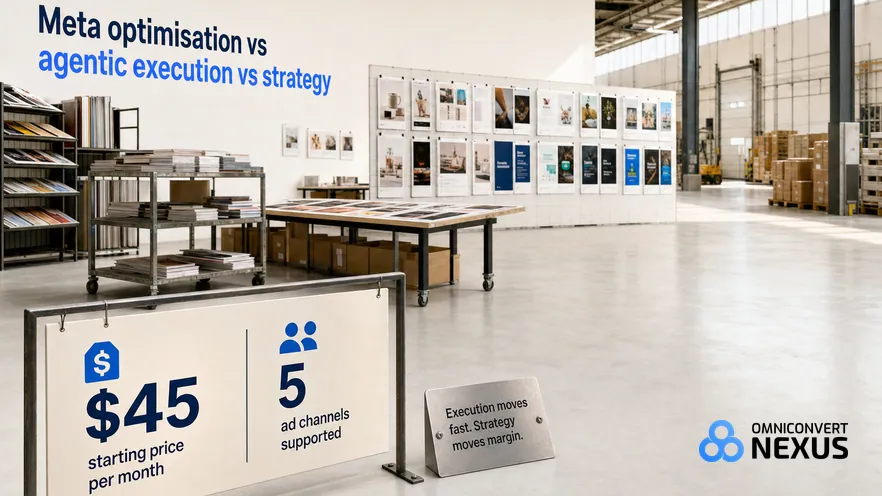
Madgicx and Omneky both operate at the ad execution layer for Meta and multichannel campaigns. Madgicx optimises Meta ads with daily AI recommendations. Omneky runs full agentic workflows from brief to launch. Neither knows which customer segments drive True Profit or whether efficient activity actually improved margin. Nexus by Omniconvert closes that gap. [Omniconvert, 2026]
- Madgicx is a Meta-first AI Marketer that turns account data into a daily list of specific campaign actions at $45 per month.
- Omneky is agentic full-stack: AI agents run brand analysis, creative generation, campaign management, and measurement end-to-end across Meta, Google, TikTok, LinkedIn, and Amazon.
- Neither tool tracks True Profit or CLV. Both optimise on ad performance data, which measures activity, not margin.
- Nexus sits above both, ranking actions by CLV-weighted opportunity and measuring outcomes in True Profit, not ROAS.
- Pick the execution tool that fits your channel mix and scale, then add the intelligence layer when margin stops improving despite efficient ROAS.
DTC operators evaluating Madgicx vs Omneky are usually choosing between two very different bets on ad automation. Madgicx layers an AI Marketer on top of Meta campaigns. Omneky runs an agentic system across the full ad workflow. Neither tool answers the strategic question that decides margin: which customer segments deserve acquisition budget right now, and did the last campaign actually improve True Profit.
What is Madgicx, and what is it actually good at?
Madgicx is an AI-powered Meta advertising platform. Its AI Marketer reviews Meta ad accounts daily and delivers specific campaign actions: pause weak ads, redistribute budgets, and test new variants. Madgicx MCP, a Model Context Protocol server, connects AI assistants such as Claude and ChatGPT to a Madgicx account to pull campaign performance, run full account audits, and act on the account — pausing underperforming ads, adjusting budgets, renaming ad sets — from the chat. Pricing starts at $45 per month, aimed at SMB and mid-market DTC brands.
Madgicx focuses tightly on the Meta ecosystem. The core product is an AI Marketer agent that reads your Facebook and Instagram ad account. It hands you a daily list of recommended actions, not dashboards to interpret.
Around that agent sit an AI Ad Generator for image variants, audience targeting automation that builds Meta audiences from account data, and creative analytics. The pitch is simple: turn a stream of Meta performance data into a short daily to-do list for a paid social manager.
Where Madgicx is genuinely strong
- Daily AI recommendations: the AI Marketer reviews your Meta account and issues specific actions, not just charts to interpret.
- Audience targeting automation: builds and refines Meta audiences from account performance data without manual segment setup.
- Accessible pricing: from $45 per month, within reach of SMB and mid-market DTC brands.
Where Madgicx hits its ceiling
- Meta-only: limited coverage of TikTok, Google, or other channels outside the Meta ecosystem.
- Ad-level signal only: recommendations rest on Meta ad performance data, no CLV, NPS, or lifetime customer signal.
- Image-first generation: the AI Ad Generator handles image ads, not a specialist video generation workflow.
What is Omneky, and what is it actually good at?
Omneky is an agentic AI advertising platform. Its AI agents run the full ad workflow, from brand analysis and creative generation to campaign management and performance measurement. A Brand LLM trained on company data keeps generated creative on-brand across formats, aimed at enterprise and high-growth brands.
Omneky takes a different bet. Instead of layering AI recommendations on top of a human-driven campaign, it runs the campaign. Autonomous agents handle brand analysis, creative generation, launch, and measurement as one continuous workflow.
The Brand LLM trains on a company's own brand data. Guidelines, past creative, tone, and product context feed the model. Generated assets stay recognisable across Meta, Google, TikTok, LinkedIn, and Amazon.
This is the tool for a performance marketing lead who wants autonomous campaign management without hiring a bigger production team.
Where Omneky is genuinely strong
- End-to-end agentic workflow: brand analysis, creative, campaign management, and measurement in one autonomous system.
- Brand LLM: generated creative stays on-brand across formats because the model trains on the company's own data.
- Multi-channel coverage: Meta, Google, TikTok, LinkedIn, and Amazon in one managed platform.
Where Omneky hits its ceiling
- Enterprise pricing: the model targets brands with meaningful ad spend, not accessible for smaller DTC teams.
- Ad-performance signal only: agents optimise against ad metrics, not CLV, NPS, or the actual margin acquired customers deliver.
- Less granular control: the full-stack managed approach limits teams that want to configure elements by hand.
Madgicx vs Omneky vs Nexus: the capability comparison
Madgicx optimises Meta campaigns with daily AI recommendations. Omneky runs full agentic workflows from brief to launch. Nexus by Omniconvert operates one layer up, feeding both with CLV-weighted priorities and measuring outcomes in True Profit, not just efficient ROAS activity.
| Capability | Madgicx | Omneky | Nexus by Omniconvert |
|---|---|---|---|
| Unified commerce data | No | Partial ad channels unified, not commerce data | Yes single source across CLV, NPS, ads, reviews |
| AI-prioritised experiment queue | Partial daily Meta campaign recommendations | Partial agents prioritise on ad performance only | Yes ranked by CLV-weighted opportunity, not ad KPIs |
| Creative generation | Partial image ad variants from existing creative | Yes Brand LLM generates cross-format assets | Yes 100+ variants per hour, ranked by CLV angle |
| True Profit tracking | No | No | Yes margin after CAC, COGS, returns, cohort cost |
| CLV and segment intelligence | No | No | Yes RFM, cohorts, churn prediction, next-best action |
| Autonomous action layer | Partial recommendations require human approval; Madgicx MCP lets connected AI assistants pause ads, adjust budgets and rename ad sets from the chat | Yes agentic execution from brief to launch | Yes ranked action queue with autonomous execution |
| AI briefing from customer data | No | Partial Brand LLM trained on company data, not CLV | Yes briefs built from CLV, NPS, reviews, competitor angles |
| Pricing model | SaaS from $45/month | Enterprise, pricing on request | Revenue-based, see /nexus#pricing |
| Best for | Meta-first DTC teams and agencies | Enterprise brands wanting autonomous ad management | eCommerce $1M+ ARR, margin-focused operators |
Capability rows compare what each platform actually does, not what marketing pages claim. Pricing rows link to each vendor's public pricing page.
What Madgicx and Omneky cannot do
Madgicx and Omneky are execution engines. They ship better ads faster inside Meta or across a full agentic workflow. Neither knows which customer segments deserve acquisition budget, whether the last campaign moved True Profit, or which cohorts are about to churn. That is the shared blind spot.
Madgicx's AI Marketer reviews your Meta account and tells you which campaigns to pause, scale, or test. Nexus provides the layer Madgicx cannot, CLV segmentation that shows which customer segments are worth acquiring and whether the campaigns Madgicx is optimising are actually improving True Profit.
Omneky's agents manage the entire ad workflow autonomously. Nexus provides the customer intelligence layer those agents are missing: CLV segmentation and True Profit measurement that turns autonomous execution into margin-positive growth, not just efficient activity. Autonomous execution optimising for the wrong signal, ROAS instead of margin, runs faster toward the wrong outcome.
Both Madgicx and Omneky assume you already know which customers to target and which message to use. They optimise the execution of that assumption. Neither questions it.
What neither tool can tell you
- Which customers deserve more acquisition spend. Priority by 12-month CLV, not last-click ROAS.
- Which cohorts are 60 days from churning. Signals from purchase pattern, NPS drop, and review sentiment before the churn shows up in the P&L.
- Whether the last campaign moved True Profit. Net of CAC, COGS, returns, and cohort cost, not gross revenue or blended ROAS.
- What your highest-CLV customers actually respond to. Their own words from reviews, NPS free text, and support tickets, fed into the next brief.
True Profit is defined as the net margin remaining after subtracting CAC, COGS, return rates, and the cost of customer acquisition from each cohort, not gross revenue or ROAS. It is what the business actually keeps. Nexus tracks this as the primary optimisation metric across all experiments.
AliveCor used Omniconvert to run a structured A/B testing programme and achieved +21% conversion rate, +5% revenue per visitor, and 94% statistical relevance across their experiments. [Omniconvert, AliveCor case study]
Which tool is right for you?
Pick Madgicx if Meta is your main channel and you want daily AI actions. Pick Omneky if you want autonomous agents running the entire ad workflow at enterprise scale. Add Nexus when campaigns look efficient but margin is not improving.
Choose Madgicx if
- Meta is your primary channel: Meta is your main or only paid social channel and you want AI-driven daily campaign recommendations.
- You want daily actions, not dashboards: the current bottleneck is turning Meta account data into specific daily decisions.
- Budget is a constraint: $45 per month is a fit for an SMB or mid-market DTC team.
Choose Omneky if
- You want end-to-end autonomy: AI agents should manage the entire ad workflow from brief to launch to measurement.
- Brand consistency matters: a Brand LLM trained on your company data keeps AI-generated creative on-brand across channels.
- You are at scale: enterprise or high-growth, replacing manual campaign management with autonomous agents.
Add Nexus if
- Your team spends more than 2 hours a day pulling data: from separate tools before making any decision.
- You are optimising paid spend without a reliable margin view: which segments actually drive True Profit is unclear.
- You want to know which experiments are worth running: before dev sprints are assigned to them.
- ROAS looks fine, margin does not: net margin is flat or falling quarter on quarter despite steady ROAS.
What each tool cannot do, honestly
Every tool on this page has a real limit. Madgicx is Meta-first. Omneky is enterprise-priced and full-stack. Nexus leaves the bid and campaign lifecycle to the ad networks, and does not manage product feeds. Naming the limits out loud is how a stack gets designed, not stitched together.
What Madgicx does not do
- Non-Meta channels: TikTok, Google, and other paid channels are outside Madgicx's core scope.
- CLV or cohort intelligence: recommendations are grounded in ad metrics, not customer lifetime value.
- Specialist video generation: the AI Ad Generator focuses on image ads.
What Omneky does not do
- Accessible pricing: the platform is aimed at enterprise and high-growth brands, not small DTC teams.
- Granular manual control: the agentic model trades element-level configuration for autonomous execution.
- CLV-weighted decisioning: agents optimise on ad performance, not on the margin each acquired cohort actually returns.
What Nexus does not do
- Media buying and bid management: Nexus does not run bids or buy inventory.
- Product feeds and dynamic catalog ads: Nexus does not manage feeds or build DCO creative.
- Retargeting audiences: Nexus does not manage retargeting flows on ad networks.
- Enterprise multi-market versioning: Nexus does not adapt creative across many markets at enterprise scale.
See where your store stands against real competitors in your category and country. Ecommerce Benchmark scores six areas free: Creative & Ads, Reviews & UGC, AI Visibility, Agentic Commerce, Competitor Synthesis, and CRO.
Benchmark Your Store FreeFrequently Asked Questions
The verdict
Choose Madgicx if Meta is your primary paid social channel and you want an AI agent giving daily campaign recommendations. Choose Omneky if you want autonomous agents running your entire ad workflow at enterprise scale. Add Nexus if your team runs efficient campaigns but margin is not improving quarter on quarter. The intelligence layer decides which customers deserve acquisition budget, before either execution tool ever runs a brief. [Omniconvert, 2026]
Madgicx and Omneky are both credible bets on ad automation. If Meta is your primary channel and you want daily AI recommendations at accessible pricing, Madgicx is the specialist. If you are at enterprise scale and want autonomous agents managing the full multichannel ad workflow, Omneky is the fit.
The harder question is whether the campaigns either tool runs actually improve True Profit, not just ROAS. That answer lives one layer up, in the customer data most execution tools never see. Nexus is built to sit in that layer, feeding whichever execution tool wins the primary choice.
Stop assembling data.
Start supervising growth.
Nexus unifies your entire eCommerce data layer, detects revenue anomalies in under 15 minutes, and generates a prioritized action queue, so your team stops being human middleware and starts running the P&L.
5.0 out of 5 across 60 reviews, Shopify App Store , as of September 2026