What Is Meta Andromeda and Why Ads Burn Out Faster

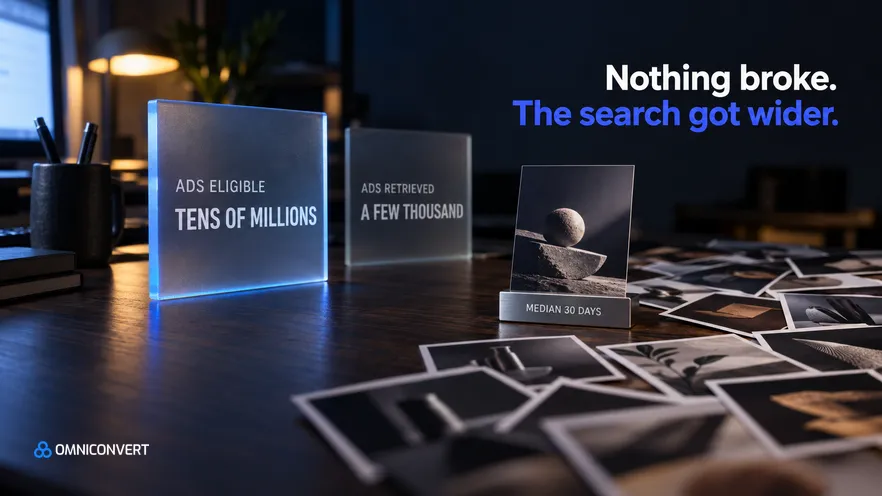
- Meta Andromeda is a retrieval system, not a campaign type, a targeting setting or the auction.
- Retrieval is the first delivery stage: tens of millions of eligible ads down to a few thousand candidates.
- Meta reports a 10,000x increase in retrieval model capacity and a +6% recall improvement [Meta Engineering, 2024].
- Meta has published no data on how long an individual advertiser's creative stays effective.
- Faster creative decay is what advertisers report and what our own longevity audits are consistent with.
- A wider candidate search rewards genuinely distinct angles and punishes cosmetic variants.
- The delivery cause sits here; refresh cadence and fatigue forecasting live on their own pages.
Meta Andromeda is the retrieval engine behind Meta ads, and the biggest change to ad delivery that most advertisers have never read about. Meta published it in December 2024 as its machine learning system design for retrieval in ad recommendation: the first stage of delivery, which narrows tens of millions of eligible ads to a few thousand candidates. Last updated: October 2026.
I have spent 13 years in eCommerce, and the question I get is never architecture. It is ads that used to run two months and now die in three weeks. Nexus by Omniconvert is the AI eCommerce growth engine for Shopify brands: it reads your store, ad and customer data, ranks growth opportunities by profit impact, and builds the campaigns to act on them, and you approve what goes live. The answer to a wider search is supply.
What is Meta Andromeda?
Meta names the parts it rebuilt: model architecture, feature representation, the learning algorithm, indexing and inference. It runs on NVIDIA Grace Hopper hardware alongside Meta's own accelerators, and organises ads into a hierarchical index trained jointly with the retrieval models, per Meta's engineering post.
Most of what circulates gets one thing wrong: Andromeda is not a campaign type, not a setting you switch on, and not the auction.
Where the Meta Andromeda algorithm sits in delivery
Retrieval is defined as the stage that cuts the eligible ad pool to a shortlist a ranking model can afford to score. Everything downstream sees only the shortlist, so if your ad is not retrieved, no bid or budget saves it and no report says so.
That is why Andromeda gets misdiagnosed. A retrieval change arrives as unexplained behaviour and gets blamed on whatever changed that week. Several of the usual Meta ads mistakes are retrieval problems in bidding costume.
What changed for advertisers
| Dimension | Before | With Andromeda |
|---|---|---|
| Model capacity | Baseline | 10,000x more [Meta Engineering, 2024] |
| Feature extraction | CPU components | Over 100x better latency [Meta Engineering, 2024] |
| Inference | One fixed cost | Elastic, 10x more efficient [Meta Engineering, 2024] |
| Retrieval quality | Baseline recall | +6% recall, +8% ads quality [Meta Engineering, 2024] |
| Ad index | Separate indexing | Hierarchical, jointly trained [Meta Engineering, 2024] |
Those are Meta's own results, on Meta's own segments. They say one thing cleanly, that the search got wider and cheaper, and nothing about any ad account.
Why do Meta ads burn faster now?
That caveat is the whole value of this page. Meta has published nothing about creative burning out faster. What it published is that retrieval got wider, and that the volume of ad creatives in its systems is expected to grow significantly [Meta Engineering, 2024]. The mechanism practitioners describe follows from that architecture, not from any Meta statement: if the system can afford far more candidates per impression, more waits behind your ad the moment its value softens. Nothing has to go wrong with it. It only has to be beaten.
The failure mode I see most often is a reasonable one. An ad dips, so the team pauses it, swaps the thumbnail and the first words of the hook, and re-uploads it as a new asset. The metric recovers for a day, which is why the habit survives. It costs them six weeks: the recycled ad re-enters a larger pool with the same angle, offer and promise, and a wider search rewards only a genuinely different thing to say.
Our own numbers point the same way without proving the cause. In an anonymized single store creative audit, the median ad had been live 30 days and nothing had passed 60. That is one store, and the distribution sits in creative longevity, in days active.
What this changes about your creative supply
AliveCor used Omniconvert to run a structured A/B testing programme and achieved +21% conversion rate, +5% revenue per visitor, and 94% statistical relevance across their experiments. [Omniconvert, AliveCor case study]
A programme with a readout beats a reaction. Fatigue mechanics and forecasting belong to creative fatigue, rotation timing to how often to refresh ad creative, the programme itself to Meta ads creative testing, and the readout layer to the best creative analytics tools for Meta ads.
A wider search raises the value of variety and lowers the value of micro-targeting a shrinking audience. Across the CROBenchmark dataset of 7,000+ websites in 15+ industries, the brands who keep ahead run a repeatable supply of distinct angles. For that job, Nexus vs Motion is the head to head.
Meta Andromeda: FAQs
What is Meta Andromeda?
Meta Andromeda is Meta's machine learning system for the retrieval stage of ad recommendation, published in December 2024. Retrieval selects a few thousand ad candidates out of tens of millions of eligible ads, before ranking models score them.
Is the Meta Andromeda algorithm the same thing as the ads auction?
No. They run in order. Andromeda decides which of your ads is considered for a person at all. Ranking and the auction come after it. Advertiser advice is mostly about those two, so a retrieval change gets misattributed.
Why do Meta ads burn faster now?
Advertisers report shorter creative lifespans and our audits are consistent with it, but Meta has published no data on lifespan. The mechanism practitioners describe is a wider candidate search: with more behind your ad, it loses share as soon as it softens.
How should I change creative testing because of Andromeda?
Raise the number of genuinely distinct angles in flight rather than cosmetic variants, because a wider search rewards having something different to say. Set refresh cadence from your own longevity data rather than a calendar rule.
Has Meta confirmed that Andromeda makes creative fatigue worse?
No. Meta's engineering post describes retrieval capacity, recall, efficiency and indexing. It makes no claim about how long one advertiser's ad stays effective.
Can Nexus by Omniconvert help with faster creative decay?
On the supply side, yes. Nexus generates launch ready ad creative from your customer data, ranks angles by CLV weighted value, and measures True Profit per ad across Meta and Google, with a scale, hold, reduce or kill recommendation you approve.
Andromeda, in one line
Andromeda is a retrieval system, and retrieval decides which of your ads is considered at all. Meta rebuilt it to search a far wider field, and published nothing about how long creative lasts. So treat faster decay as a supply question, not a settings question: a wider search finds the next best ad sooner, and rewards whoever has something genuinely different ready.