Creative Longevity: What Days Active Tells You About Ad Performance

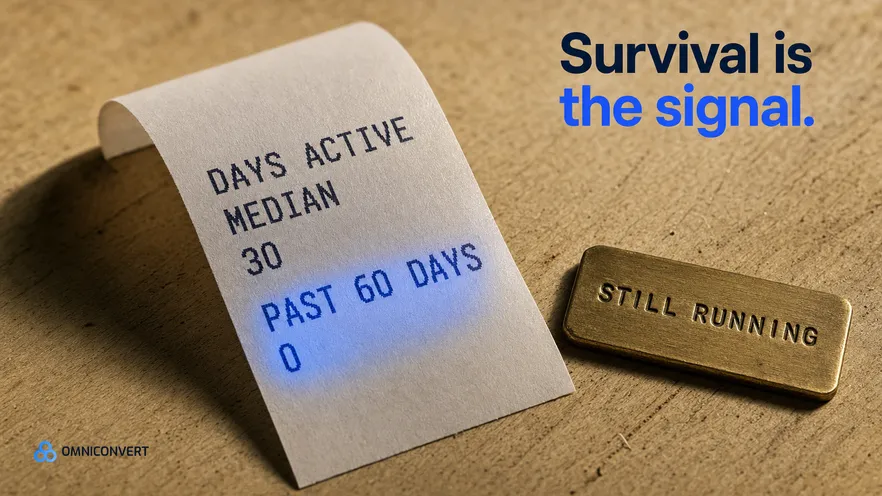
- Days active proxies performance because advertisers kill losers fast, so an ad that survives has already passed a budget test.
- It is readable from a public ad library, which makes it the one performance signal you can see on a competitor.
- In one anonymized store audit the median ad had run 30 days and not one ad had passed 60.
- Sixty days is the threshold that separates a durable winner from a survivor, and it is where the King Ad definition starts.
- Longevity cuts both ways: an old ad that nobody refreshed is a fatigue risk, not a trophy.
An advertisement that stays live is usually winning. Advertisers kill losing creative fast, because budget is finite and nobody keeps funding an ad that does not earn its place, so an ad still running after a month has survived a series of decisions to keep paying for it. That makes days active a structural proxy for performance, readable from a public ad library with no access to spend, ROAS or conversion data. Last updated: September 2026.
Omniconvert has measured how storefronts acquire and convert customers across the CROBenchmark dataset of 7,000+ websites in 15+ industries, against 248+ audit criteria, over 13 years in eCommerce, and reads live advertising through the eCommerceBenchmark ad library. Creative longevity is the first thing we look at in a creative audit, and it is the finding that most often reframes the conversation, because a team that believed it had a creative quality problem usually has a creative survival problem instead.
This piece is about that one signal: what it measures, what the numbers look like, where the 60-day line comes from, and where longevity stops being good news.
What does creative longevity measure?
The distinction is worth holding onto, because it is what keeps the signal honest. Days active does not say an ad returned three times its cost. It says somebody with full access to the numbers looked at this ad repeatedly and chose not to switch it off. That is a weaker statement, and it happens to be one you can verify from outside the account.
It is also a signal about the whole library, not only about individual ads. The distribution of days active across an advertiser's live creative describes how that account behaves: whether it rotates constantly, whether it compounds on winners, whether anything in it has ever been allowed to prove itself. Those are structural facts about how a team works, and they are visible before you have formed any opinion about the creative itself.
Why does ad survival proxy performance?
Every proxy needs a mechanism, and this one is unusually simple. An ad costs money every day it runs. Somebody is accountable for that money. Creative that is not working is the least politically costly thing to cut, because cutting it upsets nobody and frees budget immediately. So the base rate of a bad ad surviving a month is low, and it gets lower the longer the window.
What makes this useful rather than merely true is the asymmetry of information it survives. Almost every performance signal disappears when you look at a competitor: you cannot see their spend, their return, their conversion rate or their margin. Days active does not disappear, because the ad library publishes when the creative was first seen and whether it is still running. The signal is weak per ad and strong in aggregate, which is exactly the shape you want for benchmarking.
It is a structural signal, not a financial one, and the distinction matters. Longevity tells you an ad is competitive. It does not tell you the ad is profitable, and those two questions belong to different systems. The gap between them is the subject of the creative-to-profit gap.
What did one creative audit find?
The table below is the longevity distribution from that audit.
| Longevity band | What it usually means | Found in this audit |
|---|---|---|
| Under 14 days | Still in test, or cut early | A large share of the library |
| Around 30 days | Passed the first budget review | The median ad sat here |
| 30 to 60 days | Survivor, not yet proven durable | A thin tail |
| 60 days and over | King Ad territory | None |
The last row is the finding. An account where nothing reaches 60 days is not necessarily running bad creative, and the audit does not claim it is. It is running an account that restarts its search every month instead of compounding on something known to work, so the same discovery cost is paid again and again.
Treat 30 days as a working median rather than a benchmark. Lifespan varies with category, budget and how aggressively a team rotates, and the honest comparison is against your own history and your own category rather than against a single figure.
What is the 60-day creative threshold?
The threshold is a convention rather than a law of physics, and it earns its place for two reasons. Sixty days is long enough that frequency has climbed and the obvious audience has been covered, so an ad still working there is working on merit. It is also long enough to cross a planning boundary, which means at least one person has actively decided to keep it rather than merely failed to notice it.
Below the line, the reading is genuinely ambiguous. A 40-day ad might be a strong performer or a moderate one nobody has got around to reviewing. Above the line, that ambiguity mostly resolves, because the number of ways an ad survives two months by accident is small.
What follows from crossing the line is a different question from how to spot it, and it changes how the whole account should be planned. That is covered in the King Ad framework.
When does creative longevity turn into fatigue risk?
This is the failure mode that turns a useful signal into a misleading one, and it is common enough to plan for. An old ad is evidence of past success. It is not evidence of present success, and the gap between those two grows quietly, because nothing about the ad changes as it decays. The full guide to creative fatigue shows how to spot it early.
The distinguishing marks are behavioural rather than creative. A winner that is still winning tends to show stable response as frequency climbs, and it is usually accompanied by other reasonably fresh creative on the same angle. A long runner that has become dead weight tends to show climbing frequency, falling response, and no supporting creative anywhere near it, because the team stopped briefing against that angle a long time ago.
The second pattern is the more dangerous of the two, because it looks like strength on a dashboard. An account carrying one very old ad and nothing else has a single point of failure, and it will discover this on the day the ad finally breaks, with no pipeline behind it. To avoid that day, set a rhythm for how often to refresh ad creative.
How do you read days active in your own account?
Four checks cover most of it, in order.
- Find the median, not the mean. One very old ad drags an average upward and makes a young library look mature. The median describes the account you actually have.
- Count what passed 60 days. Zero is a finding. One is a concentration risk. Two or three, with fresh creative behind them, is the healthy shape.
- Check what sits behind the long runners. A King Ad with several younger ads on the same angle is a pipeline. A King Ad alone is a single point of failure.
- Read longevity against fatigue. Frequency climbing while response falls means the ad is old rather than strong, and it needs replacing rather than protecting.
Nexus by Omniconvert is the AI eCommerce growth engine: it unifies customer data, segments buyers by behavior and value, predicts churn, and ranks the next-best action, so the audience an ad has already covered can be described by behaviour instead of guessed at from frequency. Knowing which segments a long runner has saturated is what turns a fatigue reading into a plan.
What the ads are arguing is a separate axis from how long they survive, and the two get confused often. Before you conclude a library lacks variety, check whether it lacks angles, concepts or only hooks, using the definitions in hook versus concept versus angle.
What will days active not tell you?
Three limits, in the order they cause trouble.
It says nothing about profit. An ad can run for months and lose money on every order if the economics behind it are wrong, and no amount of longevity will reveal that from a public library. Profit, margin and lifetime value are a different lane with different instruments, and blending the two is how a structural signal gets oversold.
It is unreliable on a single ad. Any one ad can survive for a bad reason, so the signal is only trustworthy across a library or a category. Ranking two individual ads by days active alone is not a defensible comparison.
And it is a starting point rather than a conclusion. Longevity is the first reading in a diagnostic sequence, because a bad number here explains bad numbers downstream. The full order, and what to do when the first reading comes back low, is in how to read a creative audit.
FAQ: creative longevity and days active
What is creative longevity?
Creative longevity is how long an advertisement stays live, counted in days active from its first appearance. It is treated as a health signal rather than a performance metric, because it says an ad kept passing whatever internal test the advertiser applies, without saying how well it did. It is the one signal about an ad you can read from the outside.
How can days active tell me if an ad is working without ROAS?
Because advertisers kill losing ads quickly. Budget is finite and creative that does not earn its place gets switched off within days or weeks, so an ad still running after a month has survived repeated decisions to keep funding it. That survival is not proof of a specific return, but it is evidence that somebody with access to the numbers keeps choosing to pay for it.
What is a normal ad lifespan in eCommerce?
Short. In one anonymized store audit the median ad had been live 30 days, and the whole library turned over inside two months. Treat 30 days as a working median rather than a benchmark, because lifespan varies by category, budget and how aggressively an account rotates creative. The useful comparison is against your own history and your own category.
What does the 60-day threshold mean?
Sixty days is the line where a durable winner separates from a survivor. An ad past 60 days has outlived normal fatigue and normal seasonal rotation, so it is very unlikely to be running by accident or inertia. An ad live 60 days or more qualifies as a King Ad, and in healthy accounts a small number of them carry most of the account's results.
Is an old ad always a good ad?
No, and this is the failure mode worth watching for. An ad can stay live because it is winning or because nobody has reviewed it, and the two look identical from the outside. Longevity plus rising frequency and falling response is fatigue rather than strength, so read days active alongside fatigue signals rather than on its own.
What does it mean if no ad in a library has passed 60 days?
It means the account has no King Ad, which is a structural finding rather than a verdict on any single ad. The library is turning over faster than anything in it can prove itself, so every month restarts the search rather than compounding on a known winner. It is one of the clearest signals a creative audit can produce.
Can I measure days active on a competitor?
Yes, and that is the main reason the signal matters. Public ad libraries publish first-seen dates, so days active is readable on any advertiser without access to their spend, ROAS or conversion data. It is the rare performance-adjacent signal that survives the loss of everything else you would normally want to see.
How should I use days active in my own account?
Read the distribution rather than the average. Sort the library by days active, find the median, and check whether anything has passed 60 days. A library with no long runners is searching rather than scaling, and a library where one ad is very old while everything else is new is carrying a single point of failure. Both are actionable, and neither shows up in an average.
The bottom line
Days active is the one performance-adjacent signal that survives the loss of everything else. It works because killing a losing ad is cheap and obvious, so survival encodes a repeated decision made by somebody who could see the real numbers. Read the distribution rather than the average, and read the 60-day line first: an account with nothing past it is paying its discovery cost again every month, and an account with one very old ad and nothing behind it has concentrated its results into a single object it did not choose. Neither of those findings requires a competitor's spend data, a conversion pixel or a shared dashboard. Both are visible in a public ad library on a Tuesday afternoon, which is what makes longevity the right place to start.