How Often Should You Refresh Ad Creative on Meta?

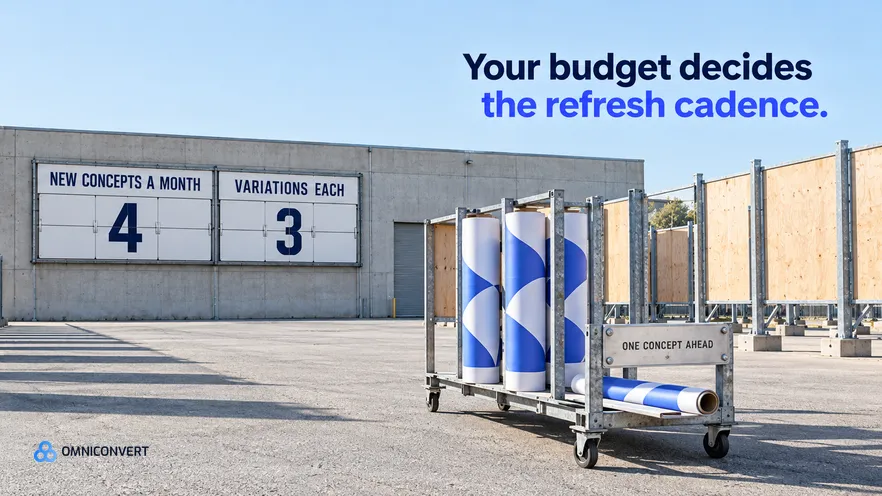
- There is no universal refresh interval: your cadence is whatever your budget can read, not whatever a calendar says.
- One readable test slot costs the number of results you need to trust a difference multiplied by your cost per result.
- A fifth of monthly spend divided by that slot cost is how many new concepts you can learn from in a month.
- Below the spend where a slot is readable, rotate on a fixed cadence and judge the account trend instead of the single ad.
- Three signals justify an off-cycle refresh: climbing frequency, cost per result drifting against a flat auction, and a hook that stops holding.
- Diagnose before you replace: a tired audience, a dearer auction and a broken tracking setup all look like tired creative.
- Keep one briefed concept ahead of the cadence so the replacement exists before the trigger fires.
There is no single answer to how often to refresh ad creative. A cadence is set by how much of a test your budget can read, not by the interval you were handed. If a new ad cannot gather enough results to tell you anything before the calendar replaces it, you are rotating rather than testing. Last updated: October 2026.
The CROBenchmark dataset behind our audits covers 7,000+ websites in 15+ industries against 248+ audit criteria [CROBenchmark Report 2026, Omniconvert], and paid media runs the same way: in 13 years in eCommerce, the accounts that fail at this fail from borrowing somebody else's cadence.
Nexus by Omniconvert is the AI eCommerce growth engine for Shopify brands: it reads your store, ad and customer data, ranks growth opportunities by profit impact, and builds the campaigns to act on them, and you approve what goes live. A cadence has a decision half and a supply half, and most teams plan one.
How often to refresh ad creative, in one rule
Ad creative refresh is defined as a change to the creative decision behind a live ad: a new concept, a new hook, or a re-cut of footage you own. Re-uploading the same idea is not on that list.
The rule has two parts: launch a new concept every cycle, and interrupt that cycle when the live ads say so. A cadence without triggers replaces winners, and triggers without a cadence leave you nothing to react with.
The failure mode I see most often in Meta accounts is the inherited calendar. A team takes a refresh-every-fortnight rule from an agency deck and switches ads off on the day the board says so. What it costs is the asset that was still improving: the winner gets killed on schedule, learning restarts on a cold replacement, cost per result goes up, and that rise reads as proof that fatigue was real.
The arithmetic behind Meta ads creative testing
Say you will not act on a difference until a new concept has produced thirty to fifty results, a working floor rather than a published threshold, and your cost per result is around twenty five. One readable slot then costs about a thousand.
Now set the learning share. A fifth of monthly budget is a sane starting point; below a tenth, Meta ads creative testing is a label on rotation, because no slot ever finishes. At a fifth the sums are simple: five thousand a month buys one slot, fifteen thousand buys three, fifty thousand buys ten. Variations are not separate slots, because three hooks on one concept share the read.
Cadence by monthly ad spend
| Monthly ad spend | New concepts per month | Variations per concept | What triggers an off-cycle refresh |
|---|---|---|---|
| Under 5,000 | 1 | 2 | Nothing at ad level: hold the cadence, watch the account trend |
| 5,000 to 15,000 | 1 to 2 | 2 to 3 | Frequency climbing two weeks running as cost per result drifts up |
| 15,000 to 50,000 | 3 to 4 | 3 | The lead ad loses hook rate while nothing else moves |
| 50,000 to 150,000 | 6 to 10 | 3 to 4 | A top ad's cost per result drifts up on a flat placement cost |
| Over 150,000 | 12 or more | 4 to 5 | Any concept's share of results falls two weeks running |
The first row is the one people argue with, and at that spend a calendar is the correct instrument. The mistake is carrying it into the next band.
Three signals that say refresh now
- Frequency climbing. The least conclusive. The same people are seeing the ad again, which predicts decay rather than proving it: start the brief, switch nothing off.
- Cost per result drifting up on a flat placement cost. The strongest, and it works only as a comparison. If reaching the same thousand people costs what it did, response is the only thing that changed.
- A hook that stops holding. The earliest. Meta reports three-second video plays, and their ratio to impressions is the usual proxy for whether the first two seconds still hold. If that ratio falls while the rest of the funnel holds, a new hook is enough; if it holds and everything after it falls, the concept is the problem.
None of this replaces knowing how long your ads survive. The distribution of days active across your library is a separate measurement with its own method, and it says whether your cadence is too fast.
Creative fatigue, tired audience, dearer auction, or broken tracking
Creative fatigue is defined as a fall in response caused by the audience having already seen the ad, not by the ad being badly made. The fix for a worn-out ad is a new ad; the fix for the other three is not.
Separate them one test at a time. A new hook that recovers cost per result means the creative was tired. A new hook that performs identically means the audience has heard the argument, so you need a new concept or a new audience. Every ad drifting together, including ones launched yesterday, means the cause sits outside the creative: check the auction, then check that conversions still arrive. A tracking break is the cheapest to rule out and the most expensive to miss.
AliveCor used Omniconvert to run a structured A/B testing programme and achieved +21% conversion rate, +5% revenue per visitor, and 94% statistical relevance across their experiments. [Omniconvert, AliveCor case study]
The deeper mechanics of decay, including how to forecast it instead of reacting to it, sit in our guide to creative fatigue.
What a refresh means, and keeping one ready
A re-cut keeps the concept and the hook and changes the assembly: a new opening frame, a tighter edit, a new end card. It is right when hook rate slips on an ad that is otherwise performing. A new hook changes the first two seconds and costs a brief and an edit. A new concept changes what the ad claims, answers a saturated audience, and carries real lead time, so it has to be produced on a cadence rather than on demand.
Run production one step ahead of delivery: if the plan is four concepts a month, brief the fifth while the fourth is being cut. Feed the shortlist from customer language, reviews and what rival advertisers keep running, which is the practical use of analyzing competitor Facebook ads. Our guide to scaling ad creative production covers throughput. Nexus sits on this half too: it generates launch-ready static and video assets from your customer data, with your approval.
Set your ad creative refresh cadence in seven steps
- Price a readable test slot. Multiply the results you need before you would act on a difference by your cost per result. Thirty to fifty is a workable floor, a rule of thumb rather than a measured threshold.
- Set the share of spend you will spend on learning. A fifth of monthly budget is a reasonable start. Below a tenth you are rotating, not testing.
- Divide the learning budget by the slot cost. The answer is how many new concepts a month can reach a readable result, and it is the only hard constraint in the plan.
- Pick the cadence row your slot count supports. Put that row's concepts and variations into the production plan as a standing commitment rather than a target.
- Instrument the three off-cycle signals. On every ad carrying real spend, track frequency, cost per result against placement cost, and three-second views as a share of impressions.
- Diagnose before you replace. Rule out a tired audience, a dearer auction and a tracking break first. Each needs a different fix.
- Keep one concept ahead of the cadence. Hold one briefed and produced concept in reserve, so a trigger leads to a launch this week, not a three-week scramble.
It is also the rhythm we describe for performance marketers.
FAQ: refresh cadence and creative fatigue
How often should you refresh ad creative on Meta?
Often enough that one new concept is always being read, and no more often than your budget can read one. Divide a fifth of your monthly spend by the cost of a readable test slot: that is how many concepts you can learn from in a month. At small spend it is one or two; at larger spend it is dozens, so you launch weekly.
How do I tell creative fatigue from a tired audience?
Change one thing at a time. If a new hook on the same concept recovers cost per result, the creative was the problem. If it performs the same, the audience has heard the argument and the concept needs replacing. If every ad drifts together, look at the auction and at your tracking first.
Does pausing and relaunching the same ad count as a refresh?
No. A relaunch resets the delivery history and the learning, which usually makes the first days look worse, and it changes nothing about the argument the ad makes. The same idea under a new ad ID gets the same answer, more expensively.
Is a fixed two-week refresh rule ever right?
It is right when it is cheaper than measuring, which happens at low spend where no single ad gathers enough results to judge. There the calendar is an admission rather than a strategy, and what you watch is the account trend. Above that spend, a fixed calendar starts switching off winners for no reason.
How does Nexus by Omniconvert help with a refresh cadence?
It works both sides of the problem. Nexus unifies store, ad and customer data, measures True Profit per ad, and recommends whether to scale, hold, reduce or kill each one, and you approve what goes live. On the supply side it generates launch-ready static and video creative from customer data, so the next concept exists before the trigger fires.
Refresh on evidence, not dates
The question is two questions wearing one coat: how often can you learn something, which your own arithmetic answers in ten minutes, and when should you break that rhythm, which is three signals you can put on a dashboard this week. Price one readable test slot, divide a fifth of your spend by it, and commit to the concepts and variations that number supports. Then rule out a tired audience, a dearer auction and a broken conversion signal before you replace anything, because three of the four conditions that look like fatigue need a different fix.