ROAS vs POAS vs True Profit: What Each Measures

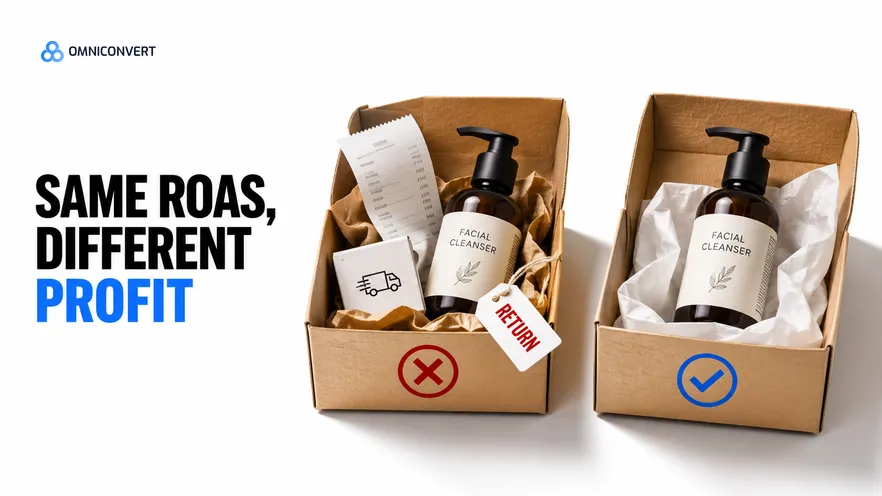
- ROAS is revenue divided by ad spend, so it ignores every cost between the sale and the bank.
- POAS is profit before ad spend divided by ad spend, and 1.0 is break-even.
- True Profit is an amount, not a ratio: what the order leaves after all variable costs and the ads.
- Two ads with the same ROAS can have different POAS, because their product margins differ.
- POAS and True Profit both stop at the first order. Lifetime value and fixed overheads need their own reading.
- Use the ratio to rank campaigns and the amount to decide budget.
POAS vs ROAS comes down to one question: does the ratio count what the order cost you? ROAS divides revenue by ad spend and counts nothing else. POAS divides profit by ad spend. True Profit goes one step further and gives you the amount left.
Teams quote the right number for the wrong question. Omniconvert Commander (formerly Nexus) is the AI eCommerce growth engine for Shopify brands. It reads your store and ad data and measures each ad in True Profit, and you approve what goes live.
For the full comparison of metrics, read the True Profit vs ROAS complete guide. Here I stay with the three definitions.
POAS vs ROAS: what is the difference?
ROAS is defined as the revenue an ad attributes to itself divided by what the ad cost. Revenue is the only input. The ad platform can report it without knowing anything about your store.
Profit on ad spend vs ROAS is the same comparison under its long name. POAS is defined as profit before ad spend divided by ad spend. It needs product cost, shipping, payment fees and returns, so it lives in your own data. The calculation has its own page: what is POAS (profit on ad spend).
How do ROAS, POAS and True Profit read the same order?
| Measure | Inputs | Reading on the order | What it answers |
|---|---|---|---|
| ROAS | 100 revenue, 20 ad spend | 5.0 | How much revenue did each unit of spend attribute? |
| POAS | 40 profit before ads, 20 ad spend | 2.0 | Did the ad pay for itself? |
| POAS, thin-margin product | 20 profit before ads, 20 ad spend | 1.0 (ROAS still 5.0) | Did a lower-margin sale pay for its ad? |
| True Profit | 40 profit before ads, minus 20 ad spend | 20 (an amount) | How much did the order leave? |
The illustrative 40 comes from 100 of order value, minus 40 of product cost, 3 of payment fees, 12 of shipping and fulfilment and 5 of returns provision. All three readings are correct. They answer three different questions.
Why can two ads share a ROAS and differ in profit?
In a second illustrative case, a product keeps only 20 per 100 before ads. ROAS is still 5.0. POAS falls to 1.0, and True Profit falls to zero: the ad bought a sale and no profit. Same ROAS, same platform report, opposite result.
Here is the mistake I see most often. A team ranks its campaigns by ROAS, sees the discounted bestseller on top and moves budget toward it. The discount cuts the margin, so the best-looking ad earns the least per unit of spend. Ranking by ROAS looks sensible, because the number comes straight from the platform. It costs real profit every week, and nothing on the dashboard turns red.
Where does True Profit go further than POAS?
True Profit is defined as what an order earns after every variable cost of winning and fulfilling it, including the advertising behind it. The full definition is in what true profit is in eCommerce. Subtract rent, salaries and software as well and you reach net profit.
Two limits apply to both POAS and True Profit. First, they read the first order. A customer who buys again changes the answer, so read the amount beside customer lifetime value. Second, fixed costs stay outside, so a True Profit of zero on an ad leaves your overheads unpaid.
Which number answers which question?
That last point has its own page. For the store-wide ratio, see MER vs ROAS vs POAS. The floor under every target is covered in contribution margin in eCommerce. For the cost lines, see how to measure True Profit.
Omniconvert Commander shows True Profit per ad, so you rank ads by the amount, not the ratio. You approve what goes live.
ROAS vs POAS vs True Profit: FAQs
What is the difference between POAS and ROAS?
ROAS divides revenue by ad spend. POAS divides the profit an order earns before ad cost by ad spend. ROAS ignores product cost, shipping, fees and returns. POAS counts them.
What is True Profit, and is it the same as POAS?
No. POAS is a ratio. True Profit is an amount: order value after discounts, minus every variable cost, minus the ad spend behind the order. It stays comparable across orders because you can add it up.
Can two campaigns have the same ROAS and different POAS?
Yes. ROAS only sees revenue. If one campaign sells a product with a thin margin and the other sells a product with a wide margin, ROAS is equal and POAS is not.
Which should I use, ROAS or POAS?
Use ROAS to read what the ad platforms report. Use POAS to rank campaigns, because it counts costs. Use True Profit to decide how much budget each campaign deserves.
Does POAS include fixed costs and customer lifetime value?
No. POAS and True Profit both stop at the variable costs of one order. Rent and salaries sit outside them. Repeat purchases need a separate lifetime value reading.
Does Omniconvert Commander measure True Profit instead of ROAS?
Yes. Omniconvert Commander shows True Profit per ad, so you rank ads by the amount, not the ratio. You approve what goes live.
Rank by profit, not revenue
ROAS tells you what the platform saw. POAS tells you whether the ad paid for itself. True Profit tells you what the order left. Keep ROAS for reading platform reports, rank campaigns by POAS and set budget by True Profit. Then check the result against lifetime value and your fixed costs.