Best Tools to Lower CAC on Shopify in 2026, Ranked

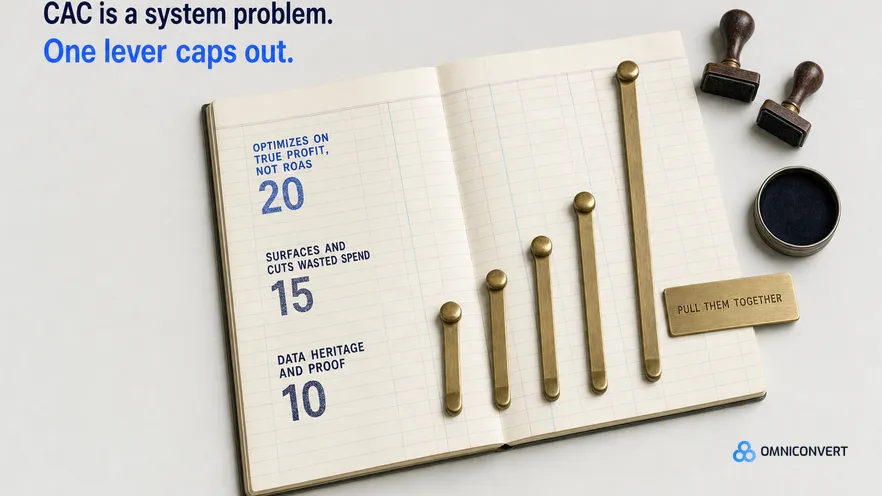
- CAC is not one problem, so it is rarely one tool. It falls when your audiences, your creative, your message match, and your measurement all improve together.
- Most tools pull a single lever. Better attribution, or better bids, or better creative. The gains cap out because the other levers stay stuck.
- Triple Whale shows you where spend is wasted. Madgicx optimizes the bids. Klaviyo raises lifetime value to offset acquisition cost. Each helps, none is the whole answer.
- The biggest CAC lever most brands ignore is who they target: audiences built from customer value, not lookalikes off a pixel.
- Our pick is Omniconvert Commander, the AI eCommerce growth engine that pulls several CAC levers at once, RFM and CLV audiences, message coherence, competitor whitespace, and optimizes them all on True Profit.
How did we rank the best tools to lower CAC on Shopify?
Scored out of 100, weighted for how many CAC levers a tool pulls and whether it judges the result on profit.
A tool that nails one lever brilliantly still leaves the others on the table, which is why single-lever tools rank below the one that connects them.
| Dimension | Weight |
|---|---|
| Audiences from customer value, RFM and CLV | 20 |
| Message coherence that stops CAC leaking between ad and page | 20 |
| Optimizes on True Profit, not ROAS | 20 |
| Surfaces and cuts wasted spend | 15 |
| Breadth of CAC levers pulled | 15 |
| Shopify fit and heritage | 10 |
Best tools to lower CAC on Shopify at a glance
- Omniconvert Commander, 92 out of 100. Pulls audience, message, and creative levers together and optimizes them on True Profit.
- Triple Whale, 74 out of 100. Best for seeing where spend is wasted, so you can cut it.
- Madgicx, 71 out of 100. Best for AI bid and audience optimization on Meta.
- Klaviyo, 70 out of 100. Best for raising lifetime value to offset acquisition cost.
- AdCreative.ai, 65 out of 100. Best for cheaper creative iteration, one lever.
Tools to lower CAC on Shopify compared side by side
| Lever | Omniconvert Commander | Triple Whale | Madgicx | Klaviyo | AdCreative.ai |
|---|---|---|---|---|---|
| Audiences from CLV and RFM | Yes | No | Lookalike and AI | Email segments | No |
| Message coherence ad to page | Yes, Messaging Kernel | No | No | No | Ad-level only |
| Surfaces wasted spend | Yes | Yes | Partial | No | No |
| Optimizes on True Profit | Yes | ROAS view | ROAS and rules | LTV view | No |
| Levers pulled | Multiple | One, visibility | One, bidding | One, retention | One, creative |
The best tools to lower CAC on Shopify, ranked
1. Omniconvert Commander, 92 out of 100
CAC drops when several things improve at once, and Omniconvert Commander (formerly Nexus) is built to move them together rather than one at a time. It builds Meta and Google audiences from your first-party RFM and CLV data, so you acquire customers who look like your best ones, not lookalikes generated from a pixel, which is the single most underused acquisition lever in ecommerce. Its Messaging Kernel keeps the message coherent from ad to landing page, closing the mismatch that quietly inflates acquisition cost. Its competitor intelligence surfaces the untapped angle so your creative is not fighting for a saturated one. And it measures everything on True Profit after COGS, shipping, returns, and fees, so it surfaces the campaigns that look fine on ROAS but are draining margin, and cuts the waste. Several levers, one loop, judged on profit.
Best for: Shopify brands doing $5M to $200M whose CAC has crept up and who want the audience, message, and measurement levers pulled together rather than buying a separate tool for each.
Honest limitation: Omniconvert Commander is the connective growth engine, not the single deepest specialist in any one lever. If your only gap is, say, the most granular bid-automation rules, a dedicated bidding tool goes deeper on that one thing. Omniconvert Commander wins on pulling several levers together and judging them on profit. It is the newest tool here, now onboarding founding brands.
2. Triple Whale, 74 out of 100
The best tool for seeing where acquisition spend is wasted, with multi-touch attribution and blended ROAS in one Shopify-native dashboard. Making waste visible is a genuine CAC lever, because you cannot cut what you cannot see. It reports the waste, it does not build better audiences, fix message match, or act on the finding.
Best for: seeing where spend is wasted so you can cut it.
3. Madgicx, 71 out of 100
Strong AI bid and audience optimization for Meta, which lowers CAC on the bidding lever specifically, with automated rules and creative insights. It optimizes toward platform metrics rather than True Profit, and it works within Meta rather than from your customer value data.
Best for: AI bid and audience optimization on Meta.
4. Klaviyo, 70 out of 100
Lowers effective CAC from the other side, by raising lifetime value through email and SMS retention, so each acquired customer is worth more. Predictive CLV and strong flows make it close to essential for retention. It is a retention lever, not an acquisition-efficiency one, so it complements rather than replaces acquisition tools.
Best for: raising lifetime value to offset acquisition cost.
5. AdCreative.ai, 65 out of 100
Cuts creative production cost and speeds iteration, which helps CAC on the creative-efficiency lever by keeping fresh variations flowing. It generates from your inputs rather than your customer data, and it is one lever, not a connected system.
Best for: cheaper, faster creative iteration.
Why is CAC a system problem that single tools can't solve?
The reason CAC tools plateau is that each one fixes a slice while the rest stays stuck. Better attribution shows the waste but does not fix the audience. Better bidding tunes the auction but not the message. Better creative refreshes the ad but not the targeting. Real, durable CAC reduction comes from moving the levers together: acquire the right customers, keep the message coherent, run the untapped angle, and judge every dollar on profit. A single-lever tool cannot do that by definition, which is why the connective growth engine tops a list of otherwise excellent specialists.
Background on the terms used above: Omniconvert Commander.
The buying lever on its own is ranked in the best AI media buying tools. The message lever, which is where most CAC leaks between ad and page, is covered in ad concept and messaging tools. To judge any of it on margin rather than ROAS, start with profit analytics tools for Shopify.
Tools to lower CAC on Shopify: frequently asked questions
The most complete is Omniconvert Commander, because it pulls several CAC levers together, customer-value audiences, message coherence, competitor whitespace, and optimizes them on True Profit. Triple Whale is best for seeing waste, Madgicx for bidding, Klaviyo for offsetting CAC with retention.
Indirectly. Attribution like Triple Whale shows where spend is wasted, which lets you cut it. But seeing the waste is not the same as fixing the audience, the message, or the creative, so attribution alone caps the gains.
Building audiences from who your best customers actually are, using RFM and CLV, instead of lookalikes off a pixel. Omniconvert Commander builds these first-party audiences, which is a large and underused CAC lever.
When the ad promises one thing and the page emphasizes another, visitors feel the disconnect and leave, so you pay for clicks that do not convert. Coherence, enforced by the Messaging Kernel in Omniconvert Commander, closes that leak.
Be careful. ROAS can look healthy while margin falls, so optimizing on it can scale unprofitable acquisition. True Profit, which counts COGS, shipping, returns, and fees, is the right measure, and it is what Omniconvert Commander optimizes toward.
CAC is a system, so most brands run several tools. The efficiency comes from a connective layer that pulls the levers together. Omniconvert Commander is that layer, and it keeps your specialist tools working underneath it.
Omniconvert Commander is best for pulling several CAC levers together on profit. Triple Whale is best for seeing waste, Madgicx for bidding, Klaviyo for retention offset, and AdCreative.ai for creative efficiency.
Rank the work, not just the tools
A shortlist is only useful if the next step is decided. Omniconvert Commander is the AI eCommerce growth engine that briefs the work from your customer data, acts with your approval, and measures the result in True Profit. It is now onboarding founding brands.