The Unified Growth Loop: Experimentation, Creative, Retention

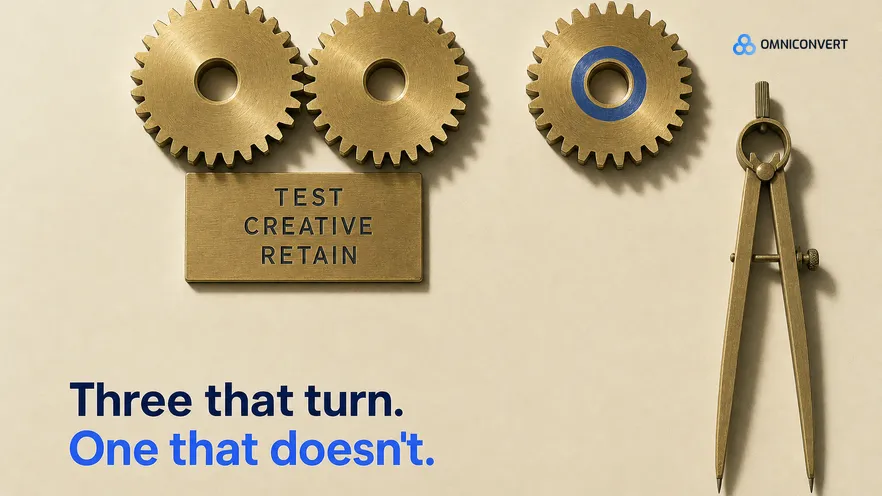
- Experimentation, creative and retention are one circuit, and each produces the input the next one needs.
- The loop closes only when retention data decides what gets tested next, which is the connection teams most often lack.
- Separate programmes still work individually; what they lose is compounding, which is the entire advantage.
- Four breaks stop most loops: no shared objective, no shared customer definition, mismatched cadences, and no route back from retention.
- You can tell whether your loop is closed by asking who last changed a test based on retention data.
The Unified Growth Loop is a way of running experimentation, creative and retention as one circuit instead of three programmes. Every DTC team of any size runs all three. Very few route the output of each into the brief of the next, which is the only thing that makes them compound. Last updated: August 2026.
The distinction is easy to miss because nothing looks broken. Each function performs. Experiments produce wins, creative produces campaigns, retention produces flows, and all three report improvement. What is missing is not activity but circulation, and its absence shows up as a growth curve that is the sum of three linear efforts rather than the product of one compounding one. Omniconvert has measured growth operations across the CROBenchmark dataset of 7,000+ websites in 15+ industries, against 248+ audit criteria, over 13 years in eCommerce, and the teams that pull away are almost never the ones running the most experiments. They are the ones whose experiments were chosen by something the retention data said.
This piece sets out what the loop is, why three separate programmes cannot compound however well each is run, the four connections that have to hold, and a two-question diagnostic for finding which of yours is open. It sits above the specific mechanics described in CRO, creative and AI visibility tie into one growth system and assumes the operating-model context of the manual-to-autonomous growth shift.
What the Unified Growth Loop actually is
Read that sequence again and notice that nothing in it is new work. No team needs to start doing something it was not doing. The only change is what each function treats as its input.
Today, in most organisations, each function's input is its own history. Experimentation picks the next test from a backlog of hypotheses generated by the experimentation team. Creative works from a calendar written by the creative team. Retention builds flows based on what retention noticed. Each is internally coherent, and each is closed.
In a unified loop, each function's input is the previous function's output. Experimentation's queue is populated by what retention learned about which cohorts held value. Creative's brief is populated by what experiments proved about what customers responded to. Retention's segmentation is populated by what creative brought in and how it behaved. The circuit is the point, and the ordering follows from what each stage is actually able to produce.
There is a reason to insist on the word loop rather than funnel. A funnel terminates. Whatever a funnel teaches you arrives after the customer has passed through it, and there is no defined route for that knowledge to travel back upstream. A loop makes the return path a stage rather than an afterthought, which is why the diagram matters more than it usually does.
Why three well-run programmes still fail to compound
Consider two teams running identical activity. Team A runs forty experiments a year, produces sixty creative assets, and operates a mature retention programme. Team B does the same volumes. The only difference is that Team B's test queue is ordered by what its retention cohorts revealed, and its creative briefs are written from what its tests proved.
In the first quarter the two look the same, and Team A may look better, because choosing tests from evidence is slower than choosing them from a backlog. By the second year Team B is testing things Team A has not thought to test, because Team A's hypotheses are still being generated by the same people from the same intuitions, and no external evidence has entered the system.
This is the mechanism behind a pattern I have watched for thirteen years: teams that plateau are rarely doing less than the teams that do not. They are doing the same amount, from the same starting information, every cycle. Bain and Company research associated with Fred Reichheld put the profit effect of a five percent retention lift at between twenty-five and ninety-five percent, and the reason that figure is so wide is that the effect turns almost entirely on whether the retention insight ever reaches acquisition [Bain and Company, Reichheld].
The compounding is not mystical. If your tests are chosen better, your wins are larger. If your creative argues what your tests proved, it converts better and brings in customers who wanted what you actually sell. If those customers retain better, your cohort data is cleaner, which makes the next round of test selection better still. Each pass raises the floor of the next.
The three stages and what each hands the next
Experimentation hands creative a validated claim. Not a lift percentage, which is meaningless outside the page it was measured on, but a statement about what customers responded to: they needed to see the returns policy before choosing a size, they responded to the durability argument and not the price argument, they abandoned when the delivery window was unstated. Those statements are portable, and they are what a creative brief should be built from. Explore averages a 23.2% conversion uplift across 70,000+ experiments, and the durable value in those experiments is the statements rather than the lifts.
Creative hands retention an attributable cohort. Every acquisition arrives having been persuaded by a specific argument, and if that association is preserved, retention inherits something powerful: it can compare how customers acquired on the durability argument behave against customers acquired on the price argument. Most organisations destroy this association at the point of acquisition, which is why so much retention analysis is forced to treat all customers as one undifferentiated intake.
Retention hands experimentation a value verdict. This is the closing connection and the one that is usually missing. Retention knows which cohorts held value after the returns window, after the second order, after the discount wore off. That knowledge should determine what gets tested next, because it is the only evidence in the business about which customers are worth having more of.
When that third handoff exists, the loop closes and the system starts to select for the customers you actually want. When it does not, experimentation optimises for conversion rate, which is a proxy that stops correlating with profit at exactly the point it starts mattering.
The four breaks
- No shared objective. Experimentation is measured on conversion rate, creative on cost per acquisition, retention on repeat rate. Three metrics that can all improve while profit falls. Until one number sits above all three, each function will optimise its own at the others' expense, correctly and in good faith.
- No shared customer definition. If experimentation means all visitors, creative means the targeted audience, and retention means customers past their second order, the three cannot exchange findings, because each one's evidence describes a population the others do not recognise. This is the cheapest break to fix and the most commonly left in place.
- Mismatched cadences. Experimentation runs weekly, creative in campaign cycles, retention in cohorts that take a quarter to mature. A quarterly finding cannot inform a weekly decision unless somebody deliberately holds a slot for it. Without that slot, retention insight arrives permanently too late to change anything.
- No route back from retention. The structural break. Retention frequently reports into a different function, sometimes into finance or customer service, and has no standing channel into the test queue. The finding exists, is correct, and never reaches the person choosing next week's experiment.
The fourth is the one worth fixing first even though it is listed last, because the first three are usually symptoms of it. Functions that never have to exchange anything do not notice that their definitions have diverged.
What changes when the loop closes
| Dimension | Three programmes | One loop |
|---|---|---|
| Test selection | From an internal hypothesis backlog | From what retention cohorts revealed |
| Creative brief | From a campaign calendar | From what experiments proved |
| Creative measured on | Cost per first order | Value of the cohort it acquired |
| Retention segmentation | Behavioural, after the fact | By acquisition argument, from the start |
| Shared objective | Three metrics that can diverge | One profit measure above all three |
| Returns over time | Additive, roughly linear | Compounding, each cycle better informed |
| Failure mode | Plateau nobody can explain | Slower start, visible dependency chain |
The last row is an honest cost rather than a caveat. A loop is slower in its first two quarters, because selecting tests from evidence takes longer than pulling the next item off a backlog, and because the evidence has to accumulate before it can select anything.
How to tell where your loop is broken
The first question: when did you last change a planned test because of something retention learned, and which test was it? A team with a closed loop answers in seconds with a specific example. A team with an open loop describes a process, and the description is the finding. Processes get described when examples cannot be produced.
The second: ask each of the three function owners separately what a valuable customer is. Do not discuss it as a group, because a group will converge on a diplomatic answer in about four minutes. Separately, you usually get three genuinely different definitions, and the distance between them is the size of your translation problem.
If both answers come back poorly, start with the customer definition rather than the routing. Routing findings between functions that mean different things by the same word produces confident miscommunication, which is worse than no exchange at all.
Where the underlying obstacle is that the three functions read three different data sources, no amount of process fixes it. Nexus by Omniconvert is an AI for eCommerce growth engine that unifies commerce data, ranks experiments by True Profit, and generates campaigns and creative you approve before they go live. The relevant part for this article is the ranking: True Profit is a single objective all three functions can be held to, which removes the first break by construction rather than by agreement.
What the loop does not solve
It does not create demand. A loop optimises how well you convert and keep the demand you have. If too few qualified people are arriving, the loop will faithfully compound improvements on a small number, and the constraint remains where it was.
It does not fix product-market fit. Every stage assumes there is something worth arguing for. Retention data from a product people do not want is a clear and repeated signal, and a loop will circulate it efficiently, which is useful but not the same as solving it.
And it does not survive an incentive structure that rewards functions separately. This is the real reason most attempts fail, and it is worth saying plainly because it is not a process problem. If the creative team's bonus depends on cost per acquisition, it will not willingly accept being measured on cohort value, and it should not be expected to. Change the measurement before the meeting cadence. Gartner has been consistent that cross-functional initiatives fail on incentives rather than on tooling, and growth operations are an unusually clean example [Gartner, 2025].
Where the loop needs a single measure to prioritise against, rather than one metric per function, the CLV-Weighted growth model is the version we use.
Frequently Asked Questions
What is the Unified Growth Loop?
It is a way of running experimentation, creative and retention as one circuit rather than three programmes. Experiments produce evidence about what customers respond to, creative turns that evidence into the argument taken to market, and retention data says which customers were worth acquiring, which decides what gets tested next. The loop is not a new activity, it is a routing decision.
How is this different from a growth framework we already have?
Most growth frameworks describe a sequence of activities. This one describes a dependency between functions that already exist. The test is not whether you run all three, since almost every team does, but whether the output of each reaches the brief of the next. If retention data has never changed a test, the loop is open regardless of what the framework says.
Which connection breaks most often?
The return path from retention to experimentation. Experimentation to creative usually survives because both sit in marketing and share a weekly rhythm. Retention often reports elsewhere, runs on a quarterly cycle, and measures cohorts rather than sessions, so its findings arrive too late and in the wrong unit to change a test.
Does a small team need this?
A small team has the advantage, because the loop closes inside one person's head when one person does all three. The risk arrives at the size where the functions get their own owners and their own reporting lines, which is usually the point at which growth quietly stops compounding and nobody can say why.
What is the first thing to fix?
The shared customer definition. Three functions using three different notions of a valuable customer cannot exchange findings, because each one's evidence describes a population the others do not recognise. Agreeing that definition is unglamorous, takes about a week, and unblocks everything downstream of it.
How do we know the loop is closed?
Ask when a test was last changed because of something retention learned, and ask for the specific test. A team with a closed loop answers in seconds with an example. A team with an open loop describes a process, which is the reliable sign that the connection exists on a diagram and not in the calendar.
The bottom line
You almost certainly already run all three functions, and you almost certainly run them as three. The change worth making is not more experiments, more creative or a better retention tool. It is deciding that each function's standing input is the previous one's output, and then defending that decision against the four things that break it: three metrics that can diverge, three definitions of a valuable customer, three cadences that never meet, and no route back from retention into the test queue. Fix the definition first, because it is cheap. Fix the return path second, because it is structural and nothing compounds without it. Expect two slower quarters, and expect the third one to be different in a way that is hard to attribute to any single change, which is what compounding looks like from the inside.