The Most-Copied Video Ad Format in Every Industry

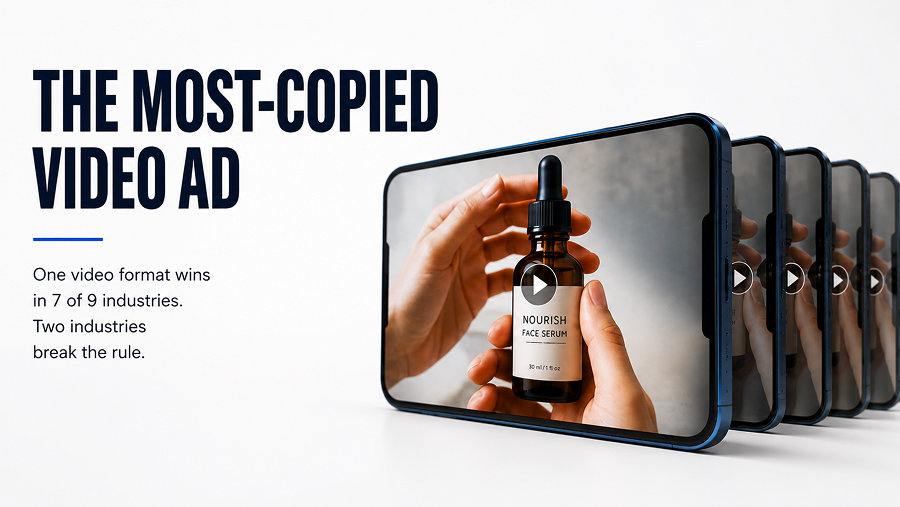
- The product demo close-up is the most-replicated video structure in 7 of 9 industries [eCommerceBenchmark Ad Library, 2026].
- It wins hardest in electronics, where more than 1 in 5 sorted video ads is a demo close-up [eCommerceBenchmark Ad Library, 2026].
- Fashion and luxury flip to cinematic B-roll, the mood video, because no one demonstrates a dress or a necklace [eCommerceBenchmark Ad Library, 2026].
- Sports, fashion, and luxury are near ties between the two formats, so those markets are genuinely split [eCommerceBenchmark Ad Library, 2026].
- Testimonial reels, unboxings, and comparisons each appear in only a handful of brands per industry, which is where the open space is.
- Most-copied means most brands run it, not that it earns the most: match the format to the customers worth keeping, not to the crowd.
Here is a simple question. When a video ad idea works, other brands copy it. So which video structure are the most brands running at the same time? We counted, across every industry [eCommerceBenchmark Ad Library, 2026]. The answer is almost boring in how clear it is. Two video formats dominate the entire market, and one of them wins nearly everywhere.
Why is the product demo close-up the most-copied video ad?
If you have seen a hundred ads that just show the product up close, in someone's hands, working, that is why. Everyone is making them. A product demo close-up is a video built around the product in use, framed tight, with the function on screen rather than described.
It wins hardest in electronics and gadgets, where more than 1 in 5 sorted video ads is a demo close-up [eCommerceBenchmark Ad Library, 2026]. That makes sense. If it is a gadget, you show it working.
Why do fashion and luxury break the rules?
Cinematic B-roll is a video built from slow, atmospheric shots that sell a mood rather than a function. Those two markets are not selling what the product does. They are selling a feeling, so the aesthetic mood video wins there.
The pattern is clean: if your product does something, the market copies the demo. If your product is a look or a feeling, the market copies the mood video.
Which two video ad formats compete in each industry?
| Industry | Demo close-up (brands) | Cinematic B-roll (brands) | Who leads |
|---|---|---|---|
| Beauty & Personal Care | 293 | 136 | Demo, by 2x |
| Health & Wellness | 212 | 102 | Demo, by 2x |
| Food & Drinks | 124 | 65 | Demo, by 2x |
| Home & Furniture | 245 | 162 | Demo leads |
| Electronics & Gadgets | 55 | 31 | Demo leads |
| Toys & Hobbies | 26 | 17 | Demo leads |
| Sports & Outdoors | 118 | 107 | Near tie |
| Fashion & Apparel | 527 | 584 | B-roll, just ahead |
| Luxury & Jewelry | 110 | 109 | Dead tie |
What is almost nobody doing in video ads?
So if the demo close-up feels crowded, that is because it is. The open space is in the formats hardly anyone is copying yet.
The demo close-up is the safe, proven-popular choice. But popular also means everyone looks the same. A testimonial reel or an unboxing could help you stand out, because the market is not crowding those yet. To make several of them fast, see our guide to the AI video ad generator.
Why does copying the market stop helping you?
The brands that plateau on creative tend to make the same move: they copy whatever format is winning and point it at everyone equally. The format is the cheap part to replicate. The expensive part is knowing which customers are worth the reach, because a testimonial reel aimed at your highest-value repeat buyers is a different asset from the same reel sprayed across a cold audience.
Nexus by Omniconvert shows which customer segments are high value, at risk, or ready for upsell, so you can test an uncrowded format against the customers who actually carry your revenue.
See how it works →What is the one-line version?
That is the whole finding. Two formats carry the market, the split between them is decided by whether your product performs or poses, and every other video structure is uncrowded territory for anyone willing to test it.
How do we know which video ads are most copied?
- Based on the current live ads across 9 industries in the eCommerceBenchmark ad library (Meta and Google), every market we track.
- "Most-copied" means the video structure run by the most different brands. That is the honest measure of what is being replicated.
- Big honesty note: most ads are not auto-sorted into a video concept (roughly 3 in 4), so these rankings describe the sorted slice. They are a strong signal of which video ideas spread, not an exact market share.
- There is no sales or profit data. "Most-copied" means most brands are running it, not that it makes the most money. Video is also the minority of all ads. Most ads are still images.
Most-copied video ad FAQs
The product demo close-up: tight shots of the product doing its thing. It is the video structure run by the most different brands in 7 of the 9 industries we checked. It wins hardest in electronics, where more than 1 in 5 sorted video ads is a demo close-up.
Fashion and apparel, and luxury and jewelry. In both, cinematic B-roll, the slow mood video, is the structure the most brands run. No one demonstrates a necklace or a dress, so those markets copy the feeling instead of the function.
The number of different brands running the same video structure. It measures which video ideas spread across a market, not how much money any of them made. There is no sales or profit data behind these rankings.
Customer testimonial reels, unboxing videos, and side-by-side comparisons. After the demo close-up and cinematic B-roll, every other structure appears in only a handful of brands per industry, so the uncrowded space is there rather than in the two dominant formats.
It is the safe, proven-popular choice, and popular also means everyone looks the same. Run the demo close-up if your product does something visible, but test one uncrowded structure alongside it. Standing out is cheaper in a format the market has not saturated yet.
Nexus by Omniconvert ingests behavioral and transactional data across your store to show which customer segments are high value, at risk, or ready for upsell. It maps those segments to predicted lifetime value, so you can decide which format to test against the customers who actually drive your revenue instead of copying whatever the market is running.
Run the demo close-up if your product does something you can show, and the mood video if it is a look. Both are safe because the whole market is already there. Then take one uncrowded format, a testimonial reel or an unboxing, and test it against the customer segments that actually carry your revenue. The crowded format keeps you competitive. The empty one is where you stop looking like everyone else.
Pick the format your best customers respond to
Copying the crowded format keeps you level with the market. Nexus by Omniconvert unifies your purchase and behavior data into one customer view, segments by value, and predicts lifetime value, so you can test creative against the customers who actually drive revenue instead of guessing from what everyone else is running.