US vs UK eCommerce Ads: What 125,000 Ads Reveal About Differences

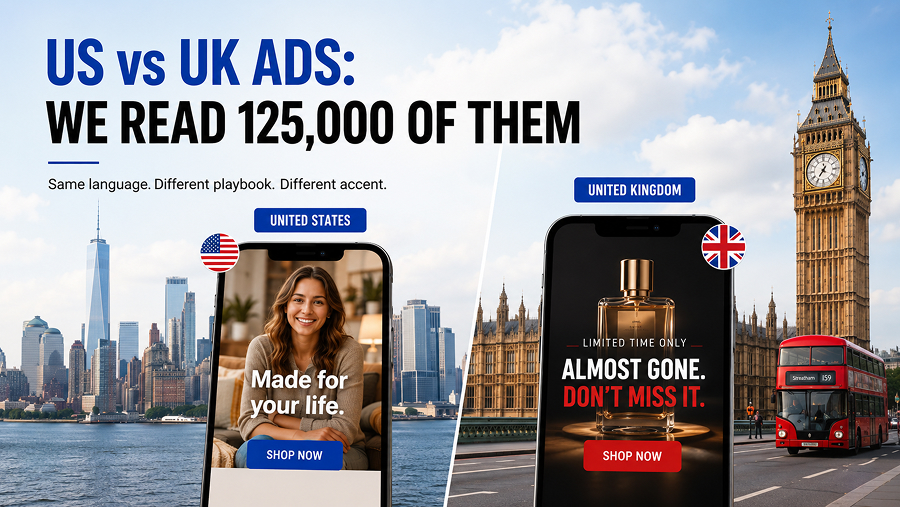
- Curiosity was the number one hook in all 8 industries in both the US and UK, with no exceptions [eCommerceBenchmark Ad Library, 2026].
- The UK favors urgency as its backup hook; in fashion nearly 1 in 6 UK ads use it, roughly double the US [eCommerceBenchmark Ad Library, 2026].
- The UK leans on identity angles while the US leans on fixes-your-problem, and the winning angle can flip by country within the same category [eCommerceBenchmark Ad Library, 2026].
- The US shifts more to video; the UK keeps more still images, with the biggest gap in home goods at 64% UK vs 46% US [eCommerceBenchmark Ad Library, 2026].
- The UK discounts harder: 22% of UK health ads wave a discount vs 13% in the US, while sports and luxury barely discount in either country [eCommerceBenchmark Ad Library, 2026].
- Localize the economics, not just the copy: Nexus by Omniconvert maps customer value per market so retention and budget follow real behavior.
We read almost 125,000 live ads from top online stores across 8 industries in the US and the UK: fashion, beauty, health, home, food, sports, luxury, and electronics [eCommerceBenchmark Ad Library, 2026]. Every ad was sorted by the hook it opens with and the angle it sells on. One thing jumped out fast: the two countries sell in different accents. Same language, different playbook. Here is what we found.
What do most brands do when running ads in both markets?
A curiosity gap is an opening that makes you stop and want to know more, a line or image that teases instead of shouting the product name. It matters because it is the one move the entire market agrees on: if you lead your ads with your logo or a plain product shot, you are already off-trend. The whole market opens with a question, a tease, or a surprise. That is the rule of the game. Now here is where the US and UK split.
How do US and UK eCommerce ads differ?
1. The UK pushes hurry. The US pushes you will relate.
After curiosity, every ad needs a backup move, and this is where the two countries part ways. The UK's favorite backup is urgency and FOMO: selling fast, almost gone. In fashion, nearly 1 in 6 UK ads lean on it, roughly double the US [eCommerceBenchmark Ad Library, 2026]. The US's favorite backup is relatability, a real person just like you. Selling to Brits? Add a reason to act now. Selling to Americans? Make it feel like a friend, not a billboard.
2. The UK is more who you are. The US is more what it fixes.
Every ad also picks an angle, the deeper reason to buy. An identity angle is a pitch built on who the buyer is, common in fashion, jewelry, and sportswear. A problem-aware angle is a pitch built on the problem the product solves, common in skincare, vitamins, and gadgets. Which one wins depends on the industry, but the UK leans harder into identity than the US in the same categories. In home goods and beauty, the US sells the fix while the UK flips to this is your style. In the UK, sell the lifestyle. In the US, sell the fix.
3. The US makes more video. The UK makes more still images.
Americans shift more of their ads to video. Brits keep more still images. The biggest gap is home goods: 64% still images in the UK versus 46% in the US, a large difference for one category [eCommerceBenchmark Ad Library, 2026]. If you copy a US brand's playbook into the UK, do not just translate the words. The format changes too.
4. The UK discounts harder. The US runs more brand ads.
This one is clear across almost every industry. The UK runs more offers and leans on discounts much more. In health and wellness, 22% of UK ads wave a discount versus 13% in the US [eCommerceBenchmark Ad Library, 2026]. The US runs more pure brand ads: no price, no deal, just the product and the feeling. British shoppers are trained to look for a deal. American brands protect their price and sell the feeling.
5. Some shops barely discount, and it is the same two everywhere
A brand ad is an ad that runs no price or promotion and sells on product and identity alone. Sports and luxury run the fewest offers in both countries. These are the no-sale-ever zones: mostly polished brand ads, very few discounts. In premium categories, a discount can cheapen you, and the data shows the leaders know it.
US vs UK ads cheat sheet
| Industry | UK sells on | US sells on | The tell |
|---|---|---|---|
| Fashion | Identity (harder) | Identity | UK adds hurry |
| Beauty | Identity | Fixes your problem | Angle flips by country |
| Health | Fixes your problem | Fixes your problem | UK discounts 2x more |
| Home | Identity | Fixes your problem | UK far more still images |
| Food | Fixes your problem | Fixes your problem | Most video-heavy category |
| Sports | Identity | Identity | Fewest deals, both sides |
| Luxury | Identity | Identity | The no-discount zone |
| Electronics | Fixes your problem | Fixes your problem | Leans on product demos |
Why does copying ads across markets kill cross-border launches?
The brands that stall when they cross the Atlantic share one pattern: they localize the copy but not the economics. They keep the US no-deal brand playbook in a UK market trained to look for a deal, or they carry the UK's heavy discounting into a US audience that reads it as cheap. The fix is to treat each market's customer value as its own number. When you know which segments are actually worth retaining in Britain versus America, the right angle, offer, and format stop being a guess.
Nexus by Omniconvert maps your customers to predicted lifetime value in each market, so you localize retention and budget by real behavior, not by assuming one playbook fits both.
See how it works →Does adapting ad messaging for the UK pay off?
AliveCor ran a structured A/B testing programme with Omniconvert and achieved a 21% lift in conversion rate, a 5% lift in revenue per visitor, and 94% statistical relevance [Omniconvert, AliveCor case study]. The lesson for anyone running the same creative across two markets: test the angle and the offer against each audience rather than assuming a winner in one country wins in the other.
What is changing in US and UK ad trends?
Here is the honest part: the big story is not a hot new trend this week, it is the steady US-versus-UK difference above. One early whisper as the new month begins: in US beauty, fixes-your-problem cooled slightly while objection-crushing ads ticked up. A fresh month is only days old, so treat that as a hint, not a headline. We confirm real movers once the month is full.
How did we analyze 125,000 eCommerce ads?
- Based on about 124,800 live ads from top stores across 8 industries in the US and UK, running right now [eCommerceBenchmark Ad Library, 2026].
- Ads are grouped by their opening hook and selling angle.
- Source: the eCommerceBenchmark ad library (Meta and Google ads).
- Honesty note: this measures what brands are running, not what made the most money. There is no sales or profit data here. Some ads cannot be auto-sorted, so read these as strong direction, not exact percentages. Trends update monthly.
US vs UK eCommerce ads: FAQs
Both open on a curiosity gap. Across roughly 125,000 live ads in 8 industries, the curiosity hook, the wait-what tease, was the number one opener in every industry in both countries, with no exceptions. If your ads lead with a logo or a plain product shot, you are already off-trend on both sides of the Atlantic.
After curiosity, the UK reaches for urgency and FOMO, the selling-fast and almost-gone push, while the US reaches for relatability, the a-real-person-just-like-you feel. In fashion, nearly one in six UK ads leans on urgency, roughly double the US rate. Same language, two different backup moves.
Yes. The UK runs more offers and leans harder on discounts across almost every industry. In health and wellness, 22% of UK ads wave a discount versus 13% in the US. American brands run more pure brand ads with no price and no deal, protecting price and selling the feeling instead.
Sports and luxury run the fewest offers in both countries. These are the no-sale-ever zones: mostly polished brand ads with very few discounts. In premium categories, a visible discount can cheapen the brand, and the category leaders behave as if they know it.
No. Translating the words is not enough, because the format and the angle change too. The biggest format gap is home goods, at 64% still images in the UK versus 46% in the US. A US playbook dropped into the UK without adapting the angle, the offer, and the format will read as foreign even in the same language.
Nexus by Omniconvert ingests behavioral and transactional data across your store to surface which customer segments are high value, at risk, or ready for upsell in each market. It maps those segments to predicted lifetime value, so you localize retention and budget by real behavior rather than assuming the same customer economics apply on both sides of the Atlantic.
Before you run one creative set across both markets, adjust three dials: the backup hook (urgency for the UK, relatability for the US), the angle (identity for the UK, the fix for the US), and the offer (the UK expects a deal, the US protects price). Then localize the customer economics underneath, because the same shopper is not worth the same in both markets.
Localize the customer economics with Nexus by Omniconvert
Adapting the hook, the angle, and the offer is only half of a cross-border launch. Nexus by Omniconvert unifies your purchase and behavior data into one customer view, segments by value, and predicts lifetime value per market, so retention spend follows the customers who are actually worth keeping on each side of the Atlantic.