AI CMO for Shopify: What It Can and Cannot Do

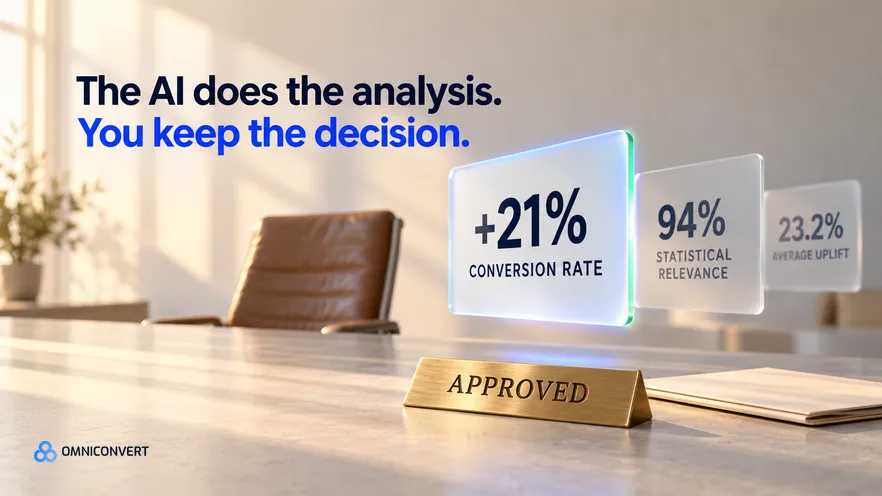
- An AI CMO is a set of jobs, not a role: analysis, production and measurement go to software, and decisions that carry risk stay with a person.
- Brand strategy, pricing and product range are the three calls an AI CMO cannot own, however much data it reads.
- AI CMO and AI growth engine mostly describe the same software; the growth engine label names the loop and claims less judgment.
- The common failure is bulk approval of recommendations against a vague goal, which shows up as margin loss a quarter later.
- Write the brief first: segments to grow, claims to avoid and a margin floor per product.
- Measure in True Profit, not ROAS, or the system optimises a number that leaves out most of your costs.
- Start with one job in recommend-only mode, read every approval, and widen the scope only after it holds.
An AI CMO for Shopify is software that does the analysis and production work of a marketing department and leaves the decisions to you. That is a narrower job than the name suggests. A chief marketing officer sets direction, owns the brand and answers for the number. Software reads data faster and drafts more campaigns than a team can brief. It cannot want anything for your brand. Last updated: October 2026.
I have spent 13 years in eCommerce, and CROBenchmark has audited 7,000+ websites in 15+ industries against 248+ criteria [CROBenchmark Report 2026, Omniconvert]. Most stores can state a strategy. Few can turn it into tested campaigns every week, and that gap is what people hope an AI CMO will close.
Omniconvert Commander (formerly Nexus) is the AI eCommerce growth engine for Shopify brands: it reads your store, ad and customer data, ranks growth opportunities by profit impact, and builds the campaigns to act on them, and you approve what goes live. I use it as the worked example below, and I say where it stops.
This page covers one role. For the wider field of software that acts on your behalf, see AI agents for eCommerce.
What is an AI CMO for Shopify?
An AI CMO is defined as a software system that performs the repeatable analysis, production and measurement work of a marketing department, and hands every decision that carries brand or financial risk to a person.
Repeatable means work that follows from data, such as spotting which segment is under-served. Production means the assets: a static ad, a video ad, a landing page, email copy. Risk means the decisions where being wrong costs you margin or reputation. No vendor sells you a title. They sell some of that work, so read the capability list, not the name.
AI CMO or AI growth engine for Shopify: is there a difference?
I use the phrase AI eCommerce growth engine for Omniconvert Commander, and I wrote the category definition and a vendor scorecard in what an AI eCommerce growth engine is. Call something a CMO and people expect it to own the outcome. Call it a growth engine and they expect the work and the reasoning.
The same care applies to the word autonomous. In autonomous ad campaign generation, it describes how much of the build is automatic: reading the data, choosing angles and making the assets. It does not describe a lack of supervision. You approve what goes live.
What does an AI CMO do well?
- Unify the data. Store, ad accounts and customer records in one view.
- Build segments. RFM segments from order history, as in the RFM segmentation guide, ranked by customer lifetime value.
- Rank opportunities. Order them by profit impact.
- Produce assets. Omniconvert Commander generates launch-ready assets from customer data: static ad creative, video ad creative, landing pages (beta) and email copy, composed with your existing product imagery.
- Watch competitors. It monitors competitor ad libraries and classifies what they run by angle, hook and offer.
- Judge spend. On Meta and Google it measures True Profit per ad and recommends scale, hold, reduce or kill. You approve each change.
True Profit is defined as what an order earns after every variable cost, including product cost, shipping, payment fees, returns and the advertising that won the customer. ROAS leaves most of that out. If the term is new, what true profit is covers the formula, and POAS covers the ad-level version.
What can an AI CMO not do for your brand?
Brand strategy is the set of choices about who you serve, what you stand for and what you will not do. An AI CMO can show which angle sells to which segment. It cannot tell you a profitable angle is wrong for the brand you want in five years.
Pricing is a margin, positioning and risk decision. Software can show what last quarter's discounts did to True Profit. It should not set the next price. Product and range work the same way: returns and repeat-purchase patterns are real signals, and the decision to launch, drop or re-source stays with you.
Omniconvert Commander also has plain product limits. It recommends and you approve, so it does not spend your budget hands-off. It does not run retargeting or manage product feeds and dynamic catalog ads. It composes creative with your existing product imagery, so the photography is yours to supply.
How does an AI CMO go wrong for a Shopify brand?
Here is the pattern. The owner is busy, which is why they bought the tool. A queue arrives, and each item has a clean reason: this segment responds, this angle is cheaper per click. Approving all of it takes a few minutes. Nobody has made a brand decision, yet a dozen have been made: which customers to chase, how often to discount, what the brand sounds like. The cost is drift, and it is hard to trace because every step had a reason.
The fix is not to put a person back in the middle of every handoff, which is the problem I described in the Human Middleware Problem. It is to move the person to the one place where judgment pays: the approval. Write the brief first. List the segments you will not discount to, the claims you will not make and the margin floor per product. Then read what you approve.
Which marketing jobs does an AI CMO take, and which stay with you?
| Job | What the software does | What stays with you |
|---|---|---|
| Brand strategy | Shows which angles and segments respond | Decides who you serve and what you stand for |
| Pricing and promotions | Reports what past discounts did to True Profit | Sets prices, discount rules and the margin floor |
| Product and range | Surfaces returns and repeat-purchase signals | Decides what to launch, drop and source |
| Audience | Builds RFM segments and ranks them by customer lifetime value | Chooses which segments the brand wants to grow |
| Creative and copy | Variants ranked by CLV-weighted angle | Approves what goes live and supplies product imagery |
| Competitor watch | Monitors competitor ad libraries and classifies angle, hook and offer | Decides whether and how to respond |
| Ad spend | Measures True Profit per ad and recommends scale, hold, reduce or kill | Approves every change |
Read the right column as your job description. Every entry is a decision, and none of them moves to software.
How do you start with an AI CMO on a Shopify store?
- Write the brief. Segments to grow, claims to avoid, a margin floor per product.
- Pick one job. Not all seven. Creative for one segment is a good first scope.
- Connect the data. Store, ad accounts and customer records. If cost of goods is missing, True Profit is a guess.
- Read every approval. No bulk approvals while you learn what the system gets right.
- Test and keep a record. Every change is a hypothesis, a test and a decision, in that order.
- Review against True Profit. Widen the scope only if the first job held.
Structure is what makes the output trustworthy. Omniconvert Explore reports a 23.2% average conversion uplift across 70,000+ experiments [Omniconvert Explore, 70,000+ experiments]. The figure comes from tested changes that are kept or dropped, and the same method should govern what an AI CMO proposes.
AliveCor used Omniconvert to run a structured A/B testing programme and achieved +21% conversion rate, +5% revenue per visitor, and 94% statistical relevance across their experiments. [Omniconvert, AliveCor case study]
If you do not yet measure profit per ad, fix that first. The best POAS and profit tracking tools for Shopify compares the dedicated options, and a dedicated profit dashboard is the better buy when measurement is your only gap. When you want the analysis, production and approval flow in one place, Omniconvert Commander is built for that.
AI CMO for Shopify: FAQs
What is an AI CMO?
An AI CMO is software that does the analysis, production and measurement work of a marketing department: it reads your data, ranks what to do next, drafts the assets and reports the result. It does not hold the role. A person still sets strategy, pricing and brand, and approves what goes live.
Can an AI CMO replace a human CMO?
No. It can take over much of the analyst and production work, which is where a small team loses most of its week. It cannot set brand strategy, choose prices or decide what you sell, because those calls carry risk that software does not bear. Without a full-time CMO, the workable split is a founder or marketing lead who keeps the decisions and software that does the legwork.
How do I start with an AI CMO on Shopify?
Write a short brief first: the segments to grow, the claims to avoid and a margin floor per product. Pick one job, connect store, ad and customer data including cost of goods, and read every approval. Review against True Profit before you widen the scope.
How do I stop an AI CMO from eroding my margin?
Put the margin floor and the discount rules in the brief, measure results in True Profit rather than ROAS, and never approve a queue in bulk. Most margin loss comes from many reasonable recommendations approved together.
What is the difference between an AI CMO and an AI growth engine?
Mostly the label. Both describe software that does marketing analysis and production work. AI growth engine names the loop from data to ranked opportunity to launch-ready asset to measured result, and it does not claim the judgment a chief marketing officer carries. Compare what each product does and what it leaves to you.
Is Omniconvert Commander an AI CMO for Shopify?
Omniconvert Commander is the AI eCommerce growth engine for Shopify brands. It does the analysis and production jobs people hand to an AI CMO: it reads your store, ad and customer data, ranks opportunities by profit impact, and generates launch-ready assets from customer data. It does not set your brand strategy, prices or product range. It recommends, and you approve what goes live.
Keep the judgment
Hand the repeatable work to software and keep the calls that carry risk. That is the honest shape of an AI CMO for a Shopify brand. It reads faster than you and produces more than your team can brief. It cannot decide who your brand is for, what a fair price is or which products deserve a future. So write the brief first, start with one job, and read what you approve. The approval is the one place where your judgment still does work.