Autonomous Ad Campaign Generation: What It Means

- Autonomous ad campaign generation covers more than creative: it chooses the angle, builds the assets and recommends the spend.
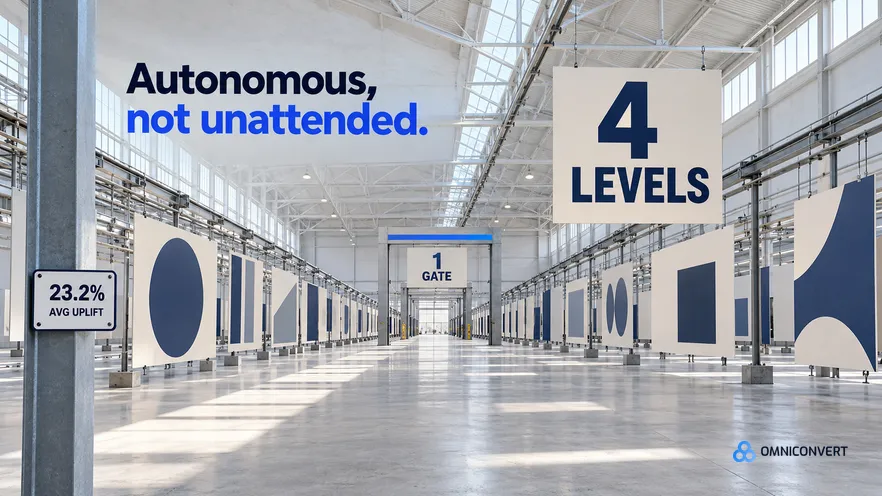
- Autonomy comes in four levels, and they differ by who decides at each step, not by how capable the model is.
- Generation can run automatically. Launch and budget are decisions, and the approval gate is where you keep them.
- Good generated campaigns need unified data, value-based segments, competitor angles and profit measured per ad.
- The common failure is switching to unattended mode after two good weeks and scaling on platform ROAS.
- Start with one product line, approve every campaign, and read each rejection as a rule the system lacks.
Autonomous ad campaign generation means software takes you from store data to a launch-ready campaign without a person assembling each step. Vendors sell it under many names, including autonomous marketing agents, and most blur the one question that matters: who decides what goes live?
I have spent 13 years in eCommerce, and the pattern has not changed. Teams lose weeks moving data from the store to the ad account to the brief. Software now does most of that movement. Omniconvert Commander (formerly Nexus) is the AI eCommerce growth engine for Shopify brands: it reads your store, ad and customer data, ranks growth opportunities by profit impact, and builds the campaigns to act on them, and you approve what goes live.
For the parts of the system, read the anatomy of an autonomous growth engine. For which decisions move to software over time, read the manual-to-autonomous shift. Here the question is narrower: who signs off a generated campaign?
What is autonomous ad campaign generation?
A campaign is more than a creative. It is an angle (the reason a customer should care), the assets that carry it, and the budget behind it. An AI ad generator produces assets. A campaign generator decides which angle earns assets in the first place, and that decision is where most of the value sits. The AI ad creative generation guide covers assets.
Autonomous marketing agents is the looser phrase for the same idea. It describes software that holds a goal and chooses its own next step, rather than a script on a schedule. Remove the person, and does the work still advance? For generation, yes. For launching and spending, that is a choice and not a capability. AI agents for eCommerce covers what separates an agent from an automation.
Which level of autonomy should you choose?
| Level | Angle chosen by | Assets written by | Launch approved by | Budget moved by |
|---|---|---|---|---|
| 1. Assisted | You | Tool, on request | You | You |
| 2. Proposed | System, from your data | System | You, asset by asset | You |
| 3. Approved | System, ranked by profit impact | System | You, per campaign | System recommends, you approve |
| 4. Unattended | System | System | System | System |
Omniconvert Commander works at level three. It generates launch-ready assets from customer data, ranks angles by CLV-weighted value, and, through its Meta and Google integrations, recommends scale, hold, reduce or kill on each ad, which you approve. It does not trade hands-off. Treat level four as a risk you take on deliberately, not a free upgrade.
What must the system know before it generates?
- Unified data. Store, ad and customer records under one definition of a customer.
- Segments by value. Customers grouped by recency, frequency and spend, as in RFM segmentation.
- Competitor angles. Competitor ads classified by angle, hook and offer, so you do not brief into a saturated message.
- Profit per ad. Results in True Profit after product cost, shipping and fees, not in ROAS.
A good creative brief names the customer, the angle and the offer, and autonomous generation writes it from data instead of from a meeting. I draw on the CROBenchmark dataset of 7,000+ websites in 15+ industries, assessed against 248+ audit criteria [CROBenchmark Report 2026, Omniconvert].
Where should a person still decide?
The failure I see most is the fortnight flip. A team runs a generator in approve-everything mode for two good weeks, decides the approvals are rubber stamps, and switches on auto-publish with a rule to scale whatever shows the best platform ROAS. It looks reasonable because early results were good. It costs margin: platform ROAS counts customers who would have bought anyway and ignores returns and shipping, so the system scales ads that look efficient and lose profit, unseen until the monthly P&L.
A structured testing programme is what keeps generated work honest, because it tells you which angle actually moved the number. Omniconvert Explore data shows what that discipline is worth: an average conversion uplift of 23.2% across 70,000+ experiments [Omniconvert Explore, 70,000+ experiments].
AliveCor used Omniconvert to run a structured A/B testing programme and achieved +21% conversion rate, +5% revenue per visitor, and 94% statistical relevance across their experiments. [Omniconvert, AliveCor case study]
How do you start without handing over the keys?
- Pick one product line with enough order history.
- Approve everything. Read each rejection as a rule the system does not know yet, and write it down.
- Judge by profit per ad, not by how many assets were produced.
- Plan for wear. Generated creative fatigues, so read the creative fatigue guide and compare ad creative fatigue tools.
None of this replaces strategy, pricing or brand calls. For what an AI marketing lead can carry, read AI CMO for Shopify.
Autonomous ad campaign generation: FAQs
What is autonomous ad campaign generation?
It is software that goes from store, ad and customer data to a launch-ready campaign without a person assembling each step. It chooses the angle, builds the assets and recommends the spend. The safe setting keeps a person at launch.
How is it different from an AI ad generator?
An AI ad generator produces assets when you ask. A campaign generator also decides which angle deserves assets and recommends where to spend.
What data does it need before it generates anything?
Unified store, ad and customer data, segments by value, competitor angles and profit per ad. Without them the output is fluent and aimed at the wrong customer.
How do I start without losing control of ad spend?
Pick one product line, approve every campaign, and judge results in True Profit for a full buying cycle. Widen the scope only when rejections are rare.
How do I know whether it is working?
Measure profit per ad after product cost, shipping and fees, not platform ROAS, and compare against your manual campaigns. If profit per ad is not better, the ranking is wrong.
Does Omniconvert Commander run campaigns on its own?
No. Omniconvert Commander generates launch-ready assets from customer data and recommends scale, hold, reduce or kill on each ad through its Meta and Google integrations. It recommends and you approve what goes live.
Autonomous, not unattended
Let software assemble: read the data, choose the angle, build the assets, recommend the spend. Keep the decision to launch and to move budget. Pick level three, measure profit per ad, and approve everything until rejections are rare. That is autonomous ad campaign generation that holds up on a real P&L, because a person signs for the money.