The Impact of AI on eCommerce in 2026: What Actually Changed

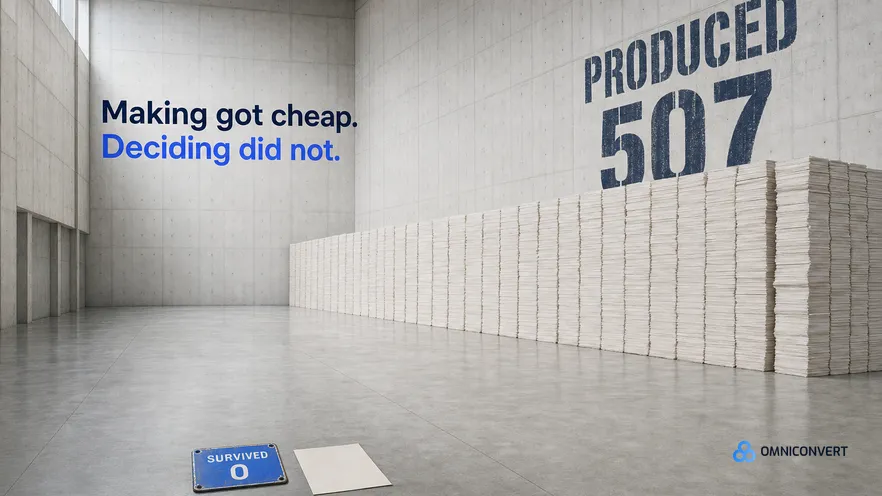
- AI collapsed production cost. It did not collapse the cost of deciding what is worth producing.
- Output rose faster than judgement, so more work now gets made and less of it survives contact with the market.
- In one audited store, 507 live ads produced no ad that lasted 60 days, which is a volume problem rather than a creative one.
- What did not change: the buyer, the margin arithmetic, and the fact that somebody has to decide.
- The advantage in 2026 sits with teams that got better at killing work, not at generating it.
One thing changed, and everything else in this piece follows from it. The cost of producing marketing work collapsed. The cost of deciding what is worth producing did not move at all. Two years of that gap widening is what the impact of AI on eCommerce actually looks like in 2026, and it explains both the wins and the far more common experience of doing much more and getting the same. Last updated: September 2026.
Omniconvert has measured how storefronts acquire and convert customers across the CROBenchmark dataset of 7,000+ websites in 15+ industries, against 248+ audit criteria, over 13 years in eCommerce, and reads live advertising through the eCommerceBenchmark ad library. This piece is a retrospective rather than a guide. If you want the practitioner framing, that is AI for eCommerce, and the honest boundaries of what the models do well sit in generative AI in eCommerce.
What is the one thing AI changed in eCommerce?
It is worth being precise about what got cheap, because the category talks as though everything did.
What got cheap is generation: turning a brief into an artefact. A product description, a set of ad variants, a first draft, a summary of last week's numbers. Work that used to be rationed because each unit cost real time and money now costs close to neither.
What did not get cheap is selection: deciding which brief to write in the first place, and which of the resulting artefacts deserves budget. That is a judgement about customers, margin and positioning, and no part of it was ever bottlenecked on production capacity.
So the sensible way to read the last two years is not that eCommerce got a new capability. It is that one constraint was removed from a system with several, and the system reorganised around whichever constraint was next. In most stores that turned out to be attention: somebody's finite ability to look at things and decide.
What did cheap AI production do to ad volume?
The volume response was correct in theory. More variants mean a wider search, a wider search means a better chance of finding something that works, and creative outcomes are concentrated enough that finding one strong performer justifies a great deal of exploration.
That argument holds on one condition, which is that the search actually learns. A search that produces a hundred candidates and evaluates none of them properly is not a wide search. It is a hundred coin flips nobody recorded.
What we see in ad libraries is the second pattern more often than the first. Volume climbed, rotation accelerated to accommodate it, and the accelerated rotation quietly removed the conditions under which anything could be evaluated. Each individual decision looked reasonable. The aggregate is a store spending more to learn less.
Why did the creative survival rate fall?
Survival is the most honest measure available for this, because an advertiser kills work that is not earning its place. An ad still running after two months has passed a repeated decision to keep funding it, and that decision was made by somebody who could see the real numbers.
The table below is what that looks like in two anonymized audits.
| Reading | Found | What it says about the search |
|---|---|---|
| Median days active | 30 | The library turns over roughly monthly |
| Ads past 60 days | None | Nothing was allowed to prove itself |
| Live ads, second store | 507 | Production was not the constraint |
| Long runners, second store | None | Volume did not convert into an asset |
The pair of readings in the bottom two rows is the finding worth sitting with. Five hundred and seven live ads is not a team that lacks capacity, and it is not a team that lacks ideas. It is an account paying its discovery cost every month at scale and banking none of it, and the monthly numbers present that as ordinary volatility rather than as a structural leak.
The mechanism behind it is not mysterious. Long-running ads have always been rare and valuable, and the traits they share are covered in the ads that refuse to die. What changed is that cheap production made rapid replacement feel free, and rapid replacement kills work in exactly the window where a future winner is still ambiguous.
What did AI not change in eCommerce?
This is the shortest section and the one that settles the most arguments.
Customers were never waiting for more advertising. The volume of messages a buyer sees rose, their willingness to be persuaded did not, and the practical effect of a category producing four times as much is that each unit is worth less attention than it was.
The arithmetic did not move either. Margin is still revenue minus cost of goods, discounts, shipping, returns and fees, and an advertisement generated in nine seconds costs exactly as much to fulfil as one that took nine days. The distinction between what an ad appears to earn and what the order behind it actually earns is set out in ROAS versus true profit versus contribution margin.
And judgement did not transfer. A model will produce a claim about your product with complete confidence and no way of knowing whether you are allowed to make it. Somebody still owns that, and the volume of things needing to be owned went up.
Where has AI genuinely moved eCommerce numbers?
The gains are real and they are narrower than the marketing suggests. They show up in one specific shape: a queue of worthwhile work that was being cut for cost reasons, with a functioning process at the end of it.
Experimentation fits that shape exactly. When building a test variant was expensive, teams tested the handful of ideas they were most confident in, and confidence is a poor predictor of which hypotheses turn out to be right. Cheap variants let the uncertain ideas into the queue, and the uncertain ideas are where the surprises live. Omniconvert Explore averages a 23.2% conversion uplift across 70,000+ experiments, and the constraint on most programmes was never the platform, it was how many hypotheses a team could afford to build.
Reporting fits it too, in a smaller way. Assembling the numbers used to consume the analyst time that should have gone into interpreting them, and that ratio genuinely improved.
What both examples share is a process that was already working and was being throttled. Where no such process existed, removing the cost constraint produced more output and no more learning, which is the outcome most stores got.
How did the eCommerce bottleneck move?
Every system has a constraint, and removing one just promotes the next.
The new constraint is somebody's finite attention: the number of things a team can genuinely look at, judge and decide about in a week. That number did not change. It is roughly what it was in 2023, and it is now being asked to cover four times the volume.
What makes this hard to fix is organisational rather than technical. Production is visible and selection is not. A team that ships forty assets has an obvious answer to what it did last month. A team that shipped eight and killed thirty-two has a better answer and a harder conversation, and the incentives in most companies reward the first.
Nexus by Omniconvert is the AI eCommerce growth engine: it unifies customer data, segments buyers by behavior and value, predicts churn, and ranks the next-best action, which is a selection problem rather than a production one. The useful question to ask any tool in 2026 is not how much it can make. It is whether it helps you decide.
What should you do about the impact of AI on eCommerce?
Four changes, in order of how quickly they pay.
- Set a survival rule and hold it. Decide how long a piece of work is allowed to live before it is judged, and stop replacing things inside that window. Most future winners are killed while they are still ambiguous, which is early.
- Report on what survived, not on what shipped. Shipped counts reward volume and volume is no longer scarce. Survival counts reward selection, which is.
- Spend the saved hours on the brief. The upstream decision about who you are talking to and what you are claiming got no cheaper and now matters more, because it is the only part of the process that is still expensive.
- Judge on value, not on first-order return. Cheap production makes discount-led work easy to mass produce, and discount-led work wins first-order measures and frequently loses on what the customers turn out to be worth.
None of this requires a tool. It requires a team willing to produce visibly less for a quarter, which is the actual reason it is rare.
Impact of AI on eCommerce FAQ
What has AI actually changed in eCommerce?
It collapsed the cost of producing marketing work. Creative, copy, product descriptions, briefs and reports went from taking days and a budget to taking minutes and almost nothing. Everything downstream of that follows from it, including the effects nobody wanted, because the cost of deciding what is worth producing did not fall at all.
Did AI increase eCommerce revenue?
For some stores, and not as a general rule, which is a less satisfying answer than the category tends to give. Production capacity is only a constraint where production was the bottleneck. Where the real constraint was knowing which customers were worth pursuing, removing the production limit changed the volume of work and not the outcome.
Why are stores running more ads but not doing better?
Because volume without selection is search without learning. When creative is cheap, the temptation is to launch more and rotate faster, and rotating faster means nothing lives long enough to prove itself. In one audited store, 507 live ads had produced no ad that survived 60 days, so the account paid its discovery cost continuously and banked none of it.
What did AI not change?
The buyer, the margin arithmetic and the need for judgement. Customers did not become easier to persuade, cost of goods did not fall, returns did not stop, and no model decides what your brand is willing to claim. Those constraints sat outside the production layer, so a change to the production layer left them where they were.
Where has AI genuinely moved the numbers?
In throughput on work that was previously rationed by cost. Testing programmes are the clearest case: when building a variant was expensive, teams tested the few ideas they were most confident in, which is the worst possible sample. Cheap variants mean more of the backlog gets tested, and more tests mean more findings, provided somebody still reads them.
Has AI made creative worse?
Not inherently, and the honest framing is that it made the median more crowded. Cheap production raises the floor on competence and does nothing for distinctiveness, so more work now looks acceptable and less of it looks like anybody in particular. The scarce thing was never execution quality; it was having something worth saying.
What is the bottleneck in 2026?
Deciding. When ten ideas cost the same as one, the constraint stops being capacity and becomes the ability to choose between them and to kill most of them quickly. Very few teams reorganised around that, because it is an unglamorous change that reduces visible output and looks like doing less.
What should an eCommerce team do differently now?
Spend the saved production time on selection rather than on more production. Set a rule for how long work is allowed to live before it is judged, hold it, and measure what survives. A team that produces half as much and keeps the right half beats one that produces four times as much and keeps none of it.
Bottom line: AI's impact on eCommerce
The impact of AI on eCommerce is not that it made marketing work better. It made marketing work cheap, and cheap is a bigger change than better, because it moves where the difficulty sits rather than removing it. Two years on, the stores that gained are the ones that already had a working process and were rationing it for cost. The stores that did not gain got exactly what the technology promised: far more output, produced far faster, judged by the same number of people in the same number of hours. The 507-ad library with no long runner is the emblem of the period, and it is not a story about bad creative. It is a story about a search that never stopped long enough to learn anything. The advantage in 2026 belongs to whoever gets better at killing work, which is the one capability nobody is selling.