How to Read a Creative Audit: Telling Symptoms From Causes

- Diagnostic order beats severity order, because a bad reading early causes the bad readings that follow it.
- The order is longevity, then concentration, then mix, then competitor gap.
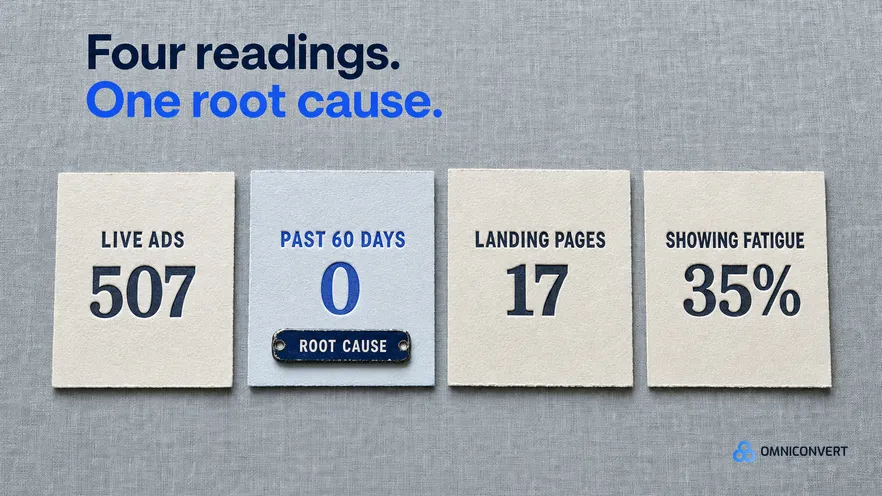
- In one audited cluster, 507 live ads produced no King Ad at all, across 17 landing pages, with 35% of creative showing fatigue signals.
- Volume is not the fix for a survival problem. More ads on a library that lets nothing live simply raises the discovery cost.
- Structural findings tell you what to brief and produce. They never tell you what the advertising earned.
Read a creative audit in diagnostic order, not in order of how bad each number looks. Longevity first, then concentration, then mix, then the competitor gap. The sequence matters because a bad reading in one step causes the bad readings in the steps after it, so a finding that looks like four separate problems is usually one root cause wearing three symptoms. Last updated: September 2026.
Omniconvert has measured how storefronts acquire and convert customers across the CROBenchmark dataset of 7,000+ websites in 15+ industries, against 248+ audit criteria, over 13 years in eCommerce, and reads live advertising through the eCommerceBenchmark ad library. Audits fail to change anything for a predictable reason: the findings arrive as a list, the list gets sorted by severity, and the team fixes the worst-looking number first. That number is very often a symptom, and fixing a symptom while its cause is untouched produces a quarter of effort and no movement.
This is the orientation piece for the series. Every step below has its own article, and the value of this one is the order rather than any individual reading. If you only take one thing, take the sequence.
Why does the order of a creative audit change the answer?
The clearest way to see this is to notice how many findings collapse once the first one is settled.
Take fatigue. A third of a library showing fatigue signals sounds like a rotation problem needing fresh creative. But if nothing in that library has ever passed 60 days, the fatigue reading is describing an account where ads are launched, decay and are replaced continuously, and the fatigue is a property of the cycle rather than of any ad. Commission thirty new ads and the same reading returns next quarter.
The same applies to coverage. A library that turns over monthly will look thin on messaging coverage almost by construction, because nothing stays live long enough to establish a territory. That is not a briefing failure, and briefing against it will not fix it.
So the discipline is to resist acting on any reading until the ones above it are settled. It feels slow, and it is far faster than four consecutive quarters of aiming at the wrong layer.
One prerequisite before the first step: agree what the words mean. Angle, concept and hook are three different layers, and an audit that blends them produces findings nobody can act on. The definitions are in hook versus concept versus angle.
Step 1: how long do your ads last (longevity)?
Longevity is the root reading, and the question is narrow: has anything here been allowed to prove itself?
The median tells you the account's normal lifespan. The count past 60 days tells you whether it has a compounding asset, and zero is a genuine finding rather than a low score. The full reasoning for treating survival as evidence, and the reason advertisers kill losers fast enough to make it evidence, is in creative longevity and days active. To set the cadence, see how often to refresh ad creative.
Inside this step sits the King Ad reading. Anything past 60 days is a durable winner rather than a survivor, and what sits behind it decides whether the account is strong or merely concentrated. That distinction, and what to do with a winner once you have found one, is the King Ad framework.
If this step comes back empty, stop and note it before reading anything else. Every finding that follows will be partly a consequence of it.
Step 2: how concentrated is your creative (concentration)?
The second reading moves from survival to distinctiveness, and it is the first that requires looking outside your own account.
Categories concentrate hard. In one audited category, two hook types covered most of the live creative, with the long tail sharing what was left. A library that lands entirely inside that crowded head is not doing anything wrong and is not doing anything that separates it either, which is a different problem from a quality problem and takes a different fix. The full reading, including why a thin tail is as often a graveyard as an opportunity, is in saturation versus edge.
Note the interaction with step one, because it is easy to miss. An account with no long runners tends to chase whatever is working in the category this month, which drives it toward the crowded head. Concentration is therefore frequently a symptom of a survival problem rather than an independent finding, and treating it as independent produces a brief for novelty that the rotation policy will discard in three weeks.
Step 3: how diverse is your creative mix?
The third reading asks what the team can actually make, which is a slower and more structural fact than anything above it.
Mix defines the region of the space you are searching. A library with no user generated content will never find a user generated winner, and a library that reformats horizontal assets into vertical slots is arriving in the feed as a visitor. In one audited brand, user generated content accounted for 19% of the mix and 20% was genuinely shot mobile-first, both well below what the strongest advertisers in that category ran. The reading, and why the fix is a production question rather than a briefing one, is in the creative mix audit.
Mix sits third rather than first for a practical reason: it is the most expensive finding to act on. Adding a format means adding capability, and doing that before the rotation policy is fixed means building a pipeline whose output will be switched off before it can prove itself.
Step 4: what is the competitor creative gap?
The final reading names the territories where the library is absent rather than merely ordinary.
Coverage is scored against a category baseline built from a named competitor set, one store at a time, which keeps the baseline stable and the finding interpretable. In one audit a brand led that baseline on 3 of 9 messaging dimensions and matched or trailed on the rest, recorded as directional because the sample was thin. The method, and the reporting discipline that keeps it honest, is in competitive benchmarking without spend data.
It goes last for two reasons. It is the most sample-sensitive of the four, so it is the most likely to produce a confident number that will not survive a second look. And its output is a set of briefs, which are worth writing only once the account can keep what those briefs produce alive long enough to matter.
Worked example: what does a creative audit of 507 ads with no King Ad show?
The table below is the cluster as the audit recorded it, then as the diagnostic order reads it.
| Reading | Found | Diagnostic verdict |
|---|---|---|
| Live ads | 507 | Volume is not the constraint |
| Ads past 60 days | None | Root cause. Nothing compounds |
| Landing pages | 17 | Destinations fragmented across the library |
| Creative showing fatigue | 35% | Symptom of continuous rotation, not of stale ads |
Read by severity, the 35% fatigue figure looks like the emergency and 507 ads looks like evidence of a hard-working team. Read in order, the second row explains almost everything else.
Five hundred and seven live ads with nothing past 60 days is not a productivity achievement. It is an account paying its discovery cost continuously, at scale, and never banking the result. The fatigue reading is what a continuously rotating library looks like from the outside, and the 17 landing pages tell you the volume is being spread across destinations rather than concentrated behind anything.
The instinctive response to this audit is more creative, and it is the one response guaranteed not to work. The account already makes plenty. What it does not do is let anything live, so the correct first move costs nothing to produce: change the rotation policy so that creative in the ambiguous window, neither obviously winning nor obviously failing, is kept rather than replaced. That window is exactly where future King Ads are killed.
Nexus by Omniconvert is the AI eCommerce growth engine: it unifies customer data, segments buyers by behavior and value, predicts churn, and ranks the next-best action, so 17 fragmented destinations can be read against the segments actually arriving at them. Fragmentation matters more when the pages are serving different customers than when they are serving the same one four ways.
Where does the creative audit diagnosis lead next?
Every reading in this sequence is a competitiveness reading. That is a real thing to know and it is not the same as knowing your advertising made money.
An account can fix its rotation policy, find two King Ads, rebalance its mix and close a coverage gap, and still be acquiring customers who never repeat and never clear their cost of goods. Nothing in a public ad library would show it, because the library holds creative and dates and nothing financial at all.
That boundary, why almost no tool crosses it, and how to work either side of it without letting one lane answer for the other, is the creative-to-profit gap. It is the honest end of this series: the structural work is worth doing, it is measurable without anybody's permission, and it stops short of the question that finally decides whether the advertising was worth running.
Creative audit FAQs
My ads are not converting. Where do I start?
Start with longevity, not with the ads themselves. Sort your live library by days active and check whether anything has survived 60 days. If nothing has, you have a survival problem rather than a creative quality problem, and every other reading in the audit has to be interpreted through that before any of it becomes a brief.
What is the diagnostic order for a creative audit?
Longevity, then concentration, then mix, then the competitor gap. The order is chosen so that each reading can explain the ones after it. Taken out of order, four findings look like four separate problems, each attracting its own fix, and three of those fixes will be aimed at symptoms.
What is the difference between a symptom and a root cause here?
A symptom is a reading that would improve on its own if something upstream were fixed. A root cause is a reading that explains others without being explained by them. Fatigue in a library where nothing survives 60 days is a symptom of the rotation policy. Fatigue in a library with healthy long runners is a real fatigue problem.
What did the worked example show?
A cluster of 507 live ads across 17 landing pages, with no King Ad anywhere in the library and 35% of creative showing fatigue signals. The volume was not the problem and it was not the solution either. Nothing in 507 ads had been given long enough to prove itself, so the account was paying its discovery cost continuously.
Does producing more creative fix a bad audit?
Rarely, and it is the most common response. Volume is the right answer only when the library is genuinely too thin to search the space. When nothing survives long enough to be judged, adding ads raises the discovery cost without raising the chance that any single ad is allowed to prove itself.
How long does a creative audit take to act on?
The reading takes days and the first fix usually takes a quarter, because the earliest steps change policy rather than assets. A rotation policy that lets creative survive to 60 days produces its first evidence roughly two months later, which is exactly the timescale that makes teams abandon it for something faster and less useful.
Can a creative audit tell me if my advertising is profitable?
No. Every reading in a structural audit describes competitiveness rather than margin, because it is built from public creative and dates. Whether the customers your advertising acquired were worth acquiring is a separate reading on your own commerce data, and almost nothing connects the two.
Who should read a creative audit?
The people who control rotation policy and production capacity, which is usually not the people who review creative. Most findings resolve into a decision about how long an ad is allowed to live or about which formats the team can make, and neither of those is settled in a creative review.
What is the bottom line on reading a creative audit?
An audit read as a list produces a list of fixes, and most of them will be aimed at symptoms. Read in order, the same findings usually collapse into one root cause with everything else hanging off it. Longevity first, because nothing else can be interpreted until you know whether anything survives. Then concentration, then mix, then the competitor gap, each one interpreted in the light of the readings above it. The cluster with 507 live ads and not one past 60 days is the case worth remembering: a team producing at scale, working hard, and paying the same discovery cost every month because the account kills creative in exactly the window where winners are still ambiguous. The first fix there cost nothing to make and everything to agree, which is true of most of the fixes that actually work.