Scaling an eCommerce Business: 6 Basics (2026)

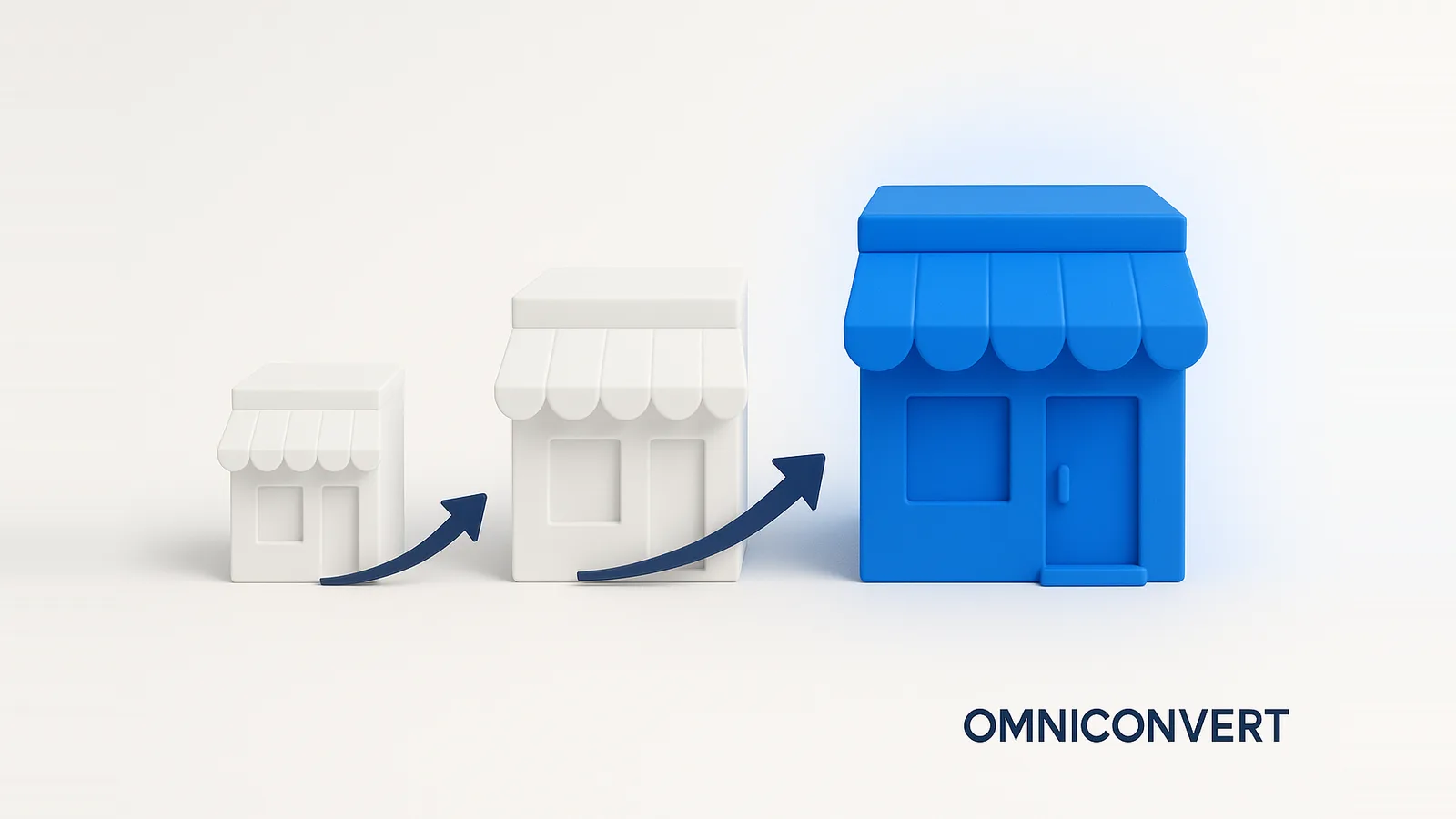
- Scaling means adding revenue while costs stay roughly flat; growing means adding revenue by adding resources at a similar rate.
- Only scale once the fundamentals hold: lifetime value exceeds acquisition cost, repeat purchases are stable, and margins survive higher volume.
- The 6 basics are inbound marketing, automation, outsourcing, customer service, retention, and reviews, each one a way to serve more for less.
- Retention is the engine of profitable scaling, because keeping a customer costs far less than acquiring a new one.
- Automation is what makes scaling possible: Nexus by Omniconvert ranks the next best action per customer, so retention scales without adding headcount.
Scaling an eCommerce business is defined as increasing revenue without increasing costs at the same rate, so profit improves as you get bigger rather than just getting busier. It is the difference between a store that doubles its sales and its overhead together, and one that doubles its sales while overhead barely moves. Omniconvert has studied what makes that leverage possible across the CROBenchmark dataset of 7,000+ websites in 15+ industries, against 248+ audit criteria, over 13 years in eCommerce conversion and retention [CROBenchmark Report 2026, Omniconvert].
Nexus by Omniconvert is the AI growth engine that turns customer and order data into ranked, autonomous actions, the kind of automation that lets a business serve far more customers without adding headcount. This guide defines what scaling actually means, shows how to tell when you are ready, walks through the six basics in their original order, and explains how to scale the profitable way rather than simply getting bigger. Every section answers the question first, then goes deeper.
Scaling vs growing: what is the difference?
The two words get used interchangeably, but they describe very different economics. When you grow, revenue and costs rise together: hire more people to handle more orders, buy more inventory, spend more on ads, and the bigger top line is largely offset by a bigger cost base. That is necessary early on, and there is nothing wrong with it, but it does not compound.
Scaling breaks that link. You add revenue while overhead stays close to where it was, by replacing manual effort with systems, earning more from existing customers, and only spending on acquisition that pays for itself. For most stores the sequence is grow first, then scale: use the early growth phase to prove the model and reach steady demand, then scale once the unit economics and systems can carry more volume cheaply. Knowing which mode you are in tells you where to put the next dollar.
Are you ready to scale?
Scaling amplifies whatever is already true about your business, which is why timing matters more than ambition. Before you pour on volume, read these signals. They are directional thresholds rather than fixed numbers, because the exact figures vary by category and margin profile.
| Readiness signal | What it tells you | What to do |
|---|---|---|
| Lifetime value comfortably exceeds acquisition cost | Your unit economics work; each customer earns back more than they cost | Invest more in acquisition and automation with confidence |
| Repeat-purchase rate is stable or rising | The model retains; new customers will likely stick too | Scale acquisition, knowing the base compounds |
| Margins hold as volume rises | Growth is profitable, not just bigger | Push volume; this is true scaling |
| Demand is steady and partly organic | There is real product-market fit, not bought demand | Scale the channels that already convert |
| Operations strain at current volume | Manual processes are the bottleneck, not demand | Automate and outsource before adding more orders |
If most of those rows are green, you are scaling from strength. If several are red, more traffic will just expose the cracks faster, so the highest-leverage move is to fix retention and unit economics first. The single best predictor is the relationship between customer lifetime value and acquisition cost, because that ratio decides whether every new customer makes you stronger or weaker.
The 6 basics of scaling an eCommerce business
1. Step up your inbound marketing game
Scaling starts with a repeatable way for new customers to find you that does not cost more with every sale. Inbound marketing, content, SEO, social, video, and influencer work, gets you found, converts traffic into customers, and gives you data to measure what works. With a large and growing share of the world's population now shopping online [Statista], the brands that win attention efficiently scale fastest. Treat inbound as an asset that compounds: a blog post or product guide keeps attracting buyers long after it is published, unlike an ad that stops the moment you stop paying.
2. Befriend automation
Automation is what breaks the link between more sales and more cost. Web push notifications, email flows, chatbots for first-line support, and automated segmentation handle repetitive work that would otherwise need more people. The point is not to remove the human touch but to reserve it for the tasks that need it, while software handles the volume. This is the single most important basic for scaling, because it lets revenue rise while headcount stays flat.
3. Outsource where possible
You do not have to build every capability in-house. Fulfillment, returns, and technical work like SEO or a CMS migration are often cheaper and faster handled by specialists, which frees your team to focus on the things only you can do, product, brand, and customer relationships. Outsourcing non-core work turns fixed costs into variable ones and lets you add capacity without a hiring cycle, both of which make scaling smoother.
4. Create an exceptional customer service policy
As volume grows, service quality is easy to lose and expensive to lose. Customers talk: roughly 87% share a good experience while 95% share a bad one [Zendesk], and around 90% say a prompt response is important [HubSpot]. Offer multiple contact channels, answer quickly, and resolve issues before they become public complaints. Good service at scale is not just damage control; it directly protects the retention that makes scaling profitable.
5. Implement a robust customer retention strategy
Retention is the basic that turns scaling from bigger into more profitable. Encourage account creation, run a loyalty program, send genuinely useful emails, and reward repeat buyers, because acquiring a new customer typically costs several times more than keeping an existing one. Even small gains in retention drive outsized profit improvements [Bain and Company]. A store that retains well earns more from each customer and spends less to grow, which is the whole point of smart eCommerce growth.
6. Collect and display reviews
Reviews are scalable social proof: your customers do the persuading for you. Around 9 in 10 shoppers read online reviews before buying [Trustpilot], so actively collect product reviews and display them where they matter most, on product pages and at checkout. Reviews lift conversion on traffic you already have, which means more revenue without more spend, and they compound as your catalog and customer base grow.
Scale retention with the right engine
The basics are sound, but running them manually across a growing customer base quickly hits a ceiling. You cannot personally segment every VIP, spot every at-risk customer, or decide the next best action for thousands of buyers. Nexus by Omniconvert is the AI eCommerce growth engine that closes that gap: it unifies customer and order data, predicts who will churn and who will become high value, and ranks the next best action for each customer, so the retention and service basics run automatically rather than as one-off campaigns.
This is what the brief's idea of scaling looks like in practice. Where a marketer might manually build a win-back list or flag loyal buyers for rewards, Nexus by Omniconvert does it continuously across the whole base and prioritizes the actions most likely to lift retention and lifetime value. Paired with experimentation in Omniconvert Explore, it lets a lean team operate like a much larger one, which is exactly the leverage scaling requires.
Scaling mistakes to avoid
As you push for scale, watch for these traps:
- Scaling too early. Pouring spend into acquisition before the model retains just multiplies churn and cost. Prove retention and unit economics first.
- Confusing growth with scaling. Adding revenue by adding cost at the same rate is growth, not scale. Watch margins, not just the top line.
- Neglecting retention. Chasing new customers while existing ones leak away is the most expensive way to grow. Retention funds everything else.
- Letting service slip. Quality often drops as volume rises, and poor experiences spread fast. Scale service capacity alongside sales.
- Keeping manual processes. Tasks that work at 50 orders a day break at 500. Automate and outsource before the cracks show, not after.
- Ignoring your data. Scaling on instinct wastes money. Let customer and order data decide where the next dollar goes.
Avoid these, and scaling becomes a compounding advantage rather than a costly gamble. For the conversion fundamentals that make every scaled customer worth more, see our guide to eCommerce CRO, and for the funnel they move through, our breakdown of the eCommerce sales funnel.
Frequently Asked Questions
Scaling an eCommerce business means increasing revenue without increasing costs at the same rate, so profit grows faster than overhead. Instead of adding staff, stock, and spend in lockstep with every extra sale, a scaling business uses systems, automation, and retention to serve far more customers with roughly the same resources. The goal is leverage: each new dollar of revenue should cost less to earn than the last.
Growing means adding revenue by adding resources at a similar rate, more headcount, more stock, more ad spend, so costs rise alongside sales. Scaling means adding revenue while costs stay roughly flat, so margins improve as you get bigger. Growth makes a business larger; scaling makes it more profitable as it gets larger. Most healthy eCommerce businesses grow first to prove the model, then scale once the economics and systems can support more volume cheaply.
An eCommerce business is ready to scale when the fundamentals hold under pressure: customer lifetime value comfortably exceeds acquisition cost, repeat-purchase rate is stable or rising, margins stay healthy as volume grows, and demand is steady rather than bought. If those signals are in place, more customers will be profitable. If they are not, scaling simply multiplies a leaky model, so fix retention and unit economics before pouring on volume.
The six basics are: step up inbound marketing so new customers find you, embrace automation to handle repetitive work, outsource non-core tasks like fulfillment and technical work, build an exceptional customer service policy, implement a robust retention strategy with loyalty and email, and collect and display reviews for social proof. Together they let you serve more customers without your costs rising at the same pace.
You scale without raising costs by replacing manual effort with systems and by earning more from customers you already have. Automate repetitive tasks, outsource what is not core, and lean on retention so revenue compounds without a matching rise in acquisition spend. Because keeping a customer costs far less than winning a new one, a strong retention program is the most reliable way to grow revenue while overhead stays roughly flat.
The most common mistake is scaling too early, pouring money into acquisition before the model retains customers or the unit economics work. Scaling amplifies whatever is already true, so multiplying traffic on a store that does not retain just multiplies churn and cost. Other frequent mistakes are confusing growth with scaling, letting customer service slip as volume rises, and keeping manual processes that break under load.
Retention is what makes scaling profitable rather than just bigger. Acquiring a new customer typically costs several times more than keeping an existing one, so a business that retains well earns more from each customer and spends less to grow. When repeat purchases and lifetime value rise, every acquisition channel becomes more affordable, which is why retention is the foundation any scaling strategy should be built on.
Nexus by Omniconvert is an AI growth engine that turns customer and order data into ranked, autonomous actions, so retention and personalization scale without adding headcount. It predicts which customers are likely to churn or become high value, then recommends the next best action to lift retention and lifetime value across the whole base. That automation is exactly what scaling requires: serving far more customers profitably with roughly the same resources.
Before you spend a dollar trying to get bigger, check the fundamentals: does lifetime value beat acquisition cost, do customers come back, and do margins survive more volume? If yes, work the six basics in order, starting with the ones that remove cost as you grow, automation, outsourcing, and retention. If not, fix retention and unit economics first, because scaling multiplies whatever is already true. Scaling is not about doing more of everything; it is about building the systems that let revenue rise while your costs stay roughly where they are.
Scale profitably with Nexus by Omniconvert
Nexus by Omniconvert is the AI eCommerce growth engine that turns your customer and order data into ranked, autonomous actions, so retention and lifetime value rise without adding headcount. As you scale, it predicts churn, finds your high-value customers, and prioritizes the next best action across your whole base, the leverage that makes more volume more profitable.