Retention-First Growth Strategy: Why Retention Comes First

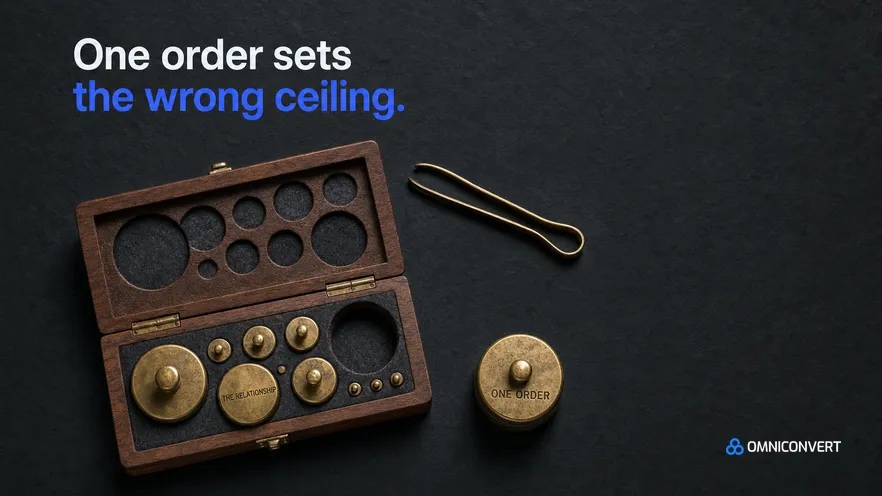
- Retention does not follow acquisition in the plan; it sets the ceiling acquisition is allowed to spend to.
- Two margins covering one acquisition cost is what lets you outbid a competitor and stay profitable.
- The blocker is reporting cadence: acquisition reports weekly, retention reports quarterly.
- Measure repeat rate by cohort, not in aggregate, or growth in new customers hides a falling one.
- Budget by contribution across the relationship, not by return on a single order.
Retention is usually described as the work that happens after acquisition. Get the customer, then keep them. That order is so familiar that it is rarely examined, and it is the wrong way round. Retention is the number that decides how much you are allowed to spend to get a customer in the first place, which makes it an input to the acquisition budget rather than a report on its consequences. Last updated: September 2026.
Omniconvert has measured how growth programmes are steered across the CROBenchmark dataset of 7,000+ websites in 15+ industries, against 248+ audit criteria, over 13 years in eCommerce. The brands that compound are not the ones with the best flows. They are the ones whose media budget was set from a number about the relationship rather than a number about the first order.
This piece argues the case, names the reason so few teams work this way, and says where to start. It sits alongside the argument that the disciplines share one input in CRO, creative & AI visibility tie into one growth system, and the wider picture of the period in the state of DTC growth in 2026.
What is the retention-first growth thesis?
Stated that plainly, almost nobody disagrees. The disagreement is about whether it is actionable, and that is a fair argument rather than a failure of nerve. A repeat rate is a fact about the past used as a forecast about the future, and forecasts are wrong.
The answer is that it does not need to be precise to be useful. It needs to be better than the alternative, and the alternative is a number that ignores the second purchase entirely. A rough estimate of relationship value beats an exact measurement of the wrong quantity.
What arithmetic decides retention-first growth?
Work it through. Suppose a first order yields a fixed contribution after the cost of goods and fulfilment. A brand whose customers buy once can pay up to that contribution to acquire one, and no more. A brand whose customers buy twice in the year can pay up to roughly twice as much for the identical customer while ending the year in the same position.
In a shared auction, that is decisive. The second brand can take every customer it wants at a price the first cannot match, and it is not being reckless. It is spending against a larger asset.
Bain and Company's work with Fred Reichheld has long held that a five percent improvement in retention can raise profits by twenty-five to ninety-five percent, and the figure sounds implausible only because it describes a compounding effect against a fixed acquisition cost [Bain and Company]. Marketing Metrics has similarly put the probability of selling to an existing customer at roughly sixty to seventy percent against five to twenty percent for a new prospect [Marketing Metrics]. Neither is new information. Both are routinely quoted in decks by companies whose budgets are set from first-order return.
The measurement that makes this operational is contribution across the relationship rather than return on a single order. Our own guide to ROAS, True Profit and contribution margin sets out the differences, and the short version is that True Profit is the contribution a relationship produces after goods, discount, acquisition and service costs.
Why do teams not work this way?
This is the part of the argument that matters, because it explains why an obviously correct idea keeps losing. The planning cycle is quarterly and the evidence cycle is annual. Anyone arguing for retention-first is asking a team to commit budget on the strength of a number that will not be confirmed for two more quarters.
There is a second, quieter reason. The acquisition number belongs to one team and the retention number belongs to another, and the two are frequently reported into different meetings against different targets. Nobody owns the ratio between them, which is the only figure the thesis actually cares about.
The fix for both is unglamorous. Report cohort contribution alongside the weekly acquisition number, in the same document, to the same person, from the first week. The point is not that the cohort number is reliable early. It is that a number nobody sees cannot influence a decision.
What changes when you reverse the order?
| Decision | Acquisition-first | Retention-first | What it changes |
|---|---|---|---|
| Budget ceiling | Set from first-order return | Set from cohort contribution | You can outbid and stay profitable |
| A good campaign | Cheap orders | Customers who come back | Creative and targeting both change |
| Valuable customer | Large first basket | High expected repeat | Segmentation stops using revenue alone |
| Discount policy | Whatever closes the order | Priced against the relationship | First-order discounting gets audited |
| Reporting line | Two teams, two meetings | One ratio, one owner | Somebody owns the trade-off |
| Conversion work | Raise the conversion rate | Raise the right conversions | Tests get ranked by contribution |
The discount row is where the argument becomes uncomfortable, and it is worth sitting with. A generous first-order discount is defensible when it buys a relationship and indefensible when it buys a single transaction at negative contribution. Most brands have never separated the two cases, because the reporting does not distinguish them.
Which retention metric should you watch?
The cohort version answers a question you can act on. Of the customers you acquired in a given month, what share bought again within the window, and how does that compare with the month before? That number responds to what you changed, and it does not move when your acquisition volume does.
Pick the window from your category's natural rhythm rather than from the calendar. A consumable might use ninety days and a durable good a year. The number matters less than holding it fixed, because a window that changes makes every comparison meaningless.
For the mechanics of separating these measures properly, our guide to repeat purchase rate, retention rate and churn rate covers what each one measures and where teams substitute one for another.
What are three fair objections to retention-first growth?
Some categories do not repeat. If you sell something a person buys once in a decade, relationship value is close to first-order value and the thesis collapses into conventional practice. That is a small set of categories and most brands that claim membership are wrong about it, but the exception is genuine.
A new business has no cohorts. Without history there is nothing to forecast from, and the honest answer is to run acquisition-first deliberately for a period while collecting the data, then switch. The mistake is forgetting to switch. A useful interim proxy is the behaviour of your earliest customers, however few, read alongside the customer lifetime value benchmarks for your category.
Cash timing can outrank profit. A company that cannot fund the gap between spending on acquisition and receiving the second order is constrained by cash rather than by margin, and no amount of correct annual arithmetic helps. That is a financing problem and it is a real one.
Where should you start?
- Put cohort contribution in the weekly document. Next to the acquisition number, in the same report, however rough it is at first.
- Fix one repeat window and stop changing it. Chosen from your category's rhythm, held for at least a year.
- Give one person the ratio. Not acquisition and not retention: the trade-off between them, reported to one executive.
- Rank your experiments by contribution rather than by conversion rate. This is where the thesis stops being a position and becomes a queue. Nexus by Omniconvert unifies commerce data, prioritises experiments by True Profit, and generates campaigns and creative you approve before they go live, which is this argument expressed as an operating system rather than an essay.
Retention-first growth FAQ
What does retention-first actually mean in practice?
It means the expected contribution from a customer relationship is calculated before the acquisition budget is set, not reported after it. In a retention-first plan the repeat rate is an input to the media budget. In a conventional plan it is an outcome that lands a quarter later, when the money is already spent.
Is retention-first just a different name for lifecycle marketing?
No. Lifecycle marketing is a set of activities that improve retention. Retention-first is a decision about where retention sits in the planning order. A company can run excellent lifecycle marketing and still set its acquisition budget from first-order return, which is the arrangement this thesis argues against.
Why do so few teams work this way?
Because of reporting cadence rather than disagreement. Acquisition produces a number within days and retention produces one across a quarter or a year, so the fast number sets the budget and the slow one arrives too late to change it. Fixing the order is an operating change, not a persuasion problem.
Does retention-first mean spending less on acquisition?
Often the opposite. A brand that knows its customers repeat can justify paying more than a competitor for the same customer and remain more profitable. The thesis is about sequencing and evidence, not austerity. What it does rule out is spending at a level the relationship value cannot support.
Which single metric should a retention-first team watch?
Repeat purchase rate by acquisition cohort, within a fixed window that matches your category. Aggregate repeat rate is the metric to avoid, because a period of strong new-customer growth pushes it down while the business improves, and a slowdown pushes it up while the business weakens.
How long before a retention-first change shows in the numbers?
One repeat cycle for your category before the leading indicators move, and two before the budget conversation changes. That is slow enough to require a decision made on principle rather than on evidence, which is the real reason the change is difficult inside a quarterly reporting rhythm.
What is the bottom line?
There is nothing new in this argument and that is rather the point. Every operator already knows that a returning customer is worth more than a new one, and almost every budget is still set as though the first order were the whole of it. The gap between what teams believe and how they allocate is not caused by ignorance. It is caused by the fact that one number arrives on Monday and the other arrives in March, and budgets are decided on Mondays. So the useful version of the retention-first thesis is not a strategy. It is a reporting discipline: put the slow number in the fast document, fix the window, give one person the ratio between the two, and rank the work by contribution rather than by conversion. Do that and the strategy follows on its own, because everyone in the room can finally see the thing they already agreed about.