The State of DTC Growth in 2026

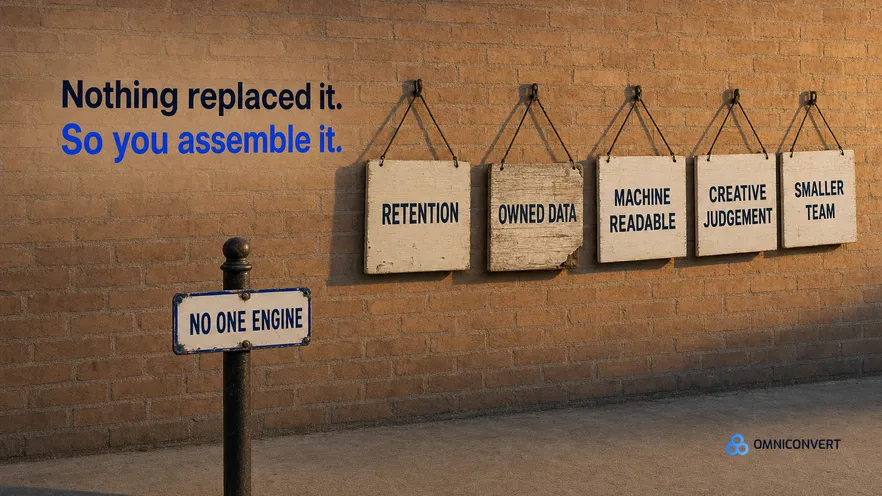
- Acquisition stopped being the growth engine and nothing replaced it wholesale, so growth is assembled rather than bought.
- Retention moved from a programme to the economics: it decides what you can afford to pay for a customer.
- Owned data is the only asset that compounds while platform access keeps changing.
- A store that machines cannot read is becoming invisible in a growing share of buying journeys.
- Creative volume is cheap now, which makes judgement about what to run the scarce part.
DTC growth in 2026 is what happens when an engine is removed and not replaced. For roughly a decade, a direct-to-consumer brand could be built by buying attention more cheaply than it was worth, and everything else, the retention programme, the data work, the conversion work, was a supporting act. That arrangement ended some years ago. What is notable about this year is not that it ended, but that nothing has taken the job, and most operators are still organised as though something will. Last updated: September 2026.
Omniconvert has measured how growth programmes are built and steered across the CROBenchmark dataset of 7,000+ websites in 15+ industries, against 248+ audit criteria, over 13 years in eCommerce. The pattern in the stores that are compounding is not a channel nobody else found. It is that they stopped organising around one engine and started running four or five smaller ones at once, which is a management change before it is a marketing one.
This piece sets out the five structural shifts that define the period and what each one actually asks of an operator. It sits alongside the argument that the disciplines share one input in CRO, creative & AI visibility tie into one growth system, and the argument about what to steer by in ROAS is the wrong north star.
The engine that was not replaced
It is worth being precise about what changed, because the popular version is that advertising got expensive, and that is only the visible half. What actually changed is the relationship between what a customer costs and what a first order is worth, and in a business where the first order was the outcome, that relationship was the whole model.
The search for a replacement has been going on ever since, and every candidate has been real and insufficient. New platforms work until their auctions mature. Influencer and affiliate arrangements work at a scale that does not carry a company. Marketplaces bring volume and take the customer relationship with them.
The brands that adapted stopped asking which engine and started asking which combination. That is a less satisfying answer, it does not fit a strategy slide, and it is what the period rewards.
Five shifts, and what each one asks
| Shift | What used to be true | What is true now | What it asks of you |
|---|---|---|---|
| Retention economics | A programme owned by lifecycle marketing | The constraint on what you can pay to acquire | Put the second purchase in the budget model |
| Owned data | A list you mailed occasionally | The only asset unaffected by platform change | Unify it before you try to act on it |
| Machine readability | A technical SEO concern | A condition of being discoverable at all | State product facts as data, not prose |
| Creative supply | Expensive to make, judged by feel | Cheap to make, and mostly unjudged | Build judgement faster than volume |
| Team shape | Specialists per channel | Fewer people, more surface each | Cut the work that produces no decision |
| The combination | One engine, several supports | Several engines, none sufficient alone | Manage a portfolio, not a channel |
The last row is the one that makes the other five coherent. Each shift taken alone reads as a familiar piece of advice that operators have heard for years and reasonably deprioritised. Taken together they describe a different job: the work is now allocation across several modest compounding sources rather than optimisation of one large one, and that is a genuinely harder thing to do well.
One: retention stopped being a programme and became the economics
The mechanism is arithmetic rather than philosophy. If a customer buys once, the acquisition cost must be covered by one margin. If they buy twice within the year, it is covered by two, and the brand can outbid a competitor for the same customer while remaining more profitable. Nothing else in this article changes the maths that decisively.
Bain and Company's work with Fred Reichheld has long held that a five percent improvement in retention can raise profits by twenty-five to ninety-five percent, and the reason that figure sounds implausible is that it is describing a compounding effect against a fixed acquisition cost [Bain and Company]. Marketing Metrics has similarly put the probability of selling to an existing customer at roughly sixty to seventy percent against five to twenty percent for a new prospect [Marketing Metrics].
What this asks of an operator is a change in where the number lives. Retention rate as a marketing metric reported monthly changes nothing. Retention rate as an input to the acquisition budget changes what you are willing to spend, which product lines you push, and whether a discount that wins a first order is worth taking.
Two: owned data is the only asset that compounds through platform change
The argument here is not about privacy regulation, though that is part of it. It is about dependency. A growth model built on any external surface inherits that surface's roadmap, and no brand has a say in that roadmap.
Owned data is the exception, and most brands have far more of it than they can use. The failure is rarely collection; it is that purchase history sits in one system, behaviour in another, service contacts in a third, and no question can be asked across all three without a project.
So the work is unification before activation. A brand that can answer which customers bought twice, which ones stopped, and what they were doing before they stopped, has something durable. A brand with the same data in four systems has an intention.
Three: the store acquired a second reader
This is the shift most likely to be dismissed as premature, and the dismissal is understandable: the volume is still small on most stores. The reason to act early is that the work is slow, compounding, and pays under every scenario including the one where agents never take off, because everything it requires is also what a human shopper needed.
Gartner has forecast a meaningful decline in traditional search volume as questions move to AI assistants, which is the visible edge of the same change [Gartner]. The practical form it takes for a merchant is mundane: delivery cost and date derivable before checkout, product attributes in fields rather than in photographs and prose, accurate availability, returns terms stated as specifics.
Every one of those also removes a reason a human shopper abandons. That is what makes this the safest item on the list to start, and the easiest to defer forever, because nothing about it is urgent this month.
Four: volume got cheap, judgement did not
The visible effect is a large increase in how much creative a small team can ship. The less visible one is that the bottleneck moved downstream, to the evaluation step, which almost nobody invested in because it was never the constraint before.
This produces a specific failure that is worth naming: a library of hundreds of assets, a spend pattern driven by whichever performed early on noisy data, and no mechanism for retiring a concept that stopped working. Volume without evaluation is not more testing. It is more guessing, conducted faster.
What it asks is that a team decide, in advance, what a creative has to do to earn continued budget and how long it gets to prove it. That is a governance question rather than a creative one, and it is the part that has not been automated.
Five: smaller teams, more surface each
Once attention is the constraint, the highest-value management act is removing work that produces no decision. Most growth teams carry a surprising amount of it: reports nobody acts on, weekly reviews of metrics that move on a quarterly timescale, and channel experiments that cannot reach significance at the volume available.
The second act is sequencing. Five engines cannot all be improved at once by four people, and attempting it produces five stalled projects. Picking one per quarter and finishing it is slower on paper and faster in practice.
This is also where tooling earns its place or does not. Nexus by Omniconvert is an AI for eCommerce growth engine that unifies commerce data, ranks experiments by True Profit rather than by ease, and generates campaigns and creative you approve before they go live, which is squarely aimed at the allocation problem this section describes rather than at the production problem the previous one does.
What this asks of an operator
The order is deliberate and it is mostly about what unblocks what. Retention economics changes what you can afford, which changes every acquisition decision downstream, so it comes first. Data unification is what makes the retention number trustworthy enough to budget against.
Machine readability comes third because it is slow and safe: it pays under every scenario and it will never be urgent, which means it only ever gets done deliberately. Creative governance and the work audit come after, because both are easier once the first three have told you what matters.
None of this is a strategy in the sense the previous decade used the word. It is a set of compounding, unglamorous commitments held for longer than a quarter, which is a poor slide and a good business.
FAQ: DTC growth in 2026
Is DTC growth actually harder in 2026?
It is more effortful rather than smaller. The work that used to be done by one channel is now done by five activities that each require attention, so the same growth costs more management even where it costs similar money. Operators experience that as difficulty, and it shows up in team fatigue long before it shows up in a growth rate.
What replaced cheap paid acquisition?
Nothing, and the search for a replacement is itself the problem. No channel has appeared with the economics paid social had at its best. What works is several smaller sources running together: retention, owned audiences, better conversion of existing traffic, and visibility in machine-mediated discovery. Each is modest alone and they compound together.
Should DTC brands still invest in paid media?
Yes, but judged differently. Paid media remains the fastest way to reach people who have never heard of you, and it stopped being the thing that makes a brand profitable on its own. Judge it on contribution after acquisition across a cohort rather than on a ratio inside the ad account.
What is the highest-return work for a small DTC team right now?
Making the second purchase more likely, and making the store legible to machines. The first improves what you can afford to pay for every customer you already buy. The second protects a share of discovery that is moving away from search results and toward answers and agents, quietly and without an announcement.
Has AI changed DTC growth materially yet?
It has changed the cost of producing work and the way some customers find products. It has not yet changed the underlying economics of a brand. The practical implication is unglamorous: the scarce resource moved from making things to deciding which things are worth making and whether they worked.
What should a DTC operator stop doing?
Waiting for a replacement engine, and steering by metrics that cannot see the business. The most expensive habit of this period is deferring the slow compounding work, retention, data, product information, because it does not produce a number this month, while running channel experiments that will not produce one either.
The bottom line
The honest description of this period is that the job got less exciting and more demanding at the same time. There is no channel to find, no arbitrage to catch, and no single decision that resets a brand's trajectory. What there is instead is a set of modest compounding sources, none of which carries a company alone and all of which reward being held for longer than a quarter. Retention decides what you can afford to pay. Owned data is the only thing you keep when a platform changes its mind. A store machines can read is becoming a condition of being found. Creative volume is free and creative judgement is not. And a smaller team means the scarce resource is attention, so the most valuable thing a leader does is delete work rather than add it. That is the state of DTC growth in 2026: not a crisis, and not a discovery. An assembly job, done patiently, by people who stopped waiting for the engine to come back.