Ad Creative Saturation vs Edge: Is Your Ad Angle Different?

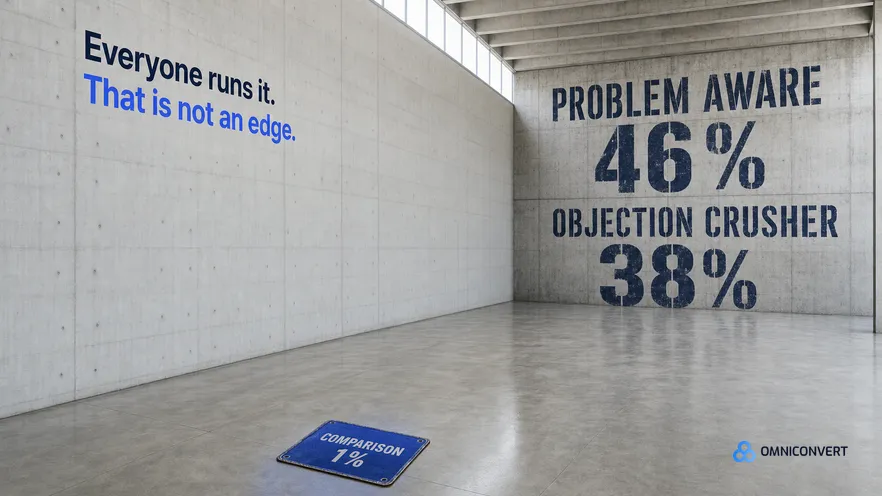
- Saturation is measured against your category, so it is invisible in an audit that only reads your own creative.
- A common angle is the price of admission. It keeps you in the conversation and differentiates nothing.
- In one audited category, 46% of hooks were Problem Aware and 38% Objection Crusher, while Comparison sat at 1%.
- An edge is a point gain over the category baseline, which makes it a number rather than an opinion.
- A thin tail is an opportunity or a graveyard, and only testing tells you which. Rarity is not the same as value.
An angle that everyone in your category already runs is the price of admission, not your edge. It qualifies you for the conversation your buyers are having and it differentiates you from nobody, and your ads can look entirely competent while doing it. An edge is something else: a measurable gap between what you run and what your category runs, expressed as a point gain over the category baseline. Last updated: September 2026.
Omniconvert has measured how storefronts acquire and convert customers across the CROBenchmark dataset of 7,000+ websites in 15+ industries, against 248+ audit criteria, over 13 years in eCommerce, and reads live advertising through the eCommerceBenchmark ad library. Saturation is the reading that most often surprises a team, because it is invisible from the inside. Nothing about your own library tells you that four competitors are making the same argument in the same order.
This piece uses the vocabulary set out in hook versus concept versus angle, because saturation is measured at each of those three layers separately and a store can be saturated at one and distinctive at the next.
What are ad saturation and edge?
Both terms describe a relationship rather than a quality, and that is the part worth holding onto. There is no such thing as a saturated ad in isolation. There is only an ad running an argument that a lot of other advertisers are also running, and you cannot know that without looking outside your own account.
The consequence is unforgiving. A creative review that examines your ads carefully, ranks them honestly and never once looks at the category will produce confident conclusions about relative quality and will be silent on the only question that decides whether the work differentiates you. Internal review is necessary and it is structurally blind to saturation.
Edge is defined as a gap so that it can be argued about with evidence. "Our creative is more distinctive" is not a claim anybody can check. "Our concept mix sits 22 points above the category on founder-led formats" is, and it can be wrong, which is what makes it useful.
Why is a common ad angle the price of admission?
There is a reasonable instinct to treat saturation as a failure and go looking for something nobody says. Resist it for a moment, because crowding is evidence.
If 46% of a category opens on the buyer's problem, that is a large number of independent teams, with their own data and their own budgets, arriving at the same place. The most likely explanation is that the approach works. Reading crowding as proof that an approach is exhausted mistakes popularity for decay, and the ads that follow that logic tend to be different and worse.
The correct handling is to split the job. Saturated angles do qualification work: they signal that you understand the category and the buyer's situation, and dropping them costs you relevance. Differentiation has to happen somewhere else, and the whole point of measuring saturation layer by layer is to find out where that somewhere else actually is.
In practice the answer is often one layer down. Two brands running the same angle can be running completely different concepts, and the concept layer then carries the entire difference. That is a good outcome, and it is invisible to anyone who scores creative as a single blended number.
What does ad saturation look like in one category?
The distribution below is from a single category read in one creative audit.
| Hook type | Share of category | What running it buys you |
|---|---|---|
| Problem Aware | 46% | Qualification. You sound like the category |
| Objection Crusher | 38% | Qualification. The second thing everyone says |
| Comparison | 1% | A test, and possibly a graveyard |
Two hook types accounting for the large majority of a category is the finding, and the tail is where the reading gets interesting. A brand whose hooks land almost entirely in the top two rows is doing what the category does. It is not doing anything wrong, and it is also not doing anything that separates it.
Note what this measurement did not require. No spend, no returns, no account access, no relationship with any of the advertisers involved. A public ad library, a consistent classification, and enough of a sample to be worth counting.
Is the thin tail of rare angles an opportunity or a graveyard?
This is where saturation analysis goes wrong most often, and it goes wrong in an appealing direction. The thin tail looks like open space, and open space in a crowded category is exactly what a team under pressure wants to find.
Sometimes it genuinely is open space. Categories develop conventions by imitation as much as by evidence, and a well-executed approach that nobody happens to be running is a real advantage while it lasts.
Often it is a graveyard. An approach can be rare because it has been tried repeatedly and quietly abandoned, and a public ad library shows you what is live rather than what was tried, so failed experiments leave almost no trace. The 1% you are looking at might be the survivors of a much larger cohort.
One reading helps separate the two: check longevity in the tail. If the few ads running a rare hook have been live a long time, somebody has found something and kept paying for it, the King Ad signal in miniature. If the tail is entirely made of new creative that never lasts, the category has been testing this and rejecting it. That is days active doing work in a different job.
How do you measure an ad edge as a point gain?
The mechanics are ordinary and the discipline is the hard part.
- Name the category. A specific set of competitors, not "the market". The baseline is only meaningful against a list somebody could disagree with.
- Classify both sides the same way. Your creative and theirs, using one taxonomy for angle, concept and hook. A different classification on each side produces a number that means nothing.
- Take the difference in points. If the category runs a format at 19% and you run it at 41%, your edge on that dimension is 22 points. That is a fact with a date on it.
- Re-measure quarterly. Angle mix moves slowly and hooks move fast. An edge is a position in a moving field, so it can be lost without anything about your own creative changing.
The last point is the one that catches teams. An edge is not a property you acquire and keep. It is a gap, and the category closes gaps, so today's differentiator becomes next year's price of admission through no fault of yours. That is a slower decay than creative fatigue, which wears out a single ad with a single audience, and it needs a different answer: a new claim, not a new execution.
Nexus by Omniconvert is the AI eCommerce growth engine: it unifies customer data, segments buyers by behavior and value, predicts churn, and ranks the next-best action, so a point gain in creative can be aimed at a defined audience rather than at a category in general. An edge against the wrong buyer is still a gap, and it is not worth having.
How do you find your own ad saturation?
The method is unglamorous and the sample discipline matters more than the analysis. Pick a real competitor set, take enough live creative from each to be worth counting, and classify all of it with the same taxonomy you use on your own. Then compare, one layer at a time.
Two warnings from doing this repeatedly. First, classify blind where you can, because knowing which brand an ad belongs to biases the classification toward the story you already believe. Second, a small sample from a large category produces confident numbers that will not survive a second look, so treat a thin sample as directional and say so out loud.
Saturation is one output of the wider competitive reading, which also covers messaging coverage against named competitors. The method for that, and what it can and cannot support, is in competitive benchmarking without spend data.
When is ad saturation the right choice?
Three cases where running the category's angle is the right call.
Entering a category. A new entrant that opens on an unfamiliar argument has to teach the buyer a frame before it can sell anything, and that is expensive. Running the convention buys immediate comprehension, and differentiation can be added once you are inside the conversation.
When the crowded angle is simply the truth. Sometimes 46% of a category opens on the same problem because it is the problem. Inventing a different one to be distinctive is a real risk, and the resulting ads tend to be memorable and irrelevant.
When the difference is in the product. If what makes you different is a fact about the offer rather than a claim about the buyer, the angle can safely be conventional and the concept can carry the fact. What matters in all three cases is that saturation is a decision on the record, not a discovery.
Ad saturation vs edge FAQ
What is creative saturation?
Creative saturation is how common an angle, concept or hook already is inside your category. It is a property of the category rather than of your ads, which is why an audit that reads only your own creative can never detect it. A saturated angle is not a bad angle, it is simply one that differentiates nothing.
What is an edge in ad creative?
An edge is the measurable gap between what you run and what your category runs, expressed as a point gain over the category baseline. Defining it as a number rather than as a quality keeps the conversation testable. If you cannot state the gap in points against a named category, what you have is a preference rather than an edge.
How do I know if my angle is saturated?
Classify a sample of live ads from your named competitors by angle, concept and hook, then count the shares. If your primary angle is also the largest share in the category, it is saturated. This needs no spend data, only a public ad library and a consistent classification, which is why it is one of the more accessible competitive readings available.
What did the hook concentration in the audited category look like?
Heavily concentrated at the top. Problem Aware hooks accounted for 46% of the category and Objection Crusher hooks for 38%, so two hook types covered most of the category between them. Comparison hooks sat at 1%, with the remaining types sharing what was left. That shape is common: a crowded head and a very thin tail.
Is a rare angle automatically an edge?
No, and treating it that way is the most expensive mistake in this analysis. A thin tail can mean nobody has tried it or that everybody tried it and it failed, and the two look identical in a share count. Rarity earns a test, not a budget. Only the test tells you which of the two explanations applies to your category.
Should I abandon a saturated angle?
Usually not. A saturated angle is often saturated because it works, and dropping it can put you outside the conversation your buyers are already having. The right move is to keep it as qualification and stop counting it as differentiation, then place the differentiation somewhere the category is thin.
Can two brands share an angle and still differ?
Yes, because saturation is measured separately at each layer. Two brands can run the same angle through completely different concepts, and the concept layer then carries the difference. That is why angle, concept and hook are classified as three separate things rather than blended into one creative score.
How often should I re-measure saturation?
Quarterly is enough for most categories, because angle mix moves slowly while hooks move fast. Re-measure sooner if a large competitor changes its positioning or a new entrant starts spending heavily, since both events can move a category baseline within weeks and quietly turn your edge into the new price of admission.
Bottom line: saturation or edge?
Saturation is not a verdict on your creative. It is a fact about your category that your own library cannot report, which is why teams find it late and find it uncomfortable. Keep the crowded angle if the crowd is right, and stop counting it as differentiation. Then go looking for the gap, state it in points against a named competitor set, and put a date on it, because a gap measured is a gap you can defend and lose deliberately rather than one you discover has closed. Treat the thin tail with more suspicion than excitement: 1% is either open ground or a graveyard, and the ads still running there after two months will tell you which. That is a test, not a plan, and confusing the two is how a category's failed experiment becomes your next quarter.