AI Ad Copy Generator: How to Write Ads From Customer Data

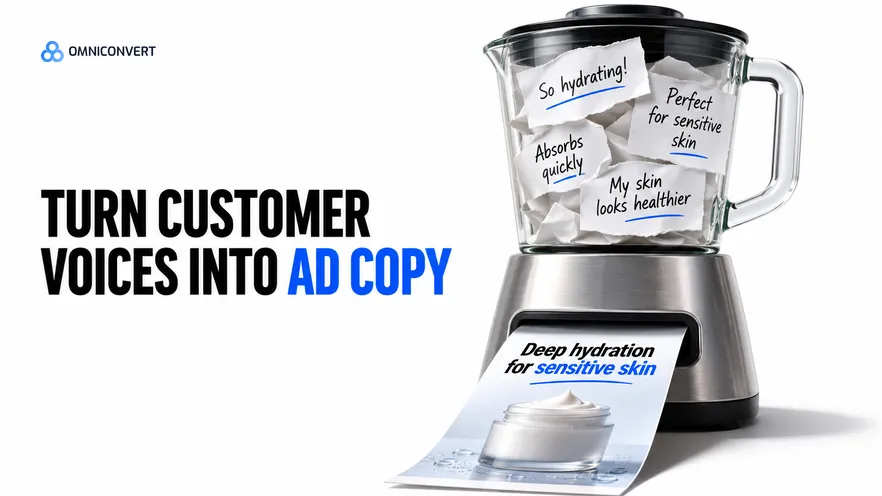
- An AI ad copy generator is only as specific as the customer data you feed it; with no data it writes the average ad for your category.
- Four inputs carry most of the value: reviews, support tickets, post-purchase survey answers and product data.
- Brief by angle, one angle per brief, and ask for hooks, headlines and primary text for that angle together.
- Customer phrases make better hooks than invented ones, because buyers already recognise their own words.
- Run a claims, ad policy and brand voice check on every output before launch, because a generator writes confident claims it cannot support.
- Test angles against each other first and wording second, so a result tells you something about the customer.
- Omniconvert Commander generates ad copy and hooks from customer data and builds creative variants ranked by CLV-weighted angle.
An AI ad copy generator writes what you ask for, and most stores ask for too little. "Write a Facebook ad for our running shoes" returns copy that fits any running shoe from any brand. The fix is not a better tool. The fix is a better brief, built from what your customers already told you.
Across 13 years in eCommerce, the best ad lines I have seen came from customers, not from copywriters. A buyer writes "finally a bag that fits my laptop and my lunch" in a review, and that sentence beats anything a model invents. The workflow runs in six steps, from customer sentences to a live test. It does not rank tools: for that, see the best AI ad copy generators.
Omniconvert Commander (formerly Nexus) is the AI eCommerce growth engine for Shopify brands: it reads your store, ad and customer data, ranks growth opportunities by profit impact, and builds the campaigns to act on them, and you approve what goes live.
What an AI ad copy generator needs from you
An AI ad copy generator is defined as software that writes ad text, such as hooks, headlines and primary text, from a prompt. Its output can only be as specific as that prompt. A model trained on millions of ads knows what ads usually say. It has no idea what your customers say.
A customer-data brief is defined as a prompt built from what real customers said: one angle, the customer phrases that support it, the product facts the copy may claim, and the offer. The generator writes from those inputs and invents nothing else. An angle is the reason the product matters to a particular buyer. Every step below serves that brief.
Picture the Monday routine: someone pastes the product page into the generator, asks for ten variations and loads all ten ads before lunch. The page is accurate and the copy reads well. But all ten ads make the same promise in different words, so the whole test budget went on one idea. A week later the result says nothing about which reason to buy moves your customers. Brief one angle per ad set, and spend the same budget on four different ideas.
The customer data to feed an AI ad copy generator
| Input | What it gives the copy | What to pull out | Watch for |
|---|---|---|---|
| Product reviews | Reasons to buy, in buyer language | Sentences about why they bought, what surprised them, what they replaced | Reviews written for a gift or for a different product variant |
| Support tickets and chats | Objections and confusion to answer | Repeated questions before purchase, such as fit, shipping or sizing | Complaints about a fixed problem: do not advertise around them |
| Post-purchase survey answers | The moment of decision | Answers to "what almost stopped you" and "what made you buy" | Leading questions that put words in the buyer's mouth |
| Product data | Facts the copy may claim | Materials, sizes, inclusions, guarantees, current offer | Claims the product page makes that you cannot back up |
| Brand voice rules | Tone and words to avoid | Three or four rules and two real sentences you like | A long style guide the model will not follow |
You do not need all five on day one. Reviews plus product data already beat a bare prompt. For how to code a review corpus into themes and rank them, see ad creative from customer reviews. The workflow here starts after that work and briefs the generator with it. For survey questions that surface the decision moment, see post-purchase survey questions.
Write ads in six steps
- Collect the customer inputs. Export reviews, support tickets and post-purchase survey answers, and pull product data from the store. Keep the customers' own words.
- Pick one angle per brief. Choose one reason to buy for one audience and one offer. Write it as a single sentence before you open the generator.
- Write the customer-data brief. Give the generator the angle, three to five real customer phrases, the product facts it may claim, the offer and the brand voice rules.
- Generate hooks first, then headlines and primary text. Ask for several hooks for the angle, pick the strongest, then ask for headlines and primary text built on those hooks.
- Run the quality pass. Check every claim against product facts, check the copy against ad platform policy, and check it against your brand voice.
- Launch a small set and test angles. Launch a few ads per angle with the same offer and format, compare angles on profit per ad, then test wording inside the winning angle.
Two details save time. In step 3, quote customers directly and label them as customer phrases, so the model reuses their wording and does not paraphrase it away. In step 4, ask for hooks separately because a hook is the one line that decides whether the rest gets read. For the difference between a hook, a concept and an angle, see hook, concept and angle explained.
Take one angle. Say it is "fits real life" for a laptop bag, supported by the review phrase about laptop and lunch. The hook reuses that phrase. The headline states the promise in a few words. The primary text gives one product fact, one proof and the offer. Each piece does one job, and all three carry the same angle.
AI ad copy for ecommerce: the quality pass
AI ad copy for ecommerce is defined as ad text written by a model and grounded in store data: product facts, offers, reviews and customer questions. It carries a duty that general marketing copy does not. Every claim must match a real product, and every ad must pass a platform review.
Claims. Read each line and ask where the proof sits. "Ships free" needs a shipping rule that says so. "Lasts for years" needs evidence. A customer's review is a quote, not a guarantee: "this fixed my back pain" is a customer's experience and a risky claim in your voice. Strike what you cannot back up.
Platform policy. Each ad platform restricts claims about health, personal attributes, before-and-after results and some offers. Read the current policy of the platform you run on, and check categories like wellness and beauty line by line. Do not rely on a model to know the rules.
Brand voice. Cut anything a competitor could run unchanged. Cut stock phrases and invented urgency. If a line sounds like it came from a template, replace it with a customer phrase.
For wider guidance on writing that converts, see conversion copywriting and these ecommerce copywriting examples.
How to test the output
A generator makes variants cheap, so the temptation is to launch many. Resist it. Ten variants of one angle test the wording. Four ads across four angles test the customer. The second teaches you more, and it tells you what to brief next. Meta ads creative testing covers the test design in depth.
Judge on profit, not clicks. A hook that wins attention and sells a heavily discounted, return-prone product can lose money. Feed the winning angle back into the next brief: its customer phrases, its objections and its proof.
Your copy tests deserve the same discipline as any experiment: one question per test and a result you can act on. For scale, here is what a structured programme delivered for another team.
AliveCor used Omniconvert to run a structured A/B testing programme and achieved +21% conversion rate, +5% revenue per visitor, and 94% statistical relevance across their experiments. [Omniconvert, AliveCor case study]
Once copy wins, it needs a page that keeps its promise. See how to match landing pages to ad creative. When the angle is clear, static ads from your product catalog turns it into images at scale. For the full picture, the pillar is AI ad creative generation.
Skip the manual brief
Doing this by hand works, and it takes hours every time: exporting reviews, coding them, briefing, checking, loading ads. Omniconvert Commander generates launch-ready assets from customer data, so the customer-data brief is built from your store, ad and customer data and not from a spreadsheet you maintain. It ranks the creative variants by CLV-weighted angle and measures True Profit per ad, not ROAS.
It does not remove the quality pass. You still review every ad yourself. If you compare it with a generic copy tool, read Omniconvert Commander vs AdCreative.ai.
FAQ: AI ad copy
What is an AI ad copy generator?
An AI ad copy generator is software that writes ad text, such as hooks, headlines and primary text, from a prompt. Its output depends on its inputs. Given a product name only, it writes generic copy. Given customer language and product facts, it writes copy that sounds like your buyers.
What is AI ad copy for ecommerce?
AI ad copy for ecommerce is ad text written by a model and grounded in store data: product facts, offers, reviews and customer questions. It differs from general marketing copy because every claim must match a real product and a real policy, and results are judged on profit.
What customer data should I feed an AI ad copy generator?
Start with reviews, support tickets, post-purchase survey answers and product data. Reviews and surveys give you reasons to buy. Tickets give you objections. Product data gives you the facts the copy is allowed to claim. Use the customers' words, not a summary of them.
How do I write ad hooks from reviews?
Find the sentences in reviews that describe why someone bought or what surprised them. Group them by theme, then turn the strongest phrase in each group into a hook. Keep the buyer's wording, cut it short and check that the claim matches your product.
How do I stop AI ad copy sounding generic?
Give it specifics: real customer phrases, one angle, one audience and the product facts. Generic copy comes from generic briefs. Then edit for your brand voice and cut any line that a competitor could run unchanged.
How do I test AI-written ad copy?
Test angles first. Run a few ads per angle with the same offer and format, and compare them on profit, not clicks. Once one angle wins, test hooks and headlines inside it. Change one element at a time so the result tells you why.
Can Omniconvert Commander write ad copy from my customer data?
Yes. Omniconvert Commander generates ad copy and hooks from customer data, and builds creative variants ranked by CLV-weighted angle. It reads your store, ad and customer data, and you approve what goes live. Approved work launches to Meta.
Brief with your customers' words
The generator is fast. It is not informed. Give it reviews, tickets, survey answers and product facts, one angle at a time, and it writes copy that sounds like your buyers. Check every claim before launch, test angles before wording, and judge the result in profit. The brief decides the copy.