Winning Ad Angles: How to Deconstruct a Competitor Ad

- A winning ad angle is the argument an ad makes for buying, and from outside you can see only that a rival kept paying for it, not that it made a profit.
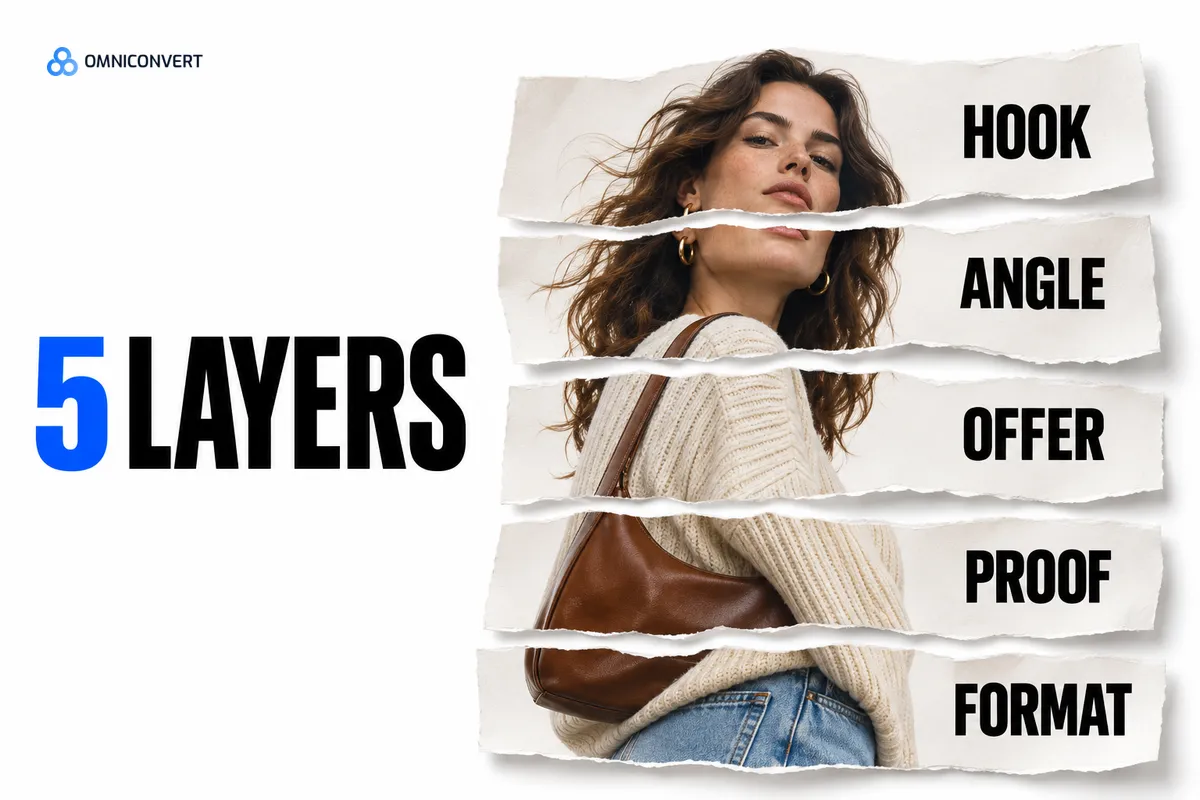
- One ad has five layers to record: hook, angle, offer, proof and format. The hook is the opening beat and the angle is the argument under it.
- Write the angle before the hook, in one sentence that does not name the product, or you will copy the layer that is easiest to see.
- Borrow the argument and the hook's move. Leave the competitor's copy, imagery, offer and proof, which belong to their margin and their customers.
- A borrowed angle is a hypothesis. Check it against your own reviews and customer data, then test it.
- One ad is an anecdote. Repeat the teardown across a rival's library before you let it steer a brief.
- Omniconvert Commander classifies competitor creative by angle, hook and offer, and you approve what goes live.
Winning ad angles are easy to spot in a competitor's library and hard to read. The ad that catches your eye is usually caught by its hook, the first beat, and the hook is the layer that carries the least. Take one ad apart, layer by layer, and you can say what it argues, what it offers and what is worth borrowing.
In creative reviews I keep seeing the same habit: teams copy what they can see, when the thing worth copying is what the ad argues. Omniconvert's CROBenchmark dataset measures how storefronts acquire and convert customers, across 7,000+ websites in 15+ industries and 248+ audit criteria [CROBenchmark Report 2026, Omniconvert]. The landing page that receives a borrowed angle is one of those storefronts.
Omniconvert Commander (formerly Nexus) is the AI eCommerce growth engine for Shopify brands: it reads your store, ad and customer data, ranks growth opportunities by profit impact, and builds the campaigns to act on them, and you approve what goes live. The method below also runs in a spreadsheet.
To read a rival's whole library at once, see how to analyze competitor Facebook ads.
What are winning ad angles?
A winning ad angle is defined as the argument an ad makes for buying, kept in market long enough that its advertiser has had the chance to kill it and chose not to. The word "winning" needs care. From outside you see durability, never profit, so read it as "funded on purpose".
That limit matters for what you do next. A competitor's ad can run for months and still bring customers who never return. For what a public library can and cannot support, see competitive ad benchmarking without spend data. For why age is a signal at all, see creative longevity and days active.
Hook vs angle, and the other three layers of one ad
The angle is the reason to buy, and the hook is the first beat that earns the attention to deliver it. The full definitions are in hook, concept and angle. A tool for writing openings is a different thing from a method for finding the argument, and the best AI ad hook and angle tools roundup ranks the first kind.
| Layer | Question to ask | What to write down | Borrow or leave |
|---|---|---|---|
| Hook | What stops the scroll in the first beat? | The first line or first frame, and the move it makes | Borrow the move, never the line |
| Angle | What reason to buy sits under the ad? | One sentence that does not name the product | Borrow, once your customer data agrees |
| Offer | What does the buyer get, on what terms? | Discount, bundle, trial, guarantee or none | Leave unless your margin supports it |
| Proof | What makes the claim believable? | Review, number, demo, authority or none | Leave theirs and use your own |
| Format | How is the ad built? | Static, video, carousel or user-generated style | Borrow only if you can produce it well |
Read the last column before you start. It tells you which layers are worth the effort of recording carefully, and which are only context.
Deconstruct a competitor ad in six steps
- Check the ad's age and where it runs. Open the ad in the public library and note the start date, the Page and the market. A young ad inside a cluster of near-identical variants is a test, so wait before you borrow from it.
- Write the angle first. State the reason to buy in one sentence that does not name the product. If you cannot, you have found a feature list and not an angle.
- Log the hook on its own. Copy the first line or describe the first frame, then name the move: question, claim, demonstration or problem.
- Separate the offer from the proof. Write down what the buyer gets and on what terms. Then write down what makes the claim believable, and mark which of the two the ad leans on harder.
- Note the format. Record whether the ad is static, video, carousel or user-generated style, and whether you could produce it to the same standard.
- Mark what to borrow and what to leave. Keep the angle and the hook's move if your own customers recognise the situation. Leave their copy, assets, offer and proof, and write one line you can hand to a brief.
That last line is the start of an ad creative brief. Write it as an argument for your buyer, not as a description of the rival's ad.
What to borrow from a winning ad and what to leave
Here is an illustrative example, not data. A rival sells a skincare set. The ad opens on a close-up of an empty bottle (the hook). It argues that you keep paying for products that give out before you finish them (the angle). It offers a refill bundle (the offer) and shows a customer quote (the proof). Now check your own reviews. If your buyers complain about the same thing, borrow the angle, open on a different moment from your own product, offer only what your margin allows and quote your own customers. If your reviews never mention it, leave the angle where you found it.
Copying the hook is the easy trap in a teardown. It looks reasonable: the hook is the part you can screenshot, it is short, and it is what stopped you. The team rebuilds the opening line around its own product and ships. The new ad now opens like the rival's but argues nothing, or argues something your buyers do not recognise. The cost is a production cycle, plus a wrong conclusion that "that angle does not work for us", drawn from an angle that was never tested.
A borrowed angle is defined as an argument taken from a competitor ad and re-expressed with your own product, proof and customers, never with their words or assets. Treat it as a hypothesis, which is the discipline a structured testing programme runs on.
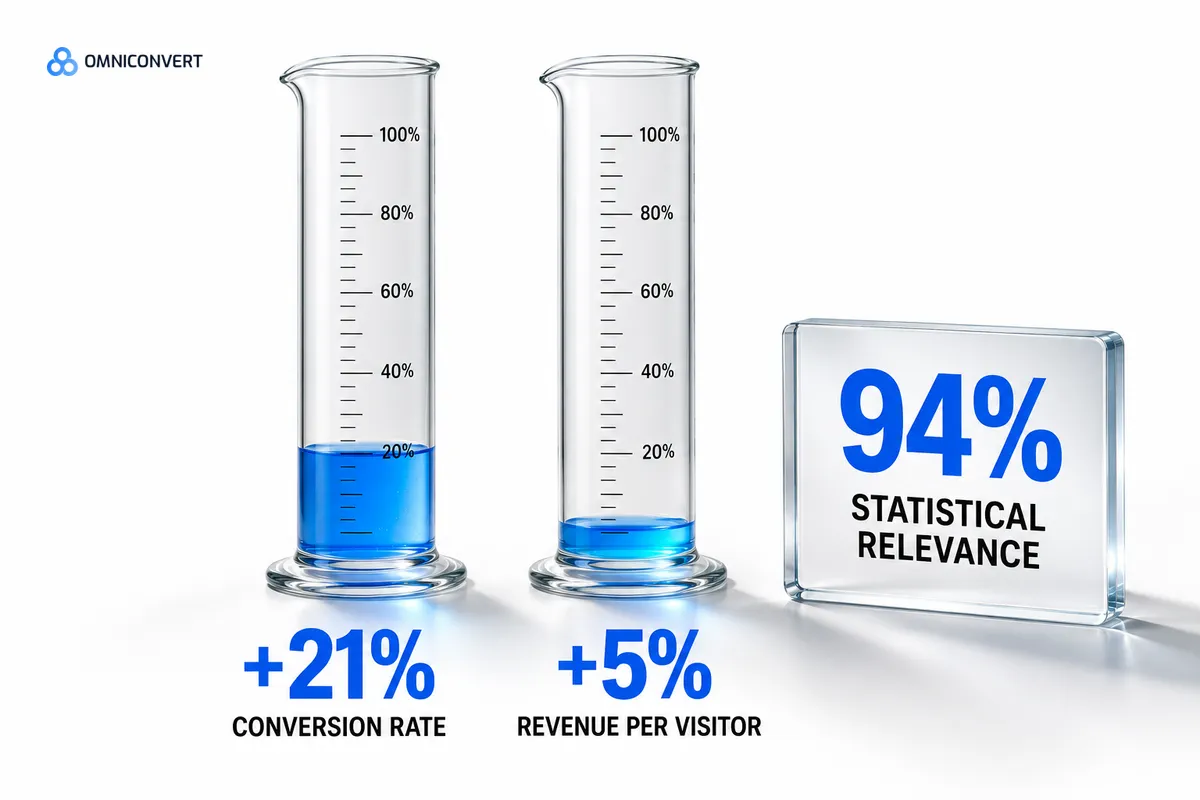
AliveCor used Omniconvert to run a structured A/B testing programme and achieved +21% conversion rate, +5% revenue per visitor, and 94% statistical relevance across their experiments. [Omniconvert, AliveCor case study]
For how to design the test that follows, see Meta ads creative testing.
When one ad is not enough
A single teardown answers "what is this ad doing?". It cannot answer "what is this competitor doing?", and the second question is the one a brief needs. So log each teardown in the same five fields and look for repeats. When the same angle sits under different hooks and formats, you are reading a decision. When an ad is the only one of its kind, you are probably reading a test.
Once you hold a few dozen rows, the work shifts from taking ads apart to finding patterns in them. That is the job of ad creative analytics, using your own winners as well as theirs.
Where the tooling fits
Omniconvert Commander monitors competitor ad libraries and classifies competitor creative by angle, hook and offer, which is the repeat-reading half of this work. It generates launch-ready assets from your customer data, and you approve what goes live. It does not tag creative at element level or build concept-level dashboards, and the finer reading of a single ad is a job for you, or for a dedicated analytics tool. For a side-by-side with one of those, see Omniconvert Commander vs Atria.
FAQ: winning ad angles and competitor ads
What is a winning ad angle?
A winning ad angle is the argument an ad makes for buying, kept in market long enough that its advertiser has had the chance to kill it and chose not to. From outside you can see that a rival keeps funding it. You cannot see that it earns a profit.
What is the difference between a hook and an angle?
The hook is the opening beat that stops the scroll. The angle is the argument underneath it. One angle can sit under many hooks, and changing the hook leaves the angle where it was. Record them in separate fields so you can tell which one is working.
How do I know a competitor ad is winning?
You cannot know from outside. You can read signals: the ad has run for a long time, it appears across several placements, and the same argument returns in newer ads. Treat those as evidence of a decision to keep paying, then test the angle yourself.
What can I borrow from a competitor ad?
Borrow the argument, the move the hook makes and the structure of the proof. Leave the exact copy, the imagery, the brand marks, the offer and any claim you cannot back. The offer belongs to their margin, and the proof belongs to their customers.
Can AI ad hooks replace deconstructing a competitor ad?
No. AI ad hooks tools write openings, and an opening is only the top layer. Without a clear angle under it, a fast stream of hooks gives you many ways to say nothing in particular. Find the angle first, then generate hooks that carry it.
Does Omniconvert Commander deconstruct competitor ads?
Omniconvert Commander monitors competitor ad libraries and classifies competitor creative by angle, hook and offer. It does not tag creative at element level or build concept-level dashboards. It generates launch-ready assets from your customer data, and you approve what goes live.
Borrow the argument
The hook is what you notice and the angle is what sold. Take one ad apart into hook, angle, offer, proof and format, write the angle first, and keep what your own customers recognise. Leave the copy, the offer and the proof. Then repeat the teardown across a rival's library, so a test does not pass for a decision.