AI Ad Creative Generation for eCommerce: A Complete Guide

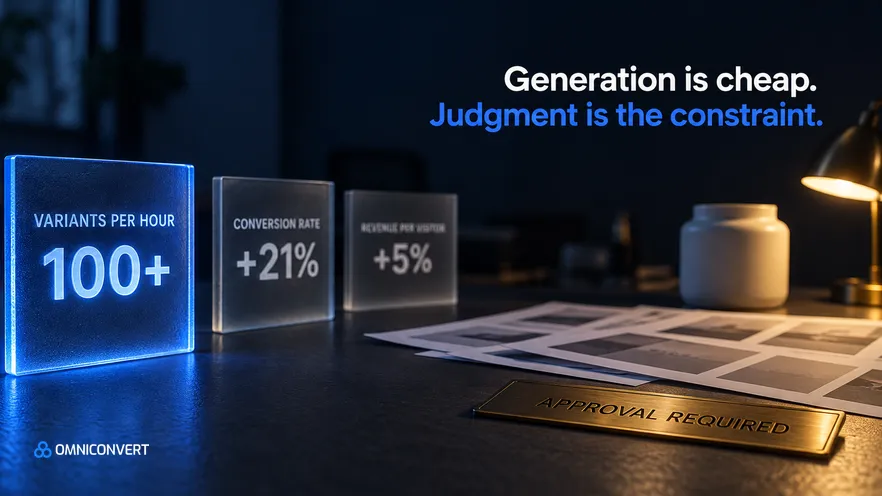
- Generation stopped being the constraint; choosing which angle deserves budget is now the bottleneck.
- A generator writes assets, a system ranks what to say before anything is rendered.
- Volume beyond your replacement rate buys nothing, because each variant cannot get enough spend to teach you anything.
- The most common failure is hundreds of variants of one unexamined angle taken from the product spec sheet.
- Judge a tool on whether it reads your customer data, reports in profit, and remembers your rejections.
- Keep the brief, the brand reference and the approval inside your team whatever you buy.
AI ad creative generation for eCommerce arrived as a production answer to a thinking problem, which is why so many brands bought it and saw nothing change. Making the asset was never the expensive part of an ad. Knowing what the ad should say was, and still is. Once you can render a hundred variants in an hour, the scarce resource moves to whoever can tell you which three of them deserve budget. Last updated: October 2026.
I have spent 13 years in eCommerce, and the CROBenchmark dataset of 7,000+ websites in 15+ industries, assessed against 248+ audit criteria, keeps pointing at the same thing [CROBenchmark Report 2026, Omniconvert]. The brands that pull ahead on paid are rarely the ones producing the most assets. They are the ones where the asset can name the customer objection it was built to answer. Generation did not change that. It just removed the excuse that production capacity was the problem.
So this is the hub page for the whole subject, and it is deliberately not a tool ranking. Nexus by Omniconvert is the AI eCommerce growth engine for Shopify brands: it reads your store, ad and customer data, ranks growth opportunities by profit impact, and builds the campaigns to act on them, and you approve what goes live. I will be specific later about which layer of this system that covers and which layers stay yours, because the layer boundaries are the only part of this topic that is genuinely useful to understand.
What AI ad creative generation actually is
AI ad creative generation is defined as the practice of producing ad assets from a brand's own store, ad and customer data, where a model reads the joined records, ranks the angles worth testing, renders creative against those angles, and a human approves what goes live. The load-bearing clause is the first one. If the input is a product spec sheet and a template, you have asset automation, which is a useful but much smaller thing.
The word that does the real work in that definition is angle. A creative angle is defined as the single claim an ad makes about why this product solves this customer's problem, stated before any asset exists. Angles come from evidence: support tickets, return reasons, review text, what repeat buyers have in common. They do not come from the product description, because the product description was written to list features to someone who already arrived.
Three activities get called the same thing and should not be. Resizing and reformatting an approved asset across placements is automation. Writing copy variants against a prompt is generation without grounding. Reading your customer data, ranking what to say, then generating and measuring in profit is a system. All three are sold with the same vocabulary, and only the third one compounds.
Why creative became the constraint
For about a decade, the lever that moved paid performance was the audience. You built a segment, you found it cheaply, and a competent asset was enough. That lever has largely been absorbed into the platforms' own automated buying, and what you hand the auction is mostly the creative and the offer. So the creative is not one input among many any more. It is the input.
The second shift is about lifespan rather than targeting. Higher frequency against a broader pool burns a concept faster than it used to, which raises how many fresh concepts a month you need just to stand still. Most teams have never written that number down, and the ones who do are usually surprised by it. Working out your own replacement rate is the first honest step, and scaling ad creative production is where I have set out the capacity side of it properly.
Put those two together and you get the squeeze that generation was sold into. You need more distinct concepts than before, you need them faster, and the surrounding process was built for a campaign calendar. Generation solves the capacity half of that squeeze convincingly and the distinctness half not at all, because distinctness is a question about what you know, not about how fast you can render.
The six layers of a working system
Think of this as a supply chain rather than a product category. Each layer takes an input and hands something to the next one, and the whole thing is only as good as the weakest handoff. The table is qualitative on purpose: the only quantities that matter here are the ones from your own account.
| Layer | What it produces | What it needs from you |
|---|---|---|
| Data | One joined record per customer, carrying behaviour and value | Clean order and event data, and one shared definition of a high-value customer |
| Angle | A ranked list of claims worth testing, weighted by customer value | Your knowledge of the objection each claim is answering |
| Asset | 100+ creative variants per hour, ranked by CLV-weighted angle | Product imagery you already own, and a written brand reference |
| Buying | Live Meta and Google campaigns built against the ranked angles | A budget, a structure, and your approval before anything publishes |
| Measurement | True Profit per ad, reconciled against the platforms daily | Your real costs: product, shipping, returns and payment fees |
| Judgment | A scale, hold, reduce or kill recommendation on each live ad | A person who approves, rejects, and can say why in one line |
Two things fall out of the table. The first is that the asset layer, the one every demo opens with, is the only layer where capacity is genuinely solved. The second is that layers one and six are where brands differ from each other, and neither of them is a software purchase. A tool can make them easier. It cannot supply them.
What an AI ad creative generator does
A plain AI ad generator is a formatting engine with a language model attached. You give it a product image, some copy fields, maybe a brand kit, and it returns statics, carousels and short video sized for each placement. That is a real capability and it collapses a job that used to take a designer days. It also knows nothing about your customers, so every judgment it makes about what to say comes from your prompt.
The integrated version sits on top of the data layer instead. It reads what your customers bought, returned, asked about and repeated, ranks the angles by the value of the customers who hold each objection, and generates against that ranking. Same rendering step, completely different brief, and the brief is where the result lives.
This page is not the place I rank the options, because that work already exists and keeping one master is better for you and for us. For the standalone versus integrated comparison and the capability checklist, read the AI ad creative generator comparison. For a shortlist with the current field assessed, read the best AI ad creative tools for eCommerce. What belongs here is the boundary: a generator owns one layer of six, and nothing about buying one changes who decides what the ad says.
Variants from customer data, not templates
Here is the failure I see most often in this specific topic, and it looks completely sensible from the inside. A team connects the generator to the product catalog, because that is the clean, structured, well-governed data they already have. It produces hundreds of variants pulled from titles, features and specifications. Every asset is on brand, every placement is filled, and the whole set argues one single point: that the product has these features. Performance moves for a fortnight on novelty, then flattens. The account reads as creative fatigue, so the team buys a second generator for more variety, and gets more restatements of the same claim. The catalog was the wrong input, and because it is the tidiest input in the business, nobody questions it.
The fix is to point the generation at language your customers produced. Generating ad variations from customer data is the mechanics of doing that from your order and behaviour records, and building ad creative from customer reviews is the cheapest version if you want to test the idea this week with nothing new installed.
Then there is the platform-specific part, which matters more than it should. A claim that works as a Meta hook needs a different shape, length and first second than the same claim on another surface, and the variant count multiplies by placement rather than adding. Building Facebook ad variations for Shopify covers that multiplication without turning it into busywork.
One discipline holds all of this together. Every variant you launch should be traceable to a sentence a customer wrote or said. If nobody can point at that sentence, the variant is decoration, and decoration is exactly what unlimited generation capacity produces when nothing upstream constrains it.
Where the product imagery comes from
This is the question that stops most first attempts, and the answer is less exciting and more workable than either side of the argument suggests. Your existing product photography is the raw material. From one clean pack shot you can produce lifestyle contexts, seasonal settings, scale references and comparison layouts, which is most of what an ad needs. Making AI product ad images is the step-by-step version of that work.
The boundary is worth stating plainly, because overclaiming here is how brands end up with ads their customers do not recognise. A model works from what it has been given. A new material, a new colourway, a product that is still a sample: those are camera jobs, and no amount of generation capacity substitutes for the shoot. Where exactly the line falls, and what is worth commissioning versus composing, is the subject of AI product photography for eCommerce ads, which is the sibling pillar to this one.
Nexus composes creative using the product imagery you already own, which is the honest description of how every tool in this category works. Treat your image library as an asset with a maintenance schedule: a few clean, well-lit, neutral-background shots per product will carry a year of generated variants, and a library of inconsistent phone photos will cap the quality of everything downstream of it.
What to look for in AI marketing tools
Most AI marketing tools in this space are demoed on the asset layer, because that is the layer that looks spectacular in four minutes. Ask instead about the layers on either side of it, and the field separates fast. If you are shortlisting AI tools for Shopify ads specifically, add one more question about whether the integration reads orders, customers and returns, or only the product catalog, since that single answer determines whether you are buying a system or a formatting engine.
- Grounding. What does it read before it writes. If the honest answer is your prompt and your product feed, you are the data layer, and you should price your own hours into the comparison.
- Unit of measurement. Ask what a winning ad means inside the tool. ROAS on a platform's own reporting and True Profit after product, shipping, returns and fees give different winners, and only one of those pays salaries.
- Memory of rejections. When you kill a concept, does anything retain why. A tool without that will offer it again next month, and your reviewer becomes the memory.
- Approval. Find the switch that decides what publishes, and make sure it is yours. Hands-off spend is a decision to make deliberately, not a default to discover.
- Competitor context. Continuous monitoring of competitor ad libraries, classified by angle, hook and offer, is the cheapest outside perspective available to an in-house team.
- Exit cost. If you stop paying, do you keep the segments, the angle library and the record of what was tried. If not, that is a lock-in you are accepting silently.
For reference on the scoring side of a shortlist, Omniconvert sits at 4.6 out of 5 on G2 [G2, 2026], and Nexus is at 5.0 out of 5 from 60 reviews on the Shopify App Store [Shopify App Store, September 2026]. I quote both only to make a point about how to read ratings: a rating tells you whether existing customers are happy with the layer they bought, not whether that layer is the one your account is short of.
The benchmarks that matter
I will not give you a benchmark for how many variants a brand should produce, because the honest answer varies by category by an order of magnitude and a made-up average would be worse than nothing. What transfers between brands is the method: measure your own baseline before you change anything, then measure the same four things after.
Structured testing is what turns volume into a result you can bank, and it is the part teams skip when production suddenly gets cheap. AliveCor used Omniconvert to run a structured A/B testing programme and achieved +21% conversion rate, +5% revenue per visitor, and 94% statistical relevance across their experiments [Omniconvert, AliveCor case study]. The relevant detail for this page is the third figure: the programme was built so that a result meant something, which is the discipline that stops a hundred variants becoming a hundred anecdotes.
On the site side of the same loop, Omniconvert Explore has produced a 23.2% average conversion uplift across 70,000+ experiments [Omniconvert Explore, 2026]. I include it because generated ad creative that sends traffic to an unexamined landing experience is a half-finished system, and the cheapest profit in most accounts is still on the page the ad points at.
Your first 30 days
- Week one: baseline. Write down your four numbers: concepts live and profitable last month, how long each held, the share of produced assets that never ran, and True Profit per concept. Without this, nothing you do next is measurable.
- Week two: find the angles. Read the last hundred reviews, the last fifty support tickets and your return reasons. Write down every distinct objection and reason to buy. Pick the three that your highest-value customers raise most often.
- Week three: generate narrow. One product, three angles, variants per angle per placement. Every variant should be traceable to a sentence a customer wrote. Reject anything that cannot name its angle.
- Week four: read it in profit. Compare each angle against your current best ad on True Profit, not platform ROAS. Keep what beat it, kill what did not, and write one line on why for each rejection.
- Then repeat with the next product. The second cycle takes a fraction of the first, because the angle library and the rejection log carry over. That accumulation, not the generation speed, is what compounds.
Two things to resist in that first month. Do not start with a volume target, because volume is the one thing you are guaranteed to hit and the one that proves nothing. And do not change your buying structure at the same time as your creative process, or you will have two variables and no conclusion.
Staff the review before you staff anything else. Once production stops being scarce, the person who can look at an asset and say no becomes your bottleneck, and that role needs enough context about the customer to be right rather than just decisive.
FAQ: AI ad creative generation
What is AI ad creative generation for eCommerce?
It is the practice of producing ad assets from your own store, ad and customer data rather than from a brief written away from that data. A model reads the joined records, proposes angles, renders statics and video against those angles, and a person approves what goes live. The generation step is the cheap part. Choosing which angle deserves budget is the part that still decides your result.
What is the difference between an AI ad generator and an AI ad creative system?
A generator takes a product image and a few text fields and returns formatted assets. A system starts one step earlier, from your customer data, and ranks what to say before anything is rendered. The practical test is whether the tool can tell you why this particular variant exists. A generator cannot, because nothing inside it knows your customers. A system can, because the angle came from them.
How do I start with AI ad creative generation without wasting a month?
Pick one product and one customer segment, write down the three angles you actually believe in, and generate against those angles only. Run them against your current best ad with enough budget to get a real read. Keep the one that beat it and throw the rest away. Starting narrow protects you from the real failure, which is hundreds of variants of a single idea nobody examined.
How many ad creative variants does an eCommerce brand actually need?
Fewer distinct angles than most teams assume, and more variants per angle than they produce. Count the concepts that were live and profitable last month and how long each held before decay, then divide the month by that lifespan. That replacement rate is your requirement. Volume beyond it buys nothing, because the account cannot spend enough on each variant to learn anything from it.
Are the best AI ad creative tools for eCommerce the ones that generate the most?
No. Throughput is the easiest capability to sell and the first one to stop mattering. Judge a tool on whether it reads your own customer data, whether it reports results in profit rather than ROAS, and whether a person can reject something and have that rejection remembered. Those three decide whether the output is worth reviewing at all.
What does Nexus by Omniconvert do in this part of the stack?
Nexus is the AI eCommerce growth engine for Shopify brands. It unifies store, ad and customer data, builds RFM segments, ranks angles by CLV, and generates launch-ready assets from customer data: static and video ad creative, landing pages and email copy. It watches competitor ad libraries continuously and classifies what it finds by angle, hook and offer. On the buying side it measures True Profit per ad across Meta and Google and recommends scale, hold, reduce or kill, and you approve what goes live.
Generation is not the constraint
The capacity problem in ad creative is solved, and solving it turned out to expose a different shortage rather than remove one. What is scarce now is a clear sentence about why the next ad should exist, written by somebody who has read what your customers actually say. So treat generation as the cheap layer it is, and spend your attention on the two layers either side of it: the data that tells you what to claim, and the judgment that decides what is worth putting money behind. Start with one product and three angles you can defend. Measure in True Profit rather than platform ROAS. Keep a written record of what you rejected and why, because that record is the only asset in this system that gets more valuable every month. The brands that win on paid creative over the next two years will not be the ones generating the most. They will be the ones who can tell you, about any live ad, which customer sentence it came from.