Do AI Generated Ads Perform Better Than Human UGC?

- The question is usually unfair before it starts: an AI ad is set against an average human ad and scored on click-through rate.
- AI creative wins on inputs: volume, iteration speed, variant coverage and cost per concept.
- Real UGC still wins where the buyer must believe a person: trust signals, social proof and physical demonstration.
- Twenty AI variants against one human clip is a best-of-twenty against a best-of-one, so match the number of variants.
- Choose a profit metric before launch and keep click-through rate as a diagnostic only.
- Check survival before calling a winner: an ad that leads in week one and fades by week three has not won.
- The usual end state is a division of labour, with AI for volume and iteration and creators for proof.
Do AI generated ads perform better than human UGC? Sometimes, and the answer is set by two choices you make before any ad runs: which human ad you compare against, and what you count as performing. Change either and the result can flip. Last updated: October 2026.
I have spent 13 years in eCommerce, and our CROBenchmark work covers 7,000+ websites in 15+ industries against 248+ audit criteria [CROBenchmark Report 2026, Omniconvert]. None of it settles this question, because I know of no clean public dataset of AI creative against human creative on matched budgets. So I will not hand you a lift figure. I will give you the method for finding it in your own account.
Omniconvert Commander is the AI eCommerce growth engine for Shopify brands: it reads your store, ad and customer data, ranks growth opportunities by profit impact, and builds the campaigns to act on them, and you approve what goes live. It judges ads in True Profit, the metric this question turns on.
Do AI generated ads perform better than human UGC?
An AI-generated ad is defined as an ad whose image, footage, script or presenter is produced by a generative model rather than captured on camera by a person. Human UGC sits at the other end: an ad built on footage a real customer or creator shot. Most live ads fall between the two, so the question needs a sharper edge.
AI creative wins on quantity, speed and coverage. Real creators win where a buyer has to believe a person. Which performs better in your account is a measurement you design, not a fact you look up.
What does the AI versus human UGC question usually get wrong?
Start with the comparison. Most tests I see put a fresh batch of AI variants beside the one creator clip the team already had. That is a best-of-twenty against a best-of-one. The larger side wins on spread alone.
Then the metric. A smooth, generic ad can win the click and lose the order, while a creator ad that explains the sizing can do the reverse. Profit per ad, after product cost, shipping, returns and spend, puts both on one scale.
The failure mode I see most is the one-week pilot. A team runs a batch of AI ads beside last year's best creator video and reads click-through rate on day six. The AI side leads, which looks reasonable, because the batch is bigger and the numbers arrive fast. The team scales it and cuts the creator budget. The cost is the proof layer: those creator ads were quietly carrying the buyers who needed reassurance, and the loss shows up weeks later as a rising cost per order that nobody ties to a decision made on a click chart.
Are AI UGC ads effective? Where AI creative genuinely wins
- Volume. You can field far more concepts than a creator pipeline delivers.
- Iteration speed. When a hook stalls, a new cut exists in days, not after a shoot and a rights check.
- Variant coverage. One concept can go out across hooks, formats and languages without a new brief each time.
- Cost per concept. A wrong idea is cheap to kill.
Each of those is an input advantage, not a result advantage: it raises the number of shots you take. Whether a shot lands is still decided by the angle, and the angle comes from your customers, which is the argument of our complete guide to AI ad creative generation. Specs and hooks for generated video are in our guide to using an AI video generator for ads.
Omniconvert Commander works on this side of the ledger. It generates launch-ready static and video creative from customer data and composes it with your existing product imagery. It is not an avatar tool, and it does not render AI avatars, clone voices or film footage, so a synthetic-presenter ad is a different product category.
AI UGC vs real UGC: where real creators still win
Trust comes first. A real customer's voice carries first-hand weight, because they bought the thing and used it. A generated presenter can say the same words and carry none. That is my judgment, not a measurement.
Social proof is the second. In July 2026, social proof was the selling angle on about 3% of the roughly 178,000 ads we read [eCommerceBenchmark Ad Library, 2026]. A thin angle can be open ground or a graveyard, and only a test tells you which. Real customers are its natural carriers.
The third is physical demonstration: scale, texture, fit, how a product behaves in a hand. A generated depiction can drift from the parcel that arrives, and that gap turns into returns. Also check who your human side really is: in one audited brand, UGC was 19% of the creative mix [eCommerceBenchmark creative audit, 2026], a fact about one brand and not a target. Our creative mix audit shows how to count yours, and our explainer on the AI UGC video ad generator covers the tools.
Which job suits AI UGC, and which suits real UGC?
| Job | Stronger fit | Why |
|---|---|---|
| Testing many hooks on one offer | AI-generated | Each hook is cheap to produce, so you can try many |
| Refreshing a tired concept fast | AI-generated | A new cut ships in days, not after a new shoot |
| Showing how a product fits or feels | Real UGC | A person shows the actual item, not a depiction of it |
| Earning trust on a first purchase | Real UGC | A first-hand voice carries weight a presenter cannot borrow |
| Carrying customer social proof | Real UGC | Real customers are the proof, and cannot be generated |
Run a fair test of AI against human UGC in seven steps
A fair test is defined as a comparison in which both ads are the best version of their kind, share one angle, offer and landing page, run on equal budget over the same dates, and are judged on a profit metric chosen before launch. The wider method sits in our guide to Meta ads creative testing.
- Fix one product, one angle and one offer. Everything except how the ad was made stays identical, landing page included. If two things differ, you cannot say which moved the result.
- Brief the human ad properly. Use your strongest creator, a written brief and the same hook you give the AI side. Do not use the clip you already had.
- Build the AI ad to the same standard. Give it the same angle and product imagery, and review it for any claim the product cannot back.
- Match the number of variants on each side. If you test four AI variants, test four human ones, or compare only each side's lead ad. Twenty against one is a best-of-twenty against a best-of-one.
- Set the metric before launch. Choose profit per ad, after product cost, shipping, returns and spend, as the decider. Keep click-through rate and hook rate as diagnostics only.
- Wait for a readable result. Set a results floor first and do not call the test before both sides reach it. A good first week is not a result.
- Check survival before you call a winner. Keep both ads live and compare how many days each stays above your profit line. An ad that leads in week one and fades by week three has not won.
How to read the result of an AI versus human UGC test
- AI wins on profit and survival. Scale it, and keep one creator ad live as a control.
- The creator ad wins on profit. Keep it, and study what it shows that the AI ad could not.
- AI wins clicks and loses profit. It attracts buyers who do not convert or who return the product. Do not scale it.
- They tie. Give each the job it suits: AI for hooks and variants, the creator for proof.
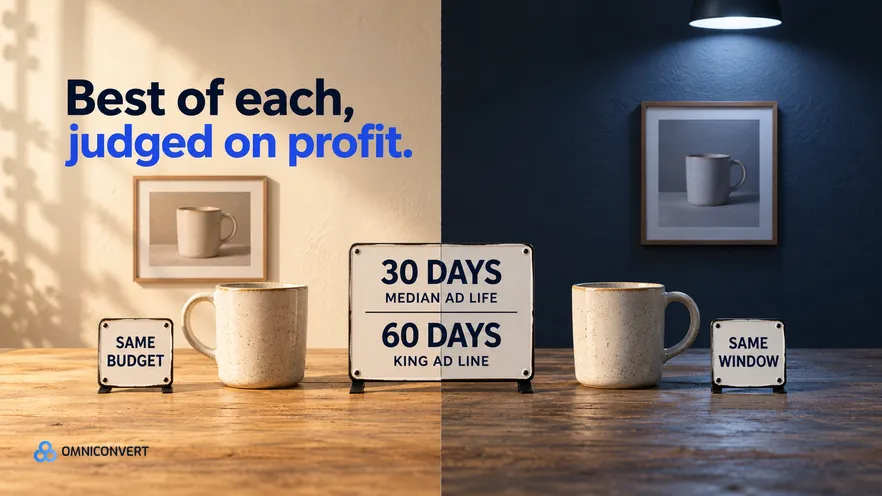
Survival matters as much as the first read. In one anonymized store audit, the median ad had been live 30 days and none had passed 60 [eCommerceBenchmark creative audit, 2026]. A type that wins week one and is gone by week four is a search cost you pay again, so compare both on days active as well as profit. A result is only worth reading if the test behind it was structured.
AliveCor used Omniconvert to run a structured A/B testing programme and achieved +21% conversion rate, +5% revenue per visitor, and 94% statistical relevance across their experiments. [Omniconvert, AliveCor case study]
Omniconvert Commander measures True Profit per ad and recommends scale, hold, reduce or kill on each one, and you approve what goes live. If you are weighing a generator-first tool, see how Omniconvert Commander compares with AdCreative.ai, or read our ranked list of the best AI ad creative tools for eCommerce.
FAQ: AI generated ads and human UGC
What is an AI-generated ad?
An AI-generated ad is an ad whose image, footage, script or presenter comes from a generative model, not from a camera. Some are fully synthetic. Others mix real product imagery with generated layouts or copy.
What is the difference between AI UGC and real UGC?
Real UGC is footage a customer or creator shot, using the product. AI UGC imitates that look with a synthetic presenter and voice. It copies the format, not the experience behind it.
How do you test AI generated ads against human UGC fairly?
Fix one product, angle and offer. Brief your best creator, build the AI ad to the same standard, and run equal variants on each side. Set a profit metric before launch, wait for a readable result, and check survival.
Do AI generated ads perform better than human UGC?
Against an average human ad they often do, because you can test far more of them. Against a good creator ad, on jobs that need trust or physical proof, they usually do not.
Are AI UGC ads effective?
They are effective at volume jobs: testing hooks, refreshing a tired concept, covering formats and languages. They are weaker where the buyer must believe a person.
Does Omniconvert Commander make AI UGC ads?
No. Omniconvert Commander is not an AI avatar tool: it does not render avatars, clone voices or film footage. It generates launch-ready static and video creative from customer data, composed with your existing product imagery. You approve what goes live.
Compare like with like
The question is really two questions. Which creative is better is answered by a fair test: the best of each side, one angle, a profit metric fixed in advance. Which is better at what is answered by the job: AI for volume, speed and coverage, creators for trust, proof and physical demonstration. So do not crown a winner. Run the seven steps on one product, read the four outcomes, and give each kind of creative the work it earned.