What Is an AI UGC Video Ad Generator?

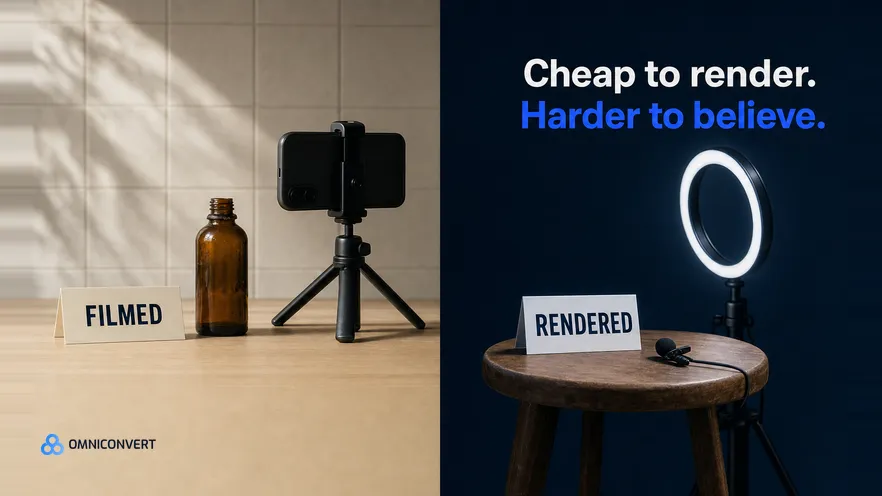
- An AI UGC video ad generator replaces filming with rendering. It does not decide which angle is worth testing.
- UGC ads now cover three lanes: avatar-based generators, creator-sourced UGC and brand-made video from real product imagery.
- Keep first-person experience claims away from synthetic presenters, because the FTC rule on fake testimonials covers people who do not exist.
- Creator-sourced UGC carries the strongest authenticity signal and is the slowest and most expensive format to iterate.
- Brand-made video wears out by angle rather than by face, so you refresh it from customer reviews you already own.
An AI UGC video ad generator is software that makes video ads in the style of user-generated content: a handheld, vertical frame, a person talking to camera, a casual product mention. Most tools sold under that label do it with a synthetic presenter and an AI voice, so you get a creator-style ad without a creator. UGC ads are a staple format for eCommerce brands on paid social, so the label now covers tools that work very differently. Last updated: September 2026.
I have spent 13 years in eCommerce, and the buying mistake I see most here is treating three different things as one. Avatar tools, real creators and brand-made video built from your own product imagery all get called UGC. They differ in who is on screen, what the ad can honestly claim, how fast you can change it and how fast it wears out.
I have a stake, so here it is up front. Nexus by Omniconvert is the AI eCommerce growth engine for Shopify brands: it reads your store, ad and customer data, ranks growth opportunities by profit impact, and builds the campaigns to act on them, and you approve what goes live. It belongs in the third group, and I cover its limits below.
What is an AI UGC video ad generator?
In most tools, you paste a product URL or write a script, pick a presenter from a library of AI actors, choose a voice and a language, and render a talking-head clip for a vertical feed.
The appeal is easy to see. A creator shoot means shipping, briefing, filming and edits. A new render means a new script. For a team that needs twenty hooks to find one that works, that changes how testing gets done.
What the tool does not do matters as much. It does not know which customers are worth acquiring or which words they use about your product. The script is still your job, and a weak script rendered fifty times is fifty weak ads.
UGC ads: the three things buyers confuse
- Avatar-based AI UGC. A synthetic person, a synthetic or cloned voice, and a script you supply. Tools in this lane each lean a different way: Arcads builds around AI actors, HeyGen around realistic avatars and voice cloning, and Creatify around turning a product URL into many avatar-led variants.
- Creator-sourced UGC. A real person receives the product, films it and is paid for the content. Sources include creator marketplaces, agencies and your own customers.
- Brand-made video ads. Motion creative built from your product photos, packshots and existing footage, with hooks taken from what customers wrote in reviews, surveys and support tickets. It does not pretend a customer made it. It borrows customer words, not customer faces.
General AI video tools such as TryHolo sit next to these lanes, generating video and content at volume for marketing teams. The split matters because each lane sets what the ad can honestly say. A real creator can say they used the product for a month, if they did. A synthetic presenter cannot.
Avatar-based generators: speed at a trust cost
Their strength is testing volume. If your question is which of fifteen opening lines stops the scroll, an avatar tool answers it cheaply. Localisation is the other: one script becomes several languages without recasting.
Their weakness starts with the product. Creator UGC works because a real person holds, opens, applies or wears the thing. A synthetic presenter talking next to a product shot is a different ad, and heavy scrollers learn to spot it.
Then there is trust. In 2024 the US Federal Trade Commission finalised a rule banning fake reviews and testimonials. It covers testimonials that misrepresent that they come from someone who does not exist, such as AI-generated ones, or from someone with no actual experience of the product. A synthetic presenter saying a serum cleared their skin in a week fits that description. Ad platforms add their own AI-content labels, and those policies change. Ask counsel before a synthetic presenter makes a first-person claim.
Fatigue is the quiet problem. A variant costs almost nothing, so teams flood the account with the same presenter grammar. Stock avatar libraries are shared by every customer of a tool, so the face in your ad can also be the face in a competitor's.
Creator-sourced UGC: real people, slower loops
This is the original form, and it still does one thing the other two cannot: show a real person using the product, with a real reaction. Where the proof is physical, such as texture, fit or size, it is hard to replace.
The costs are operational. You ship product, brief, wait for filming, review, request changes and agree usage rights. That loop takes days to weeks. When a hook fails, you cannot re-render it. You recut what you have or book another shoot.
Disclosure still applies. A paid creator is a paid endorsement, and platforms expect the partnership to be labelled. The difference is that the claims can be true.
Creator ads wear out per face and per hook. Brief several creators on one winning angle rather than one creator on many untested ones. To see how much of your live advertising is UGC today, use the creative mix audit on UGC share and format split.
Brand-made video ads from real imagery and real customer words
This is the lane buyers forget to consider, because it does not look like UGC. It borrows what makes UGC work, which is customer language, without borrowing a customer's face. A review that says the bottle finally stopped leaking in a gym bag becomes the hook, set over real product motion.
The strengths follow from that. The product on screen is the product in the box. The words come from real buyers, so the claim rests on what people experienced. And iteration is cheap by angle: durability, gifting and price per use can be three ads in the time a creator takes to reply to a brief.
The weaknesses are real too. Without a person on screen, the ad reads as brand content, and some audiences scroll past that faster. It also depends on your imagery, which is the subject of how to make ad creative from your real product photos.
These ads wear out by angle rather than by face, so the refresh is a new customer reason, not a new presenter. Customer reasons come from data you already own. How long an ad stays live is itself a signal, covered in why days active is a creative signal.
How the three compare
| Dimension | Avatar-based AI UGC | Creator-sourced UGC | Brand-made from real imagery |
|---|---|---|---|
| Who is on screen | A synthetic presenter with an AI voice | A real person who received the product | Your real product, with customer words |
| Speed to a first ad | Fastest: a render | Slowest: shipping, filming and edits | Fast, if good imagery exists |
| Cost of a new variant | Low: a new script | High: new footage or a recut | Low: a new angle on existing imagery |
| Authenticity signal | Weak once viewers notice | Strongest | Moderate: real product, real words |
| Disclosure and trust risk | High for first-person claims | Medium: paid partnerships need labels | Low, when claims are substantiated |
| Product in use | Limited: product shown beside the presenter | Strong: real hands, real use | Accurate product, no human moment |
| How it wears out | Fast: shared presenters, same grammar | Per creator and per hook | Per angle, refreshed from customer reasons |
| Best used for | Hook testing and localisation | Physical proof and social trust | Angle testing and always-on variants |
The row I would read twice is disclosure. A cheap ad that makes a claim no real person made stops being cheap once a regulator, a platform or a customer notices.
How to choose a UGC video ad generator
- What claim does the ad make, and who makes it? A first-person experience needs a real person who had it. Avatar tools are fine for product facts, offers and how-it-works scripts, not for a synthetic person saying they tried it.
- Does the proof need hands? Texture, fit and before-and-after results need a real person. Features, bundles and reasons to buy do not.
- Do you know the winning angle yet? If not, do not pay creators to find it. Test angles cheaply from customer language first, then brief creators on what won.
- How fast does your account burn creative? High spend against a narrow audience wears ads out quickly, which favours lanes where a new variant is cheap.
- Where does the script come from? If the answer is a copywriter guessing, fix that first. Hooks mined from reviews, surveys and support tickets beat invented ones.
Once you have a lane, how to create video ad variations at scale covers structuring variants so you learn which element won.
Where Nexus by Omniconvert fits, and where it does not
We built Nexus for the question upstream of all three lanes: which angle, for which customers, is worth paying to show. It unifies store, ad and customer data, reads what customers wrote in reviews, and ranks angles by CLV, so the reason your best customers stay outranks the reason a discount buyer clicked once. It also monitors competitor ad libraries and classifies their creative by angle, hook and offer, which shows when an angle is already crowded.
From there, it generates launch-ready assets from customer data, including video ad creative composed from the product imagery you already have. The work runs across 840 AI agents, results are measured in True Profit rather than ROAS, and you approve what goes live.
Now the boundary, stated plainly. It does not render AI avatars, clone voices, film footage or shoot product photography. If your plan needs a face on camera, you need a creator or an avatar tool, and the angles ranked in Nexus make a better brief for either one.
For tool-by-tool detail, see Nexus vs Arcads on AI actors and the brief, Nexus vs HeyGen on realism and localisation, Nexus vs Creatify on video volume and Nexus vs TryHolo on AI video for marketing teams.
FAQ: AI UGC video ad generators
What is a UGC video ad generator?
A UGC video ad generator is software that produces video ads in the style of user-generated content, such as a person talking to camera in a handheld, vertical frame. Most AI versions render a synthetic presenter and an AI voice from a script or a product link, so a new variant takes a render instead of a new shoot.
Do AI UGC ads need to be disclosed?
Check each ad platform you run on, because AI-content labels and policies differ and change. The larger risk is the claim itself. In the US, the FTC rule on fake reviews and testimonials covers testimonials from people who do not exist or never used the product, so keep first-person experience scripts away from synthetic presenters.
Is AI UGC cheaper than working with real creators?
Per variant, usually yes, because a new script is a new render rather than a new shoot. Per result, not always. Synthetic presenters are weaker at showing the product in use, and stock presenters can appear in other brands' ads. A sensible split is to test hooks cheaply first and then brief real creators on the winners.
Why do UGC ads wear out so quickly?
Because volume is easy and the format is uniform. When every variant uses the same presenter grammar, the audience stops seeing the difference between them. Creator ads wear out per face and per hook. Brand-made ads wear out per angle, which is easier to refresh, because new angles come from reviews and surveys you already have.
Is Nexus by Omniconvert an AI UGC video ad generator?
Not in the synthetic-presenter sense. Nexus generates video ad creative from your existing product imagery, with angles mined from customer reviews and ranked by CLV. It does not render presenters, clone voices or film footage. You approve what goes live, and Nexus is now onboarding founding brands.
Which should a Shopify brand start with?
Start with the angle, not the format. Pull the reasons customers give in reviews and surveys, test them cheaply as brand-made video, and put real creators on the angles that win. Add avatar tools where you need script or language volume, and keep first-person claims for real people.
The bottom line
An AI UGC video ad generator is a production shortcut, and a good one for testing hooks and languages. It cannot make a synthetic person's testimonial true. Treat UGC ads as three lanes. Use real creators where the proof needs hands and a genuine experience. Use avatar tools for script volume, with claims a synthetic presenter can honestly make. Use brand-made video from real product imagery and real customer words to find and refresh the angles worth paying for. Choose the lane first and the tool second, because the lane decides what your ad can honestly say.