How to Create Video Ad Variations at Scale

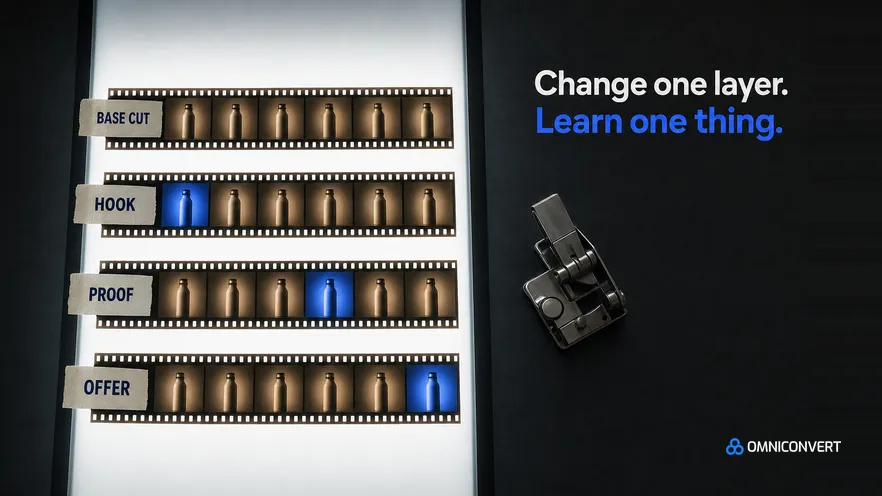
- A variation earns its place only when it changes one layer and answers a question you named before the edit.
- A modular base cut turns each new variation into an assembly job instead of a fresh edit.
- Angles justify the fewest variants and hooks the most, because the angle is the expensive decision and the hook is the cheap one.
- Judge each angle by the value of the customers it acquires, not by the cheapest cost per purchase.
- Retire rules written before launch keep fatigue from making the decision for you.
Most teams that try to produce video ad variations at scale end up with the same ad twenty times. New music, a different caption colour, a cut two seconds shorter. The account fills up, the test reads as noise, and nobody can say what was learned. Scale is not the number of files. It is the number of questions your files can answer. Last updated: September 2026.
The method in this guide rests on one rule: build a modular base cut and vary one layer at a time. The layers are the angle, the hook in the first seconds, the proof, the offer, the format and length, and the end card. Each variant changes exactly one of them, so each result tells you something you can reuse in the next brief.
I have spent 13 years in eCommerce. Omniconvert Explore reports a 23.2% average conversion uplift across 70,000+ experiments, and the lesson I carry from on-site testing into video is simple: a test that changes five things at once cannot tell you which one mattered. Nexus by Omniconvert is the AI eCommerce growth engine for Shopify brands: it reads your store, ad and customer data, ranks growth opportunities by profit impact, and builds the campaigns to act on them, and you approve what goes live.
What video ad variations at scale actually means
The failure mode is familiar. A team briefs an editor for twenty versions and gets twenty cosmetic changes to one idea. A couple look better by chance, and the next brief starts where the last one did.
A real variation changes something the customer would notice and care about. A new background track rarely qualifies. A new reason to buy always does. I have written separately about how the angle, the concept and the hook differ. The short version: the angle is the argument, the hook is the first beat, and one angle carries many hooks.
The six layers worth varying, and what each tests
| Layer | What it tests | Variants it usually justifies |
|---|---|---|
| Angle (the reason to buy) | Which argument moves the customers you want | Few, each a genuinely different argument |
| Hook (the first seconds) | Whether the opening earns attention for that angle | The most: cheap to make, quick to read |
| Proof | Which evidence makes the claim believable: demo, review, comparison | A handful per proven angle |
| Offer | Whether an incentive changes behaviour or only costs margin | Few, and only once the angle is proven |
| Format and length | Which container fits the placement and the story | A small set per placement |
| End card | Whether the close turns attention into a click | Few, tested last |
Read the table top to bottom as a sequence, not a menu. Hooks are the cheapest layer, so teams start there and end up comparing openings on an angle nobody wanted. Settle the angle first.
Format is the layer most often chosen by imitation. The most-copied video ad structure in most industries is the product demo close-up. That tells you what most brands run, not what your customers respond to. Treat format as a question to test, not a default to copy.
How to create video ad variations at scale, step by step
- Pick angles from customer data. Start from what your best customers say and buy: reviews, survey answers, support tickets and repeat-purchase patterns. Write each angle as one sentence a customer would agree with, then check which angles competitors already crowd.
- Build a modular base cut. Edit one master video as separate, swappable segments: hook, problem, proof, product demo, offer and end card. Keep each segment self-contained so it can be replaced without re-editing the rest.
- Define the variation matrix. List every planned variant, the single layer it changes and the question it answers. If two rows answer the same question, cut one. If a row changes two layers, split it.
- Produce the variants. Assemble each variant from the base cut and its new segment. Export every placement you plan to run, and name each file with its angle, layer and version so results can be grouped later.
- Run quality checks. Check product accuracy, captions, sound-off readability and safe zones on every exported file before launch. A variant that fails a check does not launch.
- Launch in structured tests. Test one layer per batch, keep the other layers fixed, and give each variant enough budget and time to produce a readable result. Do not add new variants mid-test.
- Read results by angle and by customer value. Group results by angle before you look at single files, and judge each angle by the value of the customers it brings in, not only by cost per purchase.
- Retire and replace before fatigue. Set retire rules before launch. When a variant starts to slide, replace it with a new hook or new proof on the same angle, and keep the base cut as the stable core.
Angles from customer data, then a modular base cut
Most variation budgets are lost in the brief, before anyone opens an editor. When the brief says make it more engaging, the editor can only vary surface details. When it names the angle, the customer who holds it and the evidence behind it, every variant has something real to change. That is the creative brief bottleneck, and video makes it expensive.
For angles, read the words customers already use. Reviews, post-purchase survey answers and support tickets show which problem the product solves, in their language. Repeat-purchase data shows which of those customers are worth acquiring more of. An angle that wins with one-time bargain hunters and an angle that wins with repeat buyers are different bets, even when the first-order numbers look alike.
Then check the crowd. Public ad libraries show which ads a competitor is running and how long each has been live. If every brand in your category makes the same argument, yours is one more voice in it.
The base cut is the other half. Build it with clean edit points between the opening, the problem, the proof, the demo, the offer and the end card. Use your real product in it, the same principle behind making ad creative from your real product photos.
Write the matrix last: one row per variant, with the layer it changes, the question it answers and the result that would change your next decision. If you cannot fill the last column, do not produce the variant.
The quality checks every variant must pass
- Product accuracy. The product on screen must match the product page: colourway, size, bundle contents, price. Scale multiplies small mistakes, and a wrong detail shown to a large audience comes back as returns and support tickets.
- Captions. Every spoken line needs a caption that is timed, spelled correctly and consistent with the ad copy. Check each aspect ratio, because a line that fits a wide frame can wrap badly in a vertical one.
- Sound-off readability. Watch every variant muted. Much feed video plays without sound, so the angle has to land from the picture and the on-screen text alone. If the hook depends on a voice line, it needs a text version too.
- Safe zones. Each placement lays its own interface over the video: account names, buttons, caption overlays. Keep the product, the key text and the offer clear of those areas in every format you export.
I add one check that is not about the file: the claim. If a proof variant makes a claim, someone should be able to show where it is true.
Read results by angle and by customer value
Single-file results are noisy. Ten hook variants on one angle spread across a range partly by chance, and the best of them looks better than it is. Grouped by angle, the same data answers the question you care about: which argument works.
File names do the heavy lifting. If each file carries its angle, layer and version, grouping is a spreadsheet filter. If not, someone rebuilds the mapping by hand, and that job quietly stops happening.
Then weight by value. An angle that sells a discounted starter kit to first-time buyers can post a lower cost per purchase than an angle that sells the full range to people who reorder. Judged on the first order, the first angle wins. Judged on what those customers are worth over time, the order can flip. The CLV-weighted growth model sets out the reasoning. The practical rule: rank angles by the profit of the customers they acquire.
Check delivery before you call a winner. Ad delivery systems tend to push spend toward whichever variant gets early signal. A variant that barely ran has not lost. It has not been tested.
Retire and replace before fatigue decides for you
Fatigue rarely arrives as a cliff. Frequency rises, the click rate slides and cost per purchase creeps up, often for a while before a weekly report makes it obvious. Write the retire rule into the matrix: which trend, over which window, triggers a replacement.
Replace from the bottom of the stack up. A tired hook on a strong angle needs a new hook, not a new angle. Tired proof needs new evidence. Only when every hook and proof on an angle has faded is the angle itself done.
Protect what works. An ad live for 60 days or more is a King Ad, and the King Ad framework explains why one to three of them carry most of the results in a healthy account. Do not retire a King Ad on schedule. Build new variants around its angle and let it keep earning while they prove themselves.
The same signal works on competitors. Creative longevity, measured in days active, shows which of their ads survived, because advertisers kill losing ads fast.
Where AI generation fits, and where it stops
AI video tools for ads fall into two broad groups. Some generate presenters, avatars or synthetic voices, which is the category covered in what an AI UGC video ad generator is. Others compose ads from assets you already own: product imagery, customer language and proof you can verify. Both can feed a variation matrix, and they answer different questions.
Nexus belongs to the second group. It generates launch-ready assets from customer data, including video ad creative composed from your existing product imagery. It ranks angles by CLV, measures results in True Profit rather than ROAS, and monitors competitor ad libraries continuously, classifying competitor creative by angle, hook and offer. It does not render avatars, clone voices or film footage, and it leaves the bid and campaign lifecycle to the ad networks. You approve what goes live.
FAQ: video ad variations at scale
How many video ad variations should I make per test?
Enough to answer one question, and no more. For an angle test, that means a few genuinely different arguments on the same base cut. For a hook test on a proven angle, you can run more, because hooks are cheap to make and quick to read. If you cannot say what each variant is testing, you have too many.
Should one variation change more than one element?
Not in a structured test. When a variant changes the hook and the offer at once, a better result cannot be credited to either, so the next brief learns nothing. Change one layer per variant, keep the rest of the base cut fixed, and combine winning layers only after each one has proven itself on its own.
What is a modular base cut?
A master video ad edited as separate, swappable segments: a hook, a problem beat, proof, a product demo, an offer and an end card. Each segment has clean edit points, so a new variation replaces one segment instead of re-editing the whole ad. It is what makes video variation fast without making it sloppy.
How do I know when a video ad variation is fatigued?
Watch the trend, not a single day. Rising frequency, a sliding click rate and a creeping cost per purchase over the same window usually point to fatigue. Set the rule before launch, replace a tired hook or proof on the same angle first, and keep any ad that has run 60 days or more while its results hold.
Can Nexus by Omniconvert create video ad variations?
Yes. Nexus by Omniconvert generates video ad creative from your existing product imagery and customer data, ranks angles by CLV and measures results in True Profit. It does not render avatars, clone voices, film footage or buy media. You approve what goes live, so the angle choice and the final call stay with your team.
Should I copy the video ad formats competitors run most?
Use them as information, not as a template. The most-copied format in a category tells you what most brands run, not what your customers respond to, and a crowded format makes your ad harder to tell apart. Test format as its own layer on an angle you have already proven.
The bottom line
Video ad variations at scale is a structure problem before it is a production problem. Build one modular base cut, pick angles from what your best customers say and buy, and change one layer per variant so every file answers a question you wrote down first. Check every export before it runs. Read results by angle and by customer value, not by the cheapest purchase. Retire on a rule you set before launch, and protect the ads that have earned a long life. Do that, and twenty variants stop being twenty guesses. They become twenty answers.