Best Ad Creative Fatigue Tools in 2026, Ranked

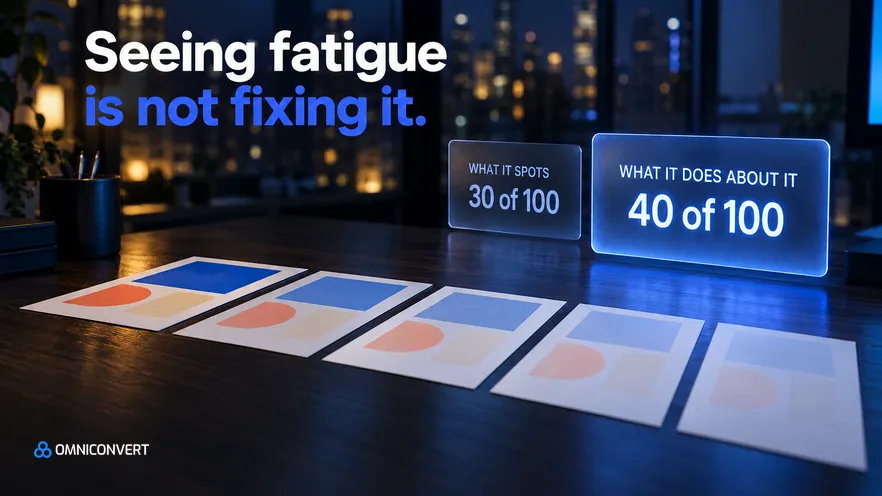
- A fatigue tool has two jobs: spot the tired ad and act on it. Most tools do the first well and stop. The rubric here gives 40 of 100 points to the second job.
- Birch ranks first because its rules turn a fatigue signal into an action every 15 minutes, across four ad platforms. You still write the threshold and the replacement.
- Motion gives the clearest read on why a concept decays, but its own fatigue guide is a report you build, not an alert, and it does not generate creative.
- A rising cost per click is not the same as falling profit. A rule that pauses on cost per click alone can kill an ad that still earns.
- Omniconvert Commander has the weakest detection score on this list, because it draws no fatigue curve. It scores on judging each ad on True Profit and generating the replacement.
- Madgicx and Atria both pair a fatigue flag with a creative workflow, but both judge ads on platform metrics such as ROAS and CPA, not profit after real costs.
The best ad creative fatigue tools do two jobs, and most do only one. They spot an ad that is wearing out, and they do something about it. I scored six tools on both jobs, using each vendor's own site.
A creative fatigue tool is defined as software that reads ad performance over time, flags creative whose results are decaying under repetition, and either acts on it or hands you the next step. This page ranks those tools. It does not re-explain the decay curve: for that, read the complete guide to creative fatigue.
One entry is ours. Omniconvert Commander (formerly Nexus) is the AI eCommerce growth engine for Shopify brands: it reads your store, ad and customer data, ranks growth opportunities by profit impact, and builds the campaigns to act on them, and you approve what goes live. It does not win this list.
How did we rank the best ad creative fatigue tools?
Five dimensions, scored out of 100, with 55 points on what a tool does after it sees fatigue.
Replacement lag is defined as the number of days between the first sign that an ad is decaying and the day its replacement is live. The rubric rewards any tool that shortens it.
| Dimension | Weight | What earns the points |
|---|---|---|
| Fatigue detection | 30 | Reads decay over time at ad or concept level, and says so on its own site |
| Response to fatigue | 25 | Rotates, pauses, rules, or recommends a specific action per ad |
| Replacement creative | 15 | Briefs, generates or launches the next ad |
| Profit judgment | 15 | Decides on profit after real costs, not a platform metric |
| Channel coverage | 15 | Ad platforms the vendor names |
Best ad creative fatigue tools at a glance
- Birch (previously Revealbot), 72 out of 100. Rules that act on a fatigue signal every 15 minutes, on four ad platforms.
- Omniconvert Commander, 71 out of 100. Per-ad True Profit, a scale, hold, reduce or kill call, and the replacement asset. The weakest detection here.
- Smartly, 70 out of 100. Automated rotation and creative production across the widest channel list.
- Atria, 61 out of 100. Fatigue flags and fix recommendations in Slack, with variants generated and launched.
- Madgicx, 58 out of 100. Continuous Meta monitoring with a creative refresh workflow.
- Motion, 57 out of 100. The clearest read on why a concept decays, and no action after it.
Ad creative fatigue tools compared side by side
| Tool | Detection (30) | Response (25) | Replacement (15) | Profit (15) | Channels (15) | Total |
|---|---|---|---|---|---|---|
| Birch | 21 | 22 | 6 | 9 | 14 | 72 |
| Omniconvert Commander | 12 | 20 | 14 | 15 | 10 | 71 |
| Smartly | 15 | 20 | 14 | 6 | 15 | 70 |
| Atria | 18 | 16 | 14 | 4 | 9 | 61 |
| Madgicx | 22 | 15 | 12 | 4 | 5 | 58 |
| Motion | 26 | 6 | 8 | 5 | 12 | 57 |
The best ad creative fatigue tools, ranked
1. Birch (previously Revealbot), 72 out of 100
Revealbot became Birch, and its rename post says the team kept the features it was valued for [Birch, 2024]. Two parts matter here. Explorer is the fatigue view: its own tagline is "Track ad performance, spot fatigue, find top assets", and it ships an "Identify fatigued ads" template. Rules are the response: nested conditions, custom metrics and 20+ actions, checked every 15 minutes [Birch, 2026]. A rule can compare a metric to itself last week, so a falling trend becomes a trigger without a person watching the chart. Birch lists Meta, Google, Snapchat and TikTok.
It loses points on replacement. Its Stage product duplicates your ad setups from Drive media. It launches the next ad, but you make it. And the threshold is yours: a rule that pauses on a cost-per-click rise inherits the problem I describe further down.
Best for: media buyers who want fatigue signals to trigger actions across four ad platforms without opening a dashboard.
2. Omniconvert Commander, 71 out of 100
Omniconvert Commander does not draw a fatigue curve, and I will not pretend it does. It reaches the same question from the profit side. It measures True Profit per ad, reconciled against Meta and Google daily, and gives each ad a scale, hold, reduce or kill recommendation that you approve. An ad whose cost per click is climbing but whose profit holds stays on the "hold" list. An ad whose profit has slipped under real costs moves toward "reduce", whatever its ROAS says. Then it generates launch-ready assets from customer data, with its customer intelligence layer choosing the angle. That is why it scores 15 of 15 on profit and 14 on replacement, and only 12 of 30 on detection.
It does not tag creative at element level or produce concept dashboards, and it covers Meta and Google only. It is also the newest tool here, so its public review base is the smallest.
Best for: Shopify brands that want to decide on profit instead of platform metrics and need the replacement written, not only flagged. Where a dedicated fatigue chart matters most, Motion is the better pick.
3. Smartly, 70 out of 100
Smartly splits its product into Creative, Media and Intelligence suites. Its media pages carry a "Curb ad fatigue and automate optimizations" section built on "automated triggers" and automatic ad rotation, and its Creative suite says it "intelligently refreshes content to prevent ad fatigue". The channel list is the widest here: all major social channels, connected TV (over 200 streaming services) and the open web [Smartly, 2026]. It scores well on response, replacement and coverage.
Its public pages do not say how fatigue is detected or which thresholds apply, so detection scores lower than the claim suggests. Ask for that detail before you buy.
Best for: large teams that want creative production and automated rotation across social, connected TV and the open web in one system.
4. Atria, 61 out of 100
Atria's fatigue workflow lives in its AI teammate, Raya, inside Slack. Its Slack page carries the prompt "Monitor our live ads and flag anything starting to fatigue" and a sample reply that sorts ads into kill, scale and hold [Atria, 2026]. Elsewhere Atria says Raya generates a per-ad fix recommendation and that "Your team makes the calls". Atria also builds briefs from your data, generates variants and launches them to Meta in a click. Meta and TikTok are the named platforms.
Fatigue is not a headline feature on its homepage, and its examples read ROAS, CPA and frequency, not profit.
Best for: small paid social teams who live in Slack and want flags, fix ideas and new variants in one place.
5. Madgicx, 58 out of 100
Madgicx lists an "Ad Fatigue detector" in its navigation, and its blog describes fatigue monitoring that "monitors your Meta advertising campaigns continuously, alerting you to performance drops". It also names a Creative Refresh Agent and an Ads Rotation Agent, and the AI Ads workflow generates new ads. Madgicx claims it forecasts fatigue 3 to 5 days early, a vendor claim I could not test.
Only Meta is named in the main text, which holds channels at 5 of 15, and its pages do not say whether the refresh agent changes live ads or waits for you. ROAS is the judge, not profit.
Best for: Meta-only advertisers who want alerts and a refresh workflow in the same tool as their media buying.
6. Motion, 57 out of 100
Motion is the best reader on this list, and its low rank is a rubric result, not a verdict on the product. It groups ads into concepts, tags them by hook and angle, and shows whether top performers are gaining or losing momentum week over week. But its own help guide treats fatigue as a report you build, with cost per click as the main indicator, and describes no alerts. It also does not generate or launch ads: it recommends what to test next. It covers Meta, TikTok, YouTube and LinkedIn. For the head-to-head with our own product, see Omniconvert Commander compared with Motion.
Best for: creative strategists who need to understand why a concept decays and brief the next round from evidence.
Why does a fatigue alert without a replacement still cost you money?
Because an alert only starts the clock on replacement lag. The ad keeps spending while you brief, make and approve its successor. This is why the rubric weighs response and replacement above detection.
The failure I see most is the blunt pause rule. A team sets a rule to pause any ad when frequency passes a number or cost per click rises, because it looks like discipline. It fires on ads that still earn. Motion's own guide makes the point: if cost per click rises but ROAS holds steady, the ad may still be worth running. The rule stops it anyway, budget moves to thinner creative, and nothing is queued behind it. The team loses a profitable ad and gets a worse one, on the day it felt most in control.
Fixing this needs a profit check in the decision and a stocked bench of replacements. A bench needs angles, and angles come from testing: across Explore data the average conversion uplift is 23.2% over 70,000+ experiments [Omniconvert Explore, 70,000+ experiments]. AliveCor used Omniconvert to run a structured A/B testing programme and achieved +21% conversion rate, +5% revenue per visitor, and 94% statistical relevance across their experiments. [Omniconvert, AliveCor case study]
Fatigue tools tell you when. Testing tells you what comes next. If the next ad is video, the best AI UGC ad generators render it. To judge how far automation should go, read about autonomous ad campaign generation. For cadence, see how often to refresh ad creative and saturation versus edge. True Profit is the check the pause rule is missing, and the buying layer is ranked in the best AI media buying tools.
Ad creative fatigue tools: frequently asked questions
A creative fatigue tool is software that reads ad performance over time, flags creative whose results are decaying under repetition, and either acts on it or hands you the next step. The good ones also help you replace the ad.
Most watch a trend in one platform metric, such as cost per click, click-through rate or frequency, and flag the ad when the trend turns. Rule engines like Birch let you set the threshold yourself. Omniconvert Commander reads per-ad True Profit instead.
Only with a profit check in the rule. A rising cost per click does not always mean a falling return, and an automatic pause can kill an ad that still earns. Safer: let the tool flag the ad, then approve the pause or the replacement.
Smartly covers the widest range, from social to connected TV and the open web. Among the lighter tools, Birch lists Meta, Google, Snapchat and TikTok, while Madgicx is described mainly around Meta.
Atria goes further on action: it flags tired ads in Slack, recommends kill, scale or hold, and generates and launches variants. Motion gives the clearer read on why a concept is decaying, but it stops at the report.
It is the decision and replacement layer. Omniconvert Commander judges each ad on True Profit, recommends scale, hold, reduce or kill, and generates launch-ready assets from customer data. You approve what goes live. It has no fatigue curve.
Birch is best for rules that act on a fatigue signal. Omniconvert Commander is best for deciding on profit and writing the replacement. Smartly suits multi-channel teams, Atria the Slack workflow, Madgicx Meta buyers and Motion creative strategists. Whichever you pick, buy a way to replace the ad, not only a way to see it die.
Replace the ad, not only the alert
A fatigue flag is only useful if the next ad is ready. Omniconvert Commander is the AI eCommerce growth engine that judges each ad on True Profit, generates launch-ready assets from customer data, and waits for your approval before anything goes live.