Ad Creative Fatigue Solution: Fix a Fading Ad in 6 Steps

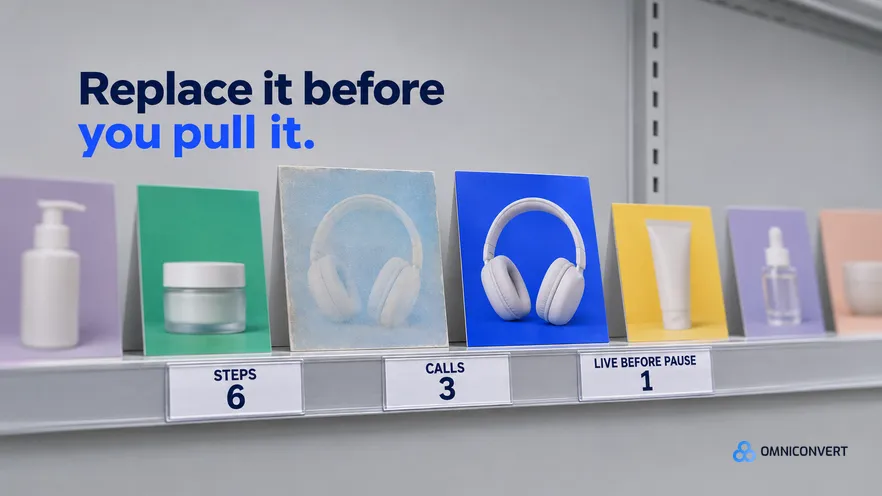
- Confirm the cause before you act: a newer ad that does no better than the old one means the cause sits outside the creative.
- Price what the fade costs in profit per ad, because click cost can climb while the ad still earns.
- Refresh when sibling ads on the same angle hold, replace when they fade together, and pause only when the ad loses money on its own orders.
- Brief the replacement around a motivation customers have already named, and keep the offer constant so the result isolates the angle.
- Launch the replacement beside the fading ad and pull the old ad only once the new one is live and spending.
- Read the result on profit per ad over a full purchase cycle, with the verdict rule written before launch.
- A tool can detect a fade and build the replacement, but it cannot cure a tired offer.
An ad creative fatigue solution is a short, ordered routine for the week a good ad starts to fade: confirm the cause, price what the fade costs, choose a response, ship the replacement and read the result. Here is that routine in six steps, for the operator who has an ad slipping today and needs to know what to do first.
Across the brands I talk to, the fade itself is rarely the expensive part. The response is. Two live pages own the neighbouring ground. Cadence is covered in how often to refresh ad creative, and software in the best ad creative fatigue tools. What follows is the week one ad starts slipping.
Omniconvert Commander (formerly Nexus) is the AI eCommerce growth engine for Shopify brands: it reads your store, ad and customer data, ranks growth opportunities by profit impact, and builds the campaigns to act on them, and you approve what goes live. The steps run in a spreadsheet and Ads Manager.
The ad creative fatigue solution in one rule
An ad creative fatigue solution is defined as the ordered response to an ad whose results are decaying under repetition: it confirms the cause, chooses between refresh, replace and pause, ships a successor and reads the outcome in profit. What fatigue is, and how it differs from audience saturation, is covered in ad creative fatigue, and the whole subject sits in the complete guide to creative fatigue.
The rule rests on one asymmetry. A fading ad often still earns something while you brief its successor. A hole where the ad used to be earns nothing. Fade means the response decline here. It shows before cost or profit moves, so profit is how you price a fade, not how you spot one.
Ad creative fatigue solution: fix a fading ad in six steps
- Confirm it is fatigue. Compare the ad with a newer ad on the same audience. If the newer ad does no better, the cause sits outside the creative: rule out audience saturation, an auction change, seasonality and a tracking break first.
- Price what the fade costs. Read profit per ad, not cost per click. An ad whose click cost climbs while profit holds is not costing you yet, so start the brief and switch nothing off. An ad that has dropped under break-even is costing you now.
- Choose refresh, replace or pause. Use the table below. Refresh the execution when sibling ads on the same angle hold. Replace the angle when they fade together. Pause only when the ad loses money on its own orders.
- Brief from what customers say. Choose the new angle from a motivation customers have already put into words. Keep the offer and the product the same as in the old ad, so that any gap in results belongs to the angle.
- Launch the replacement beside the old ad. Keep the old ad on and bring the replacement up next to it, aimed at the same audience, with a budget of its own. Pause nothing until one replacement is live and spending.
- Read the result, then retire the old ad. Compare both on profit per ad over one full purchase cycle. Retire the old ad only when the replacement holds. Log the angle, the days active and the verdict, so the next brief starts from evidence.
Steps 1 and 2 take an afternoon, with data you already hold. Step 1 is where most wasted briefs die, because new creative fixes almost none of the look-alikes. The complete guide has a check for each. To catch the next fade before step 1 starts, read how to predict ad fatigue.
How to choose between refresh, replace and pause
A replacement is defined as an ad built on a new angle, the reason someone should buy. A refresh keeps the angle and changes the execution, the specific file. The terms behind that split are in hook, concept and angle.
The complete guide starts the fix at a new angle, because fatigue is a shortage of new information. The triage starts one rung lower when sibling ads on the same angle still hold: the angle works and only one file has worn, so a new execution is the cheaper first move. When the siblings fade together, go to the top. Match what you see to the move in the table.
| What you see | What it usually means | The move | First step |
|---|---|---|---|
| One ad decays, siblings on the same angle hold | A weak execution, not a spent argument | Refresh | Rotate the execution and keep the angle |
| Every ad on the angle decays together | The angle itself is spent | Replace | Brief a new angle against a different customer motivation |
| Every ad in the account gets dearer, including one launched yesterday | An auction change or seasonality | Hold | Leave the creative alone and check the auction and demand |
| Frequency climbs, first-time reach collapses, and a new ad in the same audience does no better | Audience saturation | Widen | Change the audience before you brief another angle |
| Conversions drop sharply on one day | A tracking break | Fix tracking | Check store orders against the platform before any pause |
| Click cost climbs but profit per ad holds | A healthy ad with a worrying chart | Brief | Start the brief and switch nothing off |
| The ad loses money on its own orders, even at its best | A bad unit, not a tired one | Pause | Pause now and check whether repeat purchases repay it |
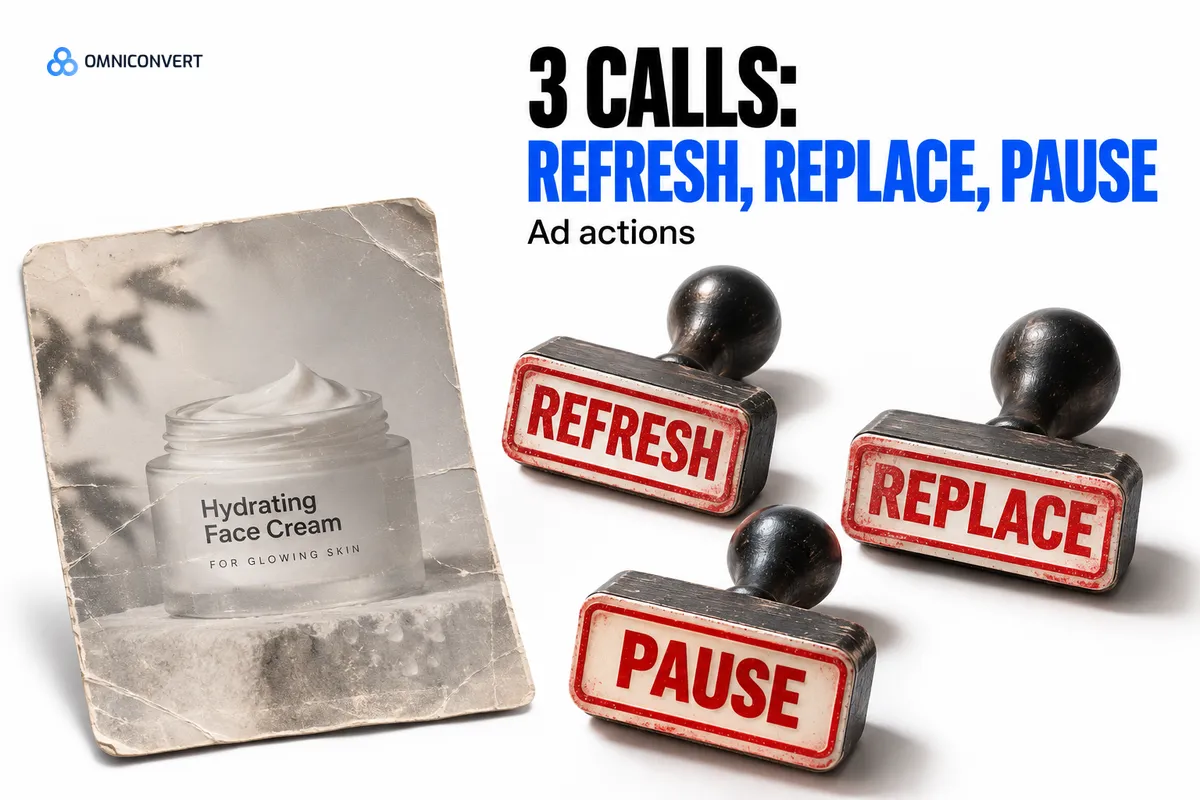
Read the first column first. If you cannot say which row you are in, you are still on step 1. Refresh, replace and pause are the three calls on the ad. The other moves leave the ad alone while you fix what is wrong, or start the next brief early.
How to read the replacement's result
Reading a replacement is a small experiment, and it fails the same way experiments fail: the verdict is argued after the numbers arrive. Write the rule first. Say which metric decides, over what window, and what the replacement must match for the old ad to retire. Profit per ad is the metric I trust, because a new angle can win clicks by promising more than the product earns. True Profit is the fuller version of that measure, after returns, discounts and costs.
Picture a replacement that wins on click cost in its first week. The team retires the old ad that Friday, because the chart says the fix worked. Two weeks later the orders land, and profit per ad sits below the old ad's: the new angle promised more than the product earns. The old ad is gone, nothing runs beside the replacement to compare it with, and the log records the angle as a win. The cost is a log that teaches the next brief the wrong lesson.
Test discipline is the same whatever you test: the result line comes before the result, and the new version is read against the old one.
AliveCor used Omniconvert to run a structured A/B testing programme and achieved +21% conversion rate, +5% revenue per visitor, and 94% statistical relevance across their experiments. [Omniconvert, AliveCor case study]
Wait the full purchase cycle, or you will mistake sales that are merely delayed for sales the new angle lost. Then log the result: the angle, the days active and the verdict. A library of those rows answers the question every team asks next, which is how long an ad lasts in your account. Creative longevity by days active shows how to measure it.
What a tool can fix, and what it cannot
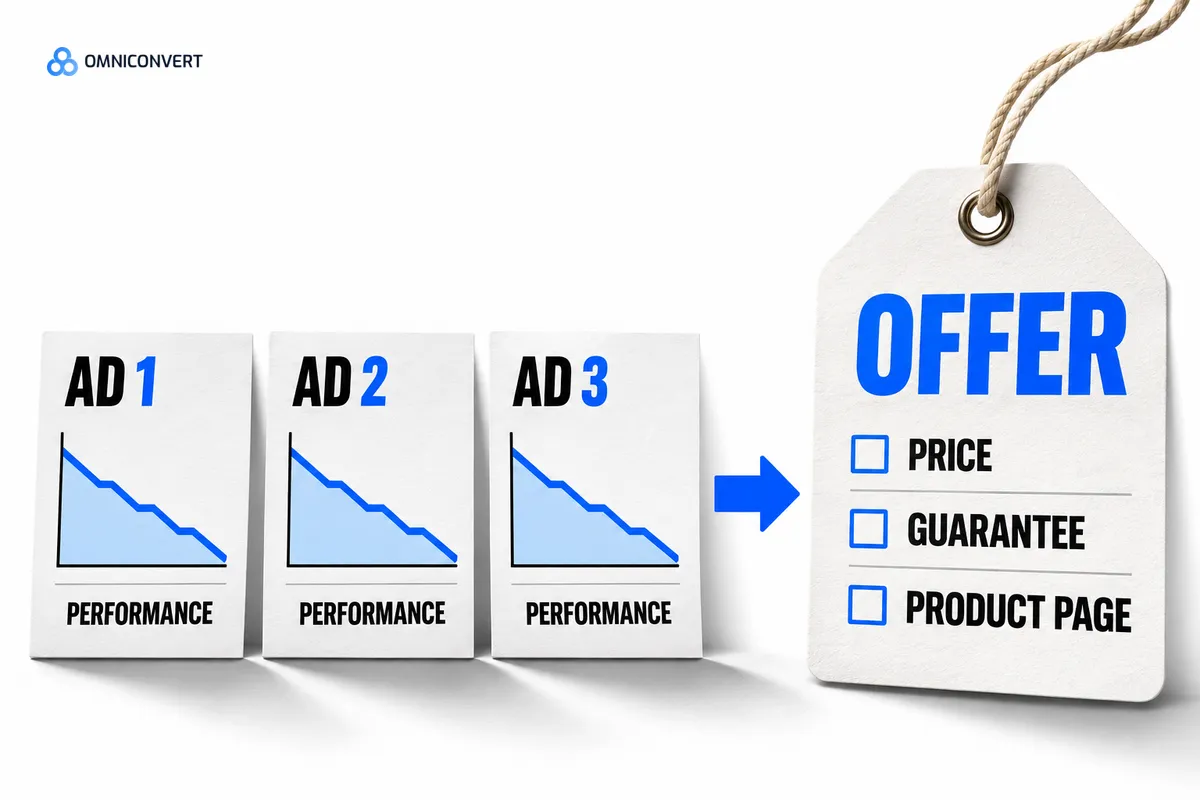
Run one check before you blame creative again. If three successive replacements on different angles each fade just as quickly, stop briefing ads and look at the offer. A weak price, a thin guarantee or a product page that loses people after the click will wear out any ad. A worn ad has lost its news. An offer nobody wants never had any.
Where the problem is the ad, Omniconvert Commander helps at two points. It measures True Profit per ad, the profit read in this routine, and recommends scale, hold, reduce or kill for each one. For the replacement, it generates launch-ready assets from customer data, with creative variants ranked by CLV-weighted angle, and approved work launches to Meta. You approve what goes live. It does not draw a fatigue curve, so confirming the cause stays with Ads Manager or a dedicated tool, and the choice between refresh, replace and pause stays with you.
FAQ: fixing a fading ad
What is an ad creative fatigue solution?
An ad creative fatigue solution is the ordered response to an ad whose results are decaying under repetition. It confirms the cause, chooses between refresh, replace and pause, ships a successor beside the old ad, and reads the result in profit before retiring the original.
How do I know an ad is fatigued and not just having a bad week?
Compare it with a newer ad on the same audience. If the newer ad does no better, the cause may be audience saturation, an auction change, seasonality or a tracking break. If the newer ad holds while the old one decays, the creative is the likely cause. Rising frequency and falling first-time reach point to decay, but they do not prove fatigue on their own.
Should I pause a fatigued ad right away?
No, not unless it loses money on its own orders. A fading ad usually still earns while you brief its successor. Pausing first leaves a gap in delivery and removes the comparison you need to judge the fix. Launch the replacement beside it, then retire the old ad.
How long do I wait before judging the replacement?
Wait one full purchase cycle for your store, the time between a first ad touch and a typical order. Write the verdict rule before launch, for example that the replacement must match the old ad on profit per ad, so the result cannot be argued afterwards.
Is there an AI tool to fix creative fatigue?
A tool can detect a fade and produce the replacement faster, and that shortens the gap. It cannot cure a tired offer. If new angles fade just as fast, the problem is the offer, the price or the product page, and no creative generator will repair that.
How does Omniconvert Commander help fix a fading ad?
Omniconvert Commander helps with the replacement and the verdict. It generates launch-ready assets from customer data, with angles ranked by CLV, and approved work launches to Meta. It measures True Profit per ad, so you can read the replacement against the old ad. It does not draw a fatigue curve, so confirming the cause stays with Ads Manager or a dedicated tool.
Replace before you retire
A fading ad is a scheduling problem more than a creative one. Confirm the cause, price what the fade costs, and choose refresh, replace or pause from what the siblings do. Then launch the successor beside the old ad and retire the original only when the new one holds on profit per ad. The order is the solution: skip a step and you lose the comparison.