Audience Analysis: How to Do It Step by Step (2026)

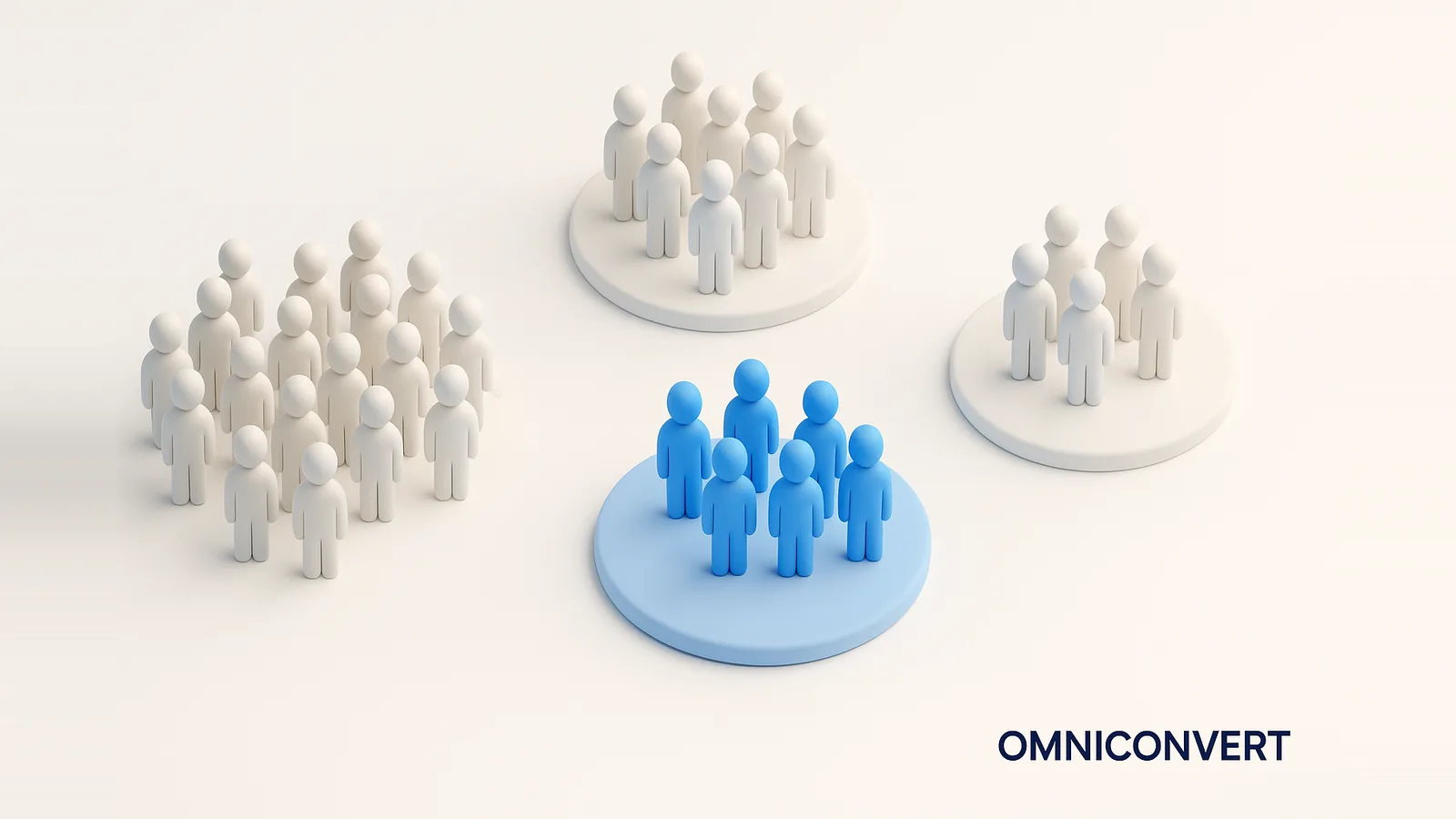
- Audience analysis studies who is most likely to buy, demographics, psychographics, behavior, and intent, so you market to segments accurately instead of to a broad average.
- Follow the Omniconvert Audience Analysis Framework: define goals, collect data, segment, validate, and activate, then repeat as the audience shifts.
- Combine first-party data, primary research, and secondary research, and pair quantitative data (what happens) with qualitative data (why).
- Use several segmentation types together, demographic, geographic, psychographic, and behavioral, plus value-based models like RFM, then turn segments into buyer personas.
- Avoid overgeneralization, outdated data, confirmation bias, and ignoring qualitative insight. Omniconvert Commander keeps segments living and value-based.
Audience analysis is the process of studying the people most likely to buy from you, their demographics, psychographics, behavior, and intent, so you can group them into meaningful segments and market to each one accurately instead of treating everyone the same. Done well, it is one of the highest-leverage things a marketing team can do, and Omniconvert has studied audience and segment behavior across the CROBenchmark dataset of 7,000+ websites in 15+ industries, against 248+ audit criteria, drawing on 13 years in eCommerce conversion rate optimization [CROBenchmark Report 2026, Omniconvert].
Omniconvert Commander (formerly Nexus) is the AI eCommerce growth engine that unifies customer data into living, value-based segments, then turns them into ranked actions, so audience analysis stops being a one-off spreadsheet exercise. This guide defines audience analysis, explains why it matters, walks through the Omniconvert Audience Analysis Framework step by step, covers what data to collect, how to segment, how to build buyer personas, and the mistakes to avoid. Every section answers the question directly, then goes deeper.
What is audience analysis?
Every audience is really several audiences wearing one label. A fitness brand might serve busy professionals who want efficiency, new parents rebuilding a routine, and committed athletes chasing performance, all at once. Audience analysis is how you see those distinct groups inside the mass, and how you learn what each one needs, fears, and responds to.
It draws on four kinds of signal. Demographic data describes who people are, psychographic data captures what they value, behavioral data records what they actually do, and intent data hints at what they are about to do. The combination is what separates a real analysis from a stereotype: demographics alone tell you age and location; behavior tells you who is genuinely about to buy.
Why does audience analysis matter?
The cost of skipping analysis is quiet but large: budget spent reaching people who were never going to buy, and messages that land flat because they speak to no one in particular. Focused analysis improves the metrics that decide whether marketing pays off:
- Click-through rate: Messages matched to a segment's actual interests earn more clicks than generic creative aimed at everyone.
- Conversion rate: When the offer fits the audience's real need, more visitors take the action, the core of conversion rate analysis.
- Customer acquisition cost: Targeting high-fit segments means less spend wasted on poor-fit prospects, lowering the cost to win each customer.
- Lifetime value and engagement: Reaching the right customers raises lifetime value and keeps engagement high, because the relationship starts with relevance.
What is the Omniconvert Audience Analysis Framework?
A complete audience analysis is not a single task but a repeatable loop. The framework breaks it into five stages so nothing important gets skipped, and so a weak stage is easy to spot.
| Stage | What you do | Output | How Omniconvert Commander supports it |
|---|---|---|---|
| 1. Define | Tie the analysis to a real goal using SMART objectives | A clear question the analysis must answer | Frames segments around revenue and retention goals |
| 2. Collect | Gather first-party, primary, secondary, and third-party data | A clean, combined dataset | Unifies scattered customer data into one source |
| 3. Segment | Group by demographics, behavior, and value | Distinct, addressable segments | Builds RFM and CLV segments automatically |
| 4. Validate | Confirm segments with A/B tests and feedback | Segments proven to behave differently | Tracks how segments respond over time |
| 5. Activate | Deploy segments in campaigns, then refine | Targeted campaigns and a repeating loop | Turns segments into ranked next actions |
The stages are sequential but the framework is circular: activation produces new behavior, which becomes new data, which sharpens the next round of segmentation. Treating it as a loop rather than a project is what keeps an analysis from going stale the moment a campaign ships.
See your audience as living, value-based segments instead of a static spreadsheet.
Learn more about Customer Intelligence in Omniconvert Commander →What data should you collect for audience analysis?
Good analysis is only as good as the data underneath it. Four types matter, and the most trustworthy ones are usually the closest to your own customers:
- First-party data: Your CRM, website analytics, and purchase history. The most reliable source because it reflects real behavior from real customers.
- Primary research: Surveys and interviews you run yourself, which add the qualitative reasons behind the numbers.
- Secondary research: Industry reports and published studies that set context and benchmarks beyond your own data.
- Third-party data: External providers that fill gaps, used with care for accuracy and privacy compliance.
The discipline is to pair the two registers of data. Quantitative sources (CRM, web analytics, email) tell you what is happening and at what scale; qualitative sources (surveys, interviews, social sentiment) tell you why. An analysis built on numbers alone profiles behavior without understanding it; one built on opinions alone mistakes a few loud voices for the market.
How do you segment your audience?
Segmentation is where analysis becomes actionable. The four core types each answer a different question:
| Segmentation type | What it groups by | Example |
|---|---|---|
| Demographic | Age, gender, income, job role | Professionals aged 30 to 45 |
| Geographic | Location, region, climate | Urban customers in cold climates |
| Psychographic | Values, interests, lifestyle | Sustainability-minded buyers |
| Behavioral | Purchase history, usage, engagement | Repeat buyers in the last 90 days |
On top of these sit value-based models that rank segments by worth. RFM segmentation groups customers by how recently and how often they buy and how much they spend, which is the fastest way to find your highest-value audience. Lifecycle segmentation tracks where each customer sits from new to loyal to lapsing, and behavioral clustering finds natural groupings in the data you might not have predicted. The strongest analyses combine several types, so a segment is defined by genuine, actionable difference rather than demographics alone.
How do you build and validate buyer personas?
A segment is a group; a persona is a face for it. To build one that a team can actually market to, capture five things: demographics, goals and motivations, pain points, the channels where they spend time, and the objections that stop them from buying. Grounded in real data, a persona keeps creative, targeting, and product decisions aligned to a real person rather than a committee's guess.
Then validate before you scale. The fastest checks are practical:
-
A/B test the segmentRun a message tailored to a segment against a generic control. If the tailored version wins, the segment is real. Omniconvert Explore runs these tests without engineering.
-
Close the feedback loopAsk the segment directly with surveys and interviews whether the persona matches their reality, and adjust where it does not.
-
Track performance metricsWatch conversion, engagement, and retention by segment over time. Segments that behave differently in the data are the ones worth keeping.
Which audience analysis mistakes should you avoid?
Most failed analyses share the same few errors:
- Overgeneralization: Treating the whole market as one audience erases the differences that make targeting work in the first place.
- Outdated data: Audiences shift. Segments built on last year's behavior quietly stop matching the people you are actually reaching.
- Confirmation bias: Using data only to confirm what you already believe turns analysis into theater. Let the data surprise you.
- Ignoring qualitative insight: Numbers show what happens but not why. Skipping the qualitative side produces segments you can describe but not understand.
Each of these leads back to the same costly place: poor segmentation, which wastes budget on mismatched messaging and drives acquisition cost up. Omniconvert Commander is the AI eCommerce growth engine that counters all four by keeping segments living and value-based, refreshing them as behavior changes and ranking which customers to act on, so the analysis never silently goes stale between campaigns.
Audience analysis FAQs
Audience analysis is the process of studying the people most likely to buy from you, examining their demographics, psychographics, behavior, and intent, so you can group them into meaningful segments and market to each one accurately. It turns a vague sense of who the audience is into a clear, evidence-based picture built from real data. The goal is to stop marketing to everyone the same way and instead match the message, channel, and offer to what each segment actually wants.
Audience analysis is important because targeting the right people with the right message lifts conversion rates, lowers customer acquisition cost, and improves return on marketing spend. When campaigns are aimed at well-defined segments rather than a broad average, click-through rate, conversion rate, and engagement rise while wasted budget falls. It also compounds: the better you understand your audience, the more efficient every future campaign becomes, which is why analysis is treated as ongoing work rather than a one-time project.
You do an audience analysis in five stages: define your goals so the analysis serves a real decision, collect data from first-party, primary, secondary, and third-party sources, segment the audience by demographics, behavior, and value, validate the segments with tests and feedback, then activate them in campaigns and refine continuously. The discipline matters more than any single tool: each stage feeds the next, and the loop repeats as the audience and the market shift over time.
Audience analysis draws on four kinds of data: first-party data you collect directly (CRM records, website analytics, purchase history), primary research you run yourself (surveys and interviews), secondary research from industry reports, and third-party data from external providers. The most reliable sources are usually your own CRM, web analytics, surveys, social insights, and email data, because they reflect how your actual customers behave. Combine quantitative data, which shows what happens, with qualitative data, which explains why.
The four core types of audience segmentation are demographic (age, gender, income, role), geographic (location and region), psychographic (values, interests, and lifestyle), and behavioral (purchase history, usage, and engagement). On top of these, value-based models like RFM, which groups customers by recency, frequency, and monetary value, lifecycle segmentation, and behavioral clustering help prioritize the segments worth the most. Most strong analyses combine several types rather than relying on demographics alone.
A buyer persona is a semi-fictional profile of a key segment, built from real audience data, that captures who the customer is, what they want, what stops them from buying, and where they can be reached. A useful persona includes demographics, goals and motivations, pain points, preferred channels, and likely purchase objections. Personas turn segments into something a team can market to concretely, but they only work when they are grounded in actual data and updated as the audience changes.
The most common audience analysis mistakes are overgeneralizing the audience into one broad group, relying on outdated data, confirmation bias that uses data only to confirm what you already believe, and ignoring qualitative insight in favor of numbers alone. Poor segmentation is the costliest result: it leads to mismatched messaging, wasted budget, low conversion, and higher acquisition cost. The fix is to refresh data regularly, combine quantitative and qualitative evidence, and validate segments with tests instead of assumptions.
Omniconvert Commander is the AI eCommerce growth engine that unifies customer data into RFM segments, retention, NPS, and Customer Lifetime Value, then turns it into ranked actions. Instead of doing audience analysis in spreadsheets and rebuilding segments by hand, teams get living, value-based segments and a clear view of which customers matter most and what to do next. It keeps the analysis continuous, so segments update as behavior changes rather than going stale between campaigns.
Do not start a fresh audience analysis from a blank page; start from a decision you need to make this quarter, then work backward to the data that informs it. Pull one segment you already suspect is valuable, your repeat buyers, your highest-spend cohort, and look at what they have in common across demographics, behavior, and value. Write a one-page persona for them, name the single objection that keeps similar people from buying, and run one test aimed at that objection. You will learn more from analyzing one real segment deeply than from profiling your whole market shallowly. Then repeat, because the audience never stops moving.
Turn audience analysis into living, value-based segments
Omniconvert Commander unifies customer data into RFM segments, retention, NPS, and Customer Lifetime Value, then tells you which segments matter most and what to do next. Stop rebuilding segments by hand in spreadsheets and keep your analysis continuous.