Which Ecommerce Analytics Tools Expose an MCP Server (2026 Comparison)

- An ecommerce MCP server is a machine-readable endpoint for store data: a dashboard is an affordance for a human eye, an MCP server is an affordance for an agent.
- Five tools expose one as of November 2026: Lifetimely, StoreHero, Triple Whale (read-only, Foundation tier and above), Klaviyo (hosted, generally available) and Google Analytics (read-only, runs locally, labelled experimental).
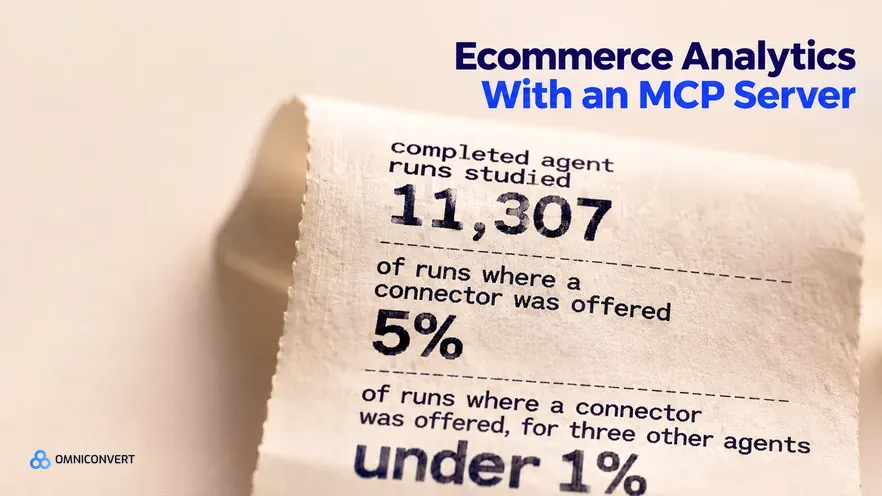
- In a16z's study of 11,307 completed agent runs, an agent asked to generate ads dropped a tool with no general API and chose one with an API and an official MCP integration, so callability now decides shortlists.
- Connector use is still small, offered in 5% of runs for one agent and under 1% for three others, so treat MCP as a renewal question rather than a migration trigger.
- An MCP server lowers switching costs by decoupling the query layer from the dashboard, but a tier-gated, proprietary-schema server is a new lock-in vector, not an escape from one.
An MCP server is a standard endpoint that exposes a software product's data and actions as callable tools, so an AI assistant can query them directly instead of a person reading a screen. For ecommerce analytics, that means asking "what was contribution margin on paid social last month" in a chat window and getting the number back, rather than exporting it. The shift matters because the questions a growth team asks are increasingly asked by software: across the CROBenchmark dataset of 7,000+ websites in 15+ industries, measured against 248+ audit criteria over 13 years of conversion rate optimization work, the constraint on acting fast has rarely been the analysis itself but how long it takes to get the data into a usable shape [CROBenchmark Report 2026, Omniconvert].
This comparison covers the five ecommerce analytics tools that expose an MCP server as of November 2026, what each one lets an assistant ask, which plan unlocks it, and the lock-in question almost nobody is putting to their vendors. If you are earlier in the stack decision, the wider field is covered in our guide to CRO analytics tools and in the roundup of ecommerce analytics and attribution tools.
What an MCP server actually is, in a paragraph you can repeat
The cleanest way to hold it is as a question of affordances. A chart is an affordance for an eye: axes, colour and layout exist so a human can take meaning from a glance. A schema is an affordance for a machine: named fields, types and tool definitions exist so a model can take meaning without guessing. A dashboard has only the first. An MCP server adds the second, over the same underlying numbers.
That framing explains behaviour that otherwise looks arbitrary. Information foraging theory describes any information-seeker as maximising information gained per unit of effort spent. An assistant pointed at a visual dashboard faces very high handling cost: screenshots, rendering, inference about what a label means. An assistant pointed at an MCP endpoint faces almost none. Given both, it will take the endpoint every time, and given only the dashboard it will frequently skip the source entirely and answer from something cheaper.
Two clarifications worth making early, because vendors blur both. First, an MCP server is not an API replacement; it is a thin, self-describing layer over one, and the description is the point, because it tells the model what it can ask without a developer writing the mapping. Second, an MCP server is not an agent. It gives an agent somewhere to ask. Whether anything useful comes back depends entirely on how well the data underneath is modelled, which is a separate problem and usually the harder one.
Which ecommerce analytics tools expose an MCP server right now
| Tool | Access scope | Plan gate | What an assistant can ask it |
|---|---|---|---|
| Lifetimely (AMP) | Hosted server, one URL per store | Paid plan, S or higher | Lifetime value, cohort and profit reporting held in Lifetimely |
| StoreHero | Hosted server, joined sources | See vendor pricing page | Shopify, Meta, Google and Klaviyo data resolved to contribution margin after cost of goods, shipping and fees |
| Triple Whale | Hosted, read-only | Foundation tier and above | Attribution and blended performance metrics already in the account |
| Klaviyo | Official hosted server, read-only flag available | Generally available to customers | Lists, flows, campaign performance and profile data |
| Google Analytics | Official, read-only, runs locally, labelled experimental | Included, but needs local setup | GA4 reporting dimensions and metrics |
A few details decide whether each one is actually usable. Lifetimely issues the server URL inside the app, under Settings, Integrations, AI Connections, and binds it to a single store, so a group running several storefronts connects several servers. StoreHero's is the most interesting of the five for a profit question, because the joining happens before the model sees anything: cost of goods, shipping and fees are already subtracted, so the assistant is reasoning over margin rather than over revenue it would have to adjust itself. Triple Whale shipped its server publicly at the end of June 2026 and kept it read-only, which is the right default. Klaviyo's is hosted at a fixed official address and available to all customers, making it the lowest-friction one to try.
Two absences are worth naming plainly. Shopify's own protocol work is real but aimed elsewhere, at shopping agents buying on a storefront rather than at a merchant asking about last quarter, and the older Storefront MCP tooling was switched off. And several comparison posts list servers for other analytics vendors that we could not confirm on those vendors' own documentation, so they are not in the table above. If a server is not documented by the company that would have to run it, treat the claim as unverified.
The a16z finding that should change your shortlist
The rest of the study explains why that single decision generalises. Agent shortlists are brutally narrow: one agent pulled at most 50 candidate options, and when it browsed, it read about three product pages on average before deciding. Worse for anyone outside the shortlist, the picks correlate. A product chosen by one agent had roughly a 73% chance of being chosen by at least one other [a16z, 2026]. Being uncallable does not cost you a fraction of agent-mediated consideration proportional to agent adoption; it costs you the whole set, repeatedly.
Honesty requires the counterweight, and the same study supplies it. Connectors were offered in just 5% of runs for one agent and in under 1% of runs for the other three. This is early. Nobody should rip out a working analytics stack in November 2026 because of a protocol that most agent runs still do not touch. What the data does justify is changing what you ask at renewal, and that costs nothing.
It is also worth separating the two populations buying through agents. There is the consumer or operator delegating a purchase, which is what a16z measured, and there is your own team delegating analysis to an assistant, which is the case in this article. The second is already live in plenty of DTC teams. The pattern we see in both is the same one described in our look at AI automation agent tools for Shopify: the bottleneck is almost never the model, it is what the model is allowed to reach.
What actually changes in your week
Three concrete questions stop costing an export once a server is connected:
- "Which acquisition cohort from Q2 still has positive contribution margin after returns?" This normally needs an order export, a returns export and a cost of goods table reconciled by hand. Against a margin-aware server, it is one question with one follow-up.
- "Show me every campaign where spend rose more than 20% month over month and revenue per visitor fell." The filtering logic is trivial but nobody builds a dashboard view for a question asked twice a year, so it stays unasked.
- "Which of our top-decile repeat buyers have not ordered in 90 days, and what did they buy last?" The segmentation is standard, but the retrieval across order history and product data is the part that gets skipped.
Notice what these have in common: none of them is a new analysis. They are questions the team already knew how to answer and did not, because the retrieval cost exceeded the perceived value of the answer. That is the actual gain, and it is a gain in question volume rather than in analytical depth. Teams that already struggle to act on the reports they have will not be rescued by asking faster.
There is a clear boundary on what any endpoint can do, and it is worth stating because vendors rarely do. An MCP server tells you what happened. It cannot tell you what would have happened. CLX Gaming ran a single A/B test of a redesigned homepage on mobile with Omniconvert and recorded a 28.57% lift in conversion rate, a 46.21% lift in revenue per user and a 94% chance to win [Omniconvert, CLX Gaming case study]. No query against any analytics endpoint would have produced those numbers, because they only exist once two versions run against each other. Fast questions are not a substitute for designed experiments.
Omniconvert Commander resolves Shopify, Klaviyo, Meta, Google Ads and GA4 into one customer record with RFM, predicted lifetime value and True Profit, so a margin question has one answer instead of five sources to reconcile.
See how it works →The scorecard: three tiers of "integration" and how to tell which you are being sold
| Tier | What it is | What an assistant can do with it | Tell-tale phrasing |
|---|---|---|---|
| 1. Event webhooks | The tool pushes a fixed set of events when they happen | React to something. It cannot ask anything. | "Real-time alerts", "notifications in Slack" |
| 2. Batch sync | A scheduled export into a warehouse or sheet | Query yesterday's shape of the data, if someone modelled it | "Nightly sync", "export to your data warehouse" |
| 3. Semantic access (MCP) | A self-describing endpoint listing callable tools | Ask an unanticipated question and chain follow-ups | A named server URL, a documented tool list, a stated scope |
Three questions separate the tiers in a single sales call, and all three are answerable on the spot by a vendor who has shipped. Ask for the tool list: a real MCP server has a documented, enumerable set of tools, and a vendor who cannot produce one does not have a server yet. Ask for the auth scope: what exactly does connecting grant, and can it be narrowed. Ask whether it is read-only, and if it is not, what the write operations are. A vendor selling tier one while using tier three language will struggle with the first question and fail the second.
This is the oldest pattern in enterprise software purchasing, dressed in new vocabulary. The logo wall of integrations says nothing about depth; a logo appears whether the connection is a rate-limited webhook or full semantic access. In our CVO work with ecommerce brands through 2026, we consistently find that teams discover which tier they actually bought only when they try to answer a question the vendor did not pre-build a view for [Omniconvert, 2026].
The ecommerce brands that plateau at a 1 to 2% conversion rate consistently share one pattern with their data stack: every number they act on has been through a manual reconciliation step that only one person on the team knows how to perform. The benchmark gap closes fastest when operators treat the modelled, reconciled layer as the asset worth owning, not the dashboard that renders it, which is the same reasoning behind treating True Profit rather than ROAS as the number a decision rests on.
The lock-in question nobody is asking
The optimistic reading is the right place to start, because it is largely true. In software architecture, an isolation layer is defined as an interface that keeps a system's core logic independent of a specific external implementation, so the implementation can be swapped without rewriting what depends on it. A standard query interface over your analytics is precisely that: if your team's questions are expressed against a protocol rather than against one vendor's dashboard, replacing the vendor stops being a retraining exercise. That is a genuine reduction in switching cost, and vendors shipping servers deserve credit for it.
The pessimistic reading is where the diligence goes, and it has three specific forms. Tier gating: when semantic access sits above a plan boundary, as it does for Lifetimely and for Triple Whale, the protocol is a reason to upgrade rather than a reason to stay portable. Proprietary schema: the protocol standardises how a model discovers tools, not what those tools are called or what they mean, so a server whose tools mirror one vendor's internal metric definitions reproduces that vendor's worldview inside every question your team asks. Scope asymmetry: a server generous with reads and silent about exports lets you query your data freely while leaving it exactly where it is.
The practical response is unglamorous: own the modelled layer yourself. Whatever resolves your sources into one customer record with a lifetime value, an RFM segment and a margin figure is the asset, because the definitions live there. That is the work Omniconvert Commander does by ingesting read-only API data from Shopify, Klaviyo, Meta, Google Ads and GA4 and resolving it into one record per customer carrying RFM, predicted customer lifetime value and True Profit after discounts, returns and cost of goods, then writing those segments back to Klaviyo and Meta. Omniconvert Commander does not expose an MCP server today. What it does is make sure that whoever asks the margin question, by protocol or by dashboard, gets the same answer.
What to do this quarter if your stack has no MCP server
A sequence that fits in a quarter without displacing anything:
- Inventory what you already have. Check Klaviyo and Triple Whale first, since both are commonly already in the stack and both ship a server. You may be one setting away from the capability you were about to shop for.
- Connect exactly one, for two weeks. Pick the hosted one with the least sensitive scope, connect it read-only, and log every question the team asks it. The log is the business case, and it is also the fastest way to find out that your data model, not your protocol access, is the real constraint.
- Add three questions to every renewal. Do you expose an MCP server or a documented equivalent; if not, when; and will it be tier-gated. Ask in writing. A vendor with no answer in late 2026 has told you something about their roadmap.
- Fix the modelled layer regardless. Every failure mode above, from reconciliation bottlenecks to contradictory margin figures, exists whether or not an agent is asking. The protocol only makes a bad data model fail faster and more confidently.
Point four is the one to keep if you keep nothing else. The gap between a tool that answers questions well and one that answers them badly is not the endpoint, it is whether the numbers behind it have been reconciled once, properly, by something other than a person with a spreadsheet and a good memory.
FAQ: ecommerce MCP servers
An ecommerce MCP server is a standard endpoint that exposes your store data as a set of callable tools, so an AI assistant can query it directly and get structured answers back. MCP stands for Model Context Protocol. The practical difference is that a dashboard answers a question by drawing a chart a person reads, while an MCP server answers it by returning numbers a model can use, chain and check.
As of November 2026: Lifetimely from AMP, StoreHero, Triple Whale, Klaviyo and Google Analytics. Lifetimely gives each store a server URL under Settings, Integrations, AI Connections on a paid plan. StoreHero joins Shopify, Meta, Google and Klaviyo data into contribution margin. Triple Whale's is read-only and gated above its Foundation tier. Klaviyo hosts one for all customers. Shopify's own work targets shopping agents, not merchant reporting.
Mostly read. Triple Whale's server launched read-only, Klaviyo supports a read-only flag, and Google's analytics server is read-only by design. That still matters, because read access to revenue, customer and margin data is sensitive on its own. Before connecting anything, ask the vendor for the tool list, the auth scope and whether write operations exist, and connect with the narrowest scope that answers your questions.
For a hosted server, no. Lifetimely, StoreHero, Triple Whale and Klaviyo give you a URL that you paste into Claude or ChatGPT, authorise once, and then query in plain language. Google Analytics is the exception: its official server runs locally on a machine you control rather than as a hosted endpoint, which does need a short technical setup and someone to maintain it.
It replaces the ad-hoc question, not the standing report. Recurring reports, alerts and anything a team reads on a schedule still belong in a dashboard. What moves is the one-off question that used to mean a CSV export and twenty minutes in a spreadsheet. One vendor has publicly claimed a large drop in dashboard use among power users after shipping MCP, but that figure comes from the vendor, not from independent measurement.
Omniconvert Commander ingests read-only API data from Shopify, Klaviyo, Meta, Google Ads and GA4, then resolves it into one customer record carrying RFM score, predicted lifetime value and True Profit after discounts, returns and cost of goods. It writes the resulting segments back to Klaviyo and Meta. That gives you a single modelled layer to ask questions against rather than five raw sources, which is the work that has to happen before any assistant, connected by MCP or otherwise, can answer a profit question correctly.
Five of the analytics tools a DTC team already pays for expose an MCP server as of November 2026, and the a16z data on 11,307 agent runs shows what happens to the ones that do not: an agent asked to do a job dropped the tool it could not call and chose the one it could. The counterweight is honest, though, because connectors were offered in just 5% of runs for one agent and under 1% for three others. That combination argues for a renewal conversation, not a migration: ask each vendor for the tool list, the auth scope and the ship date, and keep owning the modelled layer underneath so the answer is right whoever asks for it. See how Customer Intelligence in Omniconvert Commander models that layer.
Own the data layer your agents will ask about
An endpoint is only as good as the numbers behind it. Omniconvert Commander unifies Shopify, Klaviyo, Meta, Google Ads and GA4 into one customer record with RFM, predicted lifetime value and True Profit, so the answer to a margin question is the same whether a person or an assistant asks it.