DTC Ad Creative: Scaling Production Without Losing Quality

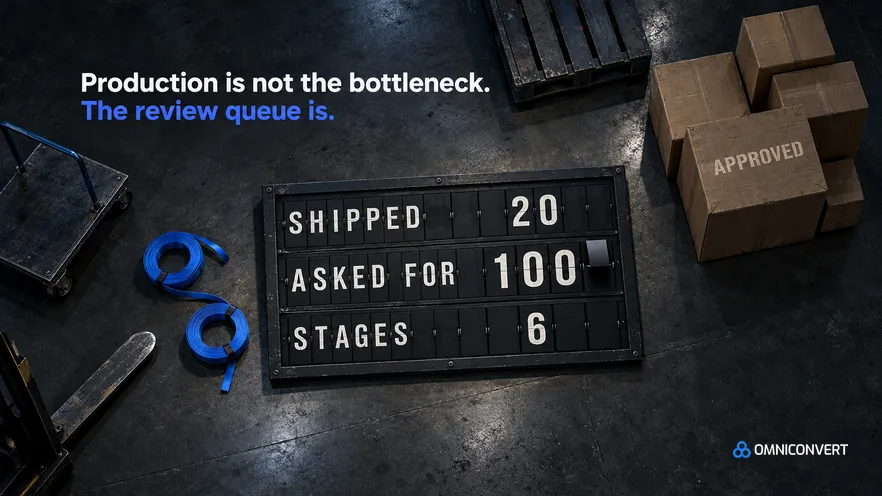
- The generation step is almost never what limits ad volume: briefing, asset sourcing, review and naming are.
- A 100-ad month is not 100 concepts, so decide the concept to variant ratio before you commit to the total.
- The review queue breaks first and breaks quietly, because a backlog appears in no creative report.
- A naming convention has to encode the angle and the concept, or results come back unreadable at volume.
- Full human review belongs to new concepts; variants inside an approved concept need automated checks and sampling.
- Shopify brands already own most of the asset library they need: product imagery, variant photos, reviews and product page copy.
A brand that ships 20 ads a month and is asked for 100 is not short of production capacity. It is short of a pipeline. The gap between what Meta delivery now absorbs and what a small team shipped two years ago is five to ten times, and almost none of that gap sits in the step everyone looks at. What limits DTC ad creative at volume is briefing, asset sourcing, review and naming. Last updated: October 2026.
I have spent 13 years in eCommerce, and the CROBenchmark dataset behind that work covers 7,000+ websites in 15+ industries against 248+ audit criteria [CROBenchmark Report 2026, Omniconvert]. The pattern in creative is the one I keep finding in checkout: the stage everybody measures is rarely the stage that is slow. Production is measured because it produces a file. Briefing, review and naming produce a decision, and nobody reports on decisions.
This is the volume chapter of our wider guide to AI ad creative generation for eCommerce, and it is also the problem we built for. Nexus by Omniconvert is the AI eCommerce growth engine for Shopify brands: it reads your store, ad and customer data, ranks growth opportunities by profit impact, and builds the campaigns to act on them, and you approve what goes live. Most of what follows works with or without it, because the parts that break are process, not software.
What scaling DTC ad creative actually requires
DTC ad creative is defined as the paid advertising assets a direct-to-consumer brand makes for its own store, where one team owns the brief, the production and the result. That single ownership is why volume hurts differently here than it does at an agency. There is no account manager absorbing the coordination and no separate studio to push the work into. The same handful of people choose the angle, build the asset, review it, name it and read the result back.
So when the ask moves from 20 assets a month to 100, five jobs multiply, not one. The job everybody looks at, making the asset, already has an answer: generative tools took it from days to minutes, which is why it stopped being the constraint and why the other four became visible.
Four conditions have to hold before a higher number is reachable:
- A brief queue deep enough to feed the target. Enough signed angles that production never waits and never improvises. This is the condition most teams fail, and it fails silently, because an empty brief queue looks like a busy production team.
- An asset library that answers in minutes. Product imagery, footage, reviews and cleared claims, findable by product and by segment. If sourcing one hero image takes an afternoon, no generator will help you.
- A review path with a stated bar. Written criteria, lanes by risk, a named approver per lane. An unwritten bar sends every asset to the one person who holds it in their head.
- A naming convention every asset obeys. Encoded at launch, not reconstructed later. Without it, five times the ads is five times the ambiguity in your reporting.
Miss any one and the extra output still arrives, unreadable or unreviewed, and the next quarter's plan gets written from that data.
How to go from 20 ads to 100 a month
Start with the ratio, not the total. A 100-ad month is not 100 concepts. If each concept carries eight executions, a different hook, opener, format or crop, then 100 assets needs thirteen concepts briefed and signed. If each carries four, you need twenty-five. The total is a production number. The ratio is the decision, and it sets how much thinking the month requires.
An ad creative strategy for eCommerce that names only a monthly asset count is a production plan wearing a strategy label: it says how many files to make and nothing about how many arguments. Write the concept number first.
Then stage the increase. Raise the brief count first, with production flat, so you find out whether briefing can fill the target. Fix the asset library second, because that turns an approved brief into a buildable one. Raise production last. Teams do the reverse, because production is the part a tool purchase visibly changes, and they end month one with a queue nobody has reviewed and a reporting set nobody can read.
Who does the work is a separate decision from how much work there is: in-house versus agency ad creative covers that trade-off. The short version here is that an agency can absorb production volume and cannot absorb your briefing or your naming, because both rest on data and decisions inside your business.
Where the production week actually goes
The table is the shape of the problem, not a timesheet. Run the six rows against your own week and mark the ones you could honestly multiply by five.
| Stage | At 20 ads a month | At 100 ads a month | What to change first |
|---|---|---|---|
| Briefing and angle choice | Informal, often verbal, held by one person | The hard constraint: too few signed angles to fill the target | A named brief owner and a standing angle backlog |
| Asset sourcing | A folder search and a message to the photographer | Repeated searching, duplicate requests, assets rebuilt twice | One library, indexed by product and segment |
| Production and variants | The visible cost, measured in shoot and edit days | Close to flat per asset once a generator is in place | Nothing: this stage is already solved |
| Review and brand QA | One approver, same day, by eye | Breaks first and breaks quietly, as an invisible backlog | Written criteria and three review lanes by risk |
| Naming, tagging and upload | Ad hoc, fixed later by memory | Memory fails, and reporting loses the link to the brief | A convention enforced at export, not at upload |
| Read-back and reporting | A weekly scan of the ad account | Impossible to group by angle, so the next brief guesses | Report by concept and angle before adding volume |
Production is the only row whose honest answer in the last column is nothing, and it takes most of the budget. Review is the row that breaks, and in most brands it has no budget line at all.
The briefing row stays stubborn for a measurable reason. Omniconvert puts the time eCommerce managers spend assembling data at about 3 hours a day. A brief owner who pulls reviews, segments and lifetime value together by hand will write fewer briefs than the plan assumes, every month, and the plan will keep assuming otherwise.
Who writes the brief at 100 ads a month
At 20 ads a month a founder can brief in a message. At 100 the brief is the throughput limit, and it needs an owner judged on the angle portfolio rather than on output or media efficiency. The maker is rewarded for volume and the buyer for efficiency, and both pressures push the brief toward whatever worked last month. That is how an account ends up running one argument in fifteen wrappers.
The symptoms that tell you brief quality is your constraint sit in the creative brief bottleneck, the companion to this page: that one is brief quality, this one brief supply. Poor quality gives you a hundred ads making the same point. Poor supply gives you a team improvising to hit a number.
Three habits keep supply up without dropping quality. Brief in batches on a fixed day, so briefing is a calendar commitment rather than a reaction to an empty queue. Keep the unit straight: one angle per brief, hooks and formats free inside it. If your team uses hook, concept and angle interchangeably, settle the difference between a hook, a concept and an angle first. And feed the backlog from customer evidence, not the ad account: building ad creative from customer reviews is the cheapest source of angles a DTC brand already owns.
What a creative naming convention has to encode
Teams skip this stage and pay twice: once in a quarter of reporting you cannot group, and again in the next plan, written from it. At 20 ads a month you can reconstruct what an ad was by looking at it. At 100 you cannot, and nobody notices until someone asks which angle is tiring.
Encode these eight fields, in a fixed order, separated by a character you never use inside a field:
- Launch month. Four digits, year then month. It sorts correctly and it dates the brief.
- Product or line. The thing being sold, not the campaign name. Campaign names change and products do not.
- Segment. The customer the brief named, ideally an RFM segment code rather than a demographic label.
- Angle. The argument, as a short slug. Fatigue attaches to this field, so it has to be in the name.
- Concept identifier. A code shared by every execution of one concept. Without it you cannot tell eight variants of one idea from eight ideas.
- Execution or format. Static, carousel, UGC-style video, founder talking head, before and after.
- Variant number. Two digits, so the sort order survives past nine.
- Aspect ratio. The placement constraint, and the field that catches the most upload mistakes.
A name built that way reads like this: 2610_hydration_rfm-champions_durability_c04_ugc_v03_9x16. It is ugly and machine-readable, which is the trade you want. Test it by handing the name to someone who was not in the briefing and asking them to find the brief.
Two rules make it hold. Enforce the name at export, in the template that produces the file, not at upload, where a person is already in a hurry. And never let the ad platform's name drift from the asset name: the moment a buyer renames an ad for readability, the link back to the brief is gone.
How QA scales when volume goes up 5x
Here is the move I see most often, and it looks reasonable from the inside. A brand hits its volume target by opening a fast lane for AI-made variants, on the grounds that variants of an approved concept are basically resizes. Nobody writes the fast lane down, so it skips the naming convention too. Six weeks later a few hundred ads are live, a third named by whoever uploaded them, and the reporting cannot separate the briefed lane from the fast one. The quarter looks flat, the obvious conclusion is weak creative, and the real cause is a dataset mixing two populations. The fast lane was a good idea. Leaving it undefined was the mistake.
So define it. Three lanes, each with a written bar:
- Automated, on every asset. Dimensions and aspect ratio, text safe zones, file weight, required legal and disclaimer copy, banned claim words, the right product on the right SKU, and a filename matching the convention. None of it needs judgement, and all of it is where volume errors come from.
- Sampled, inside an approved concept. Review a fixed share of each batch properly. A clean sample ships the batch. A dirty one sends the batch back and the concept to full review, because a systematic error repeats across every variant of it.
- Full human review, for new concepts and new claims. Anything arguing something for the first time, any new proof point or product, anything touching regulated copy. Slow on purpose, and small by design.
Skip this and what breaks first is the review queue. It breaks before production does, and it breaks quietly, because a backlog of unreviewed assets appears in no creative report. No dashboard has the queue as its subject. The symptom surfaces weeks later as live ads that were never named properly, and by then the cause is three steps back.
One rule holds it together: the lane is decided at brief time, not review time. Choosing it while looking at the asset puts the judgement back into the queue you were shortening.
Shopify ad creative and the asset library you already own
Asset sourcing is the second row of the table and the best return on an afternoon of work. On Shopify the raw material is already structured: products and variants have imagery, options carry the words customers use, page copy holds cleared claims, the reviews app holds the problem each buyer was solving, and order history says which segment bought which variant.
What is missing is one index tying those together, so a brief for a segment and an angle resolves to usable assets without a person searching. Build it once, by product and by segment, and the sourcing row stops costing a day a week. The mechanics of turning catalogue data into assets, including what to do when the imagery is thin, are in generating ad variations from customer data.
Placement rules cause the most rework at volume: aspect ratios per placement, text safe zones, the first frame carrying the message, sound-off comprehension. Facebook ad variations for Shopify covers them in detail. Encode them in your automated lane, not in a reviewer's memory, because a reviewer checking safe zones by eye on the eightieth asset of the week will miss one.
One caution: product imagery is shared between the store and the ads, and the store wins any conflict. Keep an ads copy rather than editing in place, and keep the mapping from ad asset back to SKU, or a product discontinued mid-month stays live in your ad account for weeks.
Tools and what to look for
Most of this category sells throughput, because throughput demos well. A tool making a hundred variants an hour is answering the one row of the table that was already solved. Ask these four instead:
- Does it brief from customer data, or from your last winner? A tool whose only input is your top ad will reproduce that ad. Look for review text, segments and lifetime value as inputs.
- Can it export names that obey your convention? Filenames that come out as a hash move the naming problem rather than solve it.
- Do concept and angle survive into reporting? Results that come back per asset with no way to group by concept cannot answer the question volume makes urgent, which is which argument is tiring.
- What does it measure? Platform return describes the auction. Profit per order describes the business. The two disagree most on exactly the ads a volume programme makes most of.
Nexus sits on both sides of the pipeline, which is why we built it rather than another generator. It unifies store, ad and customer data, builds RFM segments, monitors competitor ad libraries continuously and classifies competitor creative by angle, hook and offer, and ranks angles by CLV. It generates launch-ready assets from customer data: static and video ad creative, landing pages and email copy, composed with your existing product imagery. On the buying side it runs live Meta and Google integrations, measures True Profit per ad, and recommends scale, hold, reduce or kill on each one. You approve what goes live. Nexus runs on 840 AI agents and is now onboarding founding brands; it holds 5.0 out of 5 from 60 reviews on the Shopify App Store as of September 2026, and Omniconvert sits at 4.6 out of 5 on G2 [G2, 2026].
Two things it does not do, and hold any vendor to the same honesty. It does not shoot product photography: it composes with the imagery you already have. And it does not own your naming convention or your review bar. Those stay operating decisions.
Benchmarks for scaling ad creative production
Set the baseline before the increase, because the change is the interesting number. Concepts briefed and signed per month is your real supply. Assets per concept says whether the ratio you chose is the one you run. First-pass clearance reads the brief and the library at once, since most rework traces to one of the two. And the share of live ads whose name resolves to a brief predicts whether next quarter's plan gets written from evidence.
Structured programmes beat ad hoc volume, and the evidence is older than AI creative. AliveCor used Omniconvert to run a structured A/B testing programme and achieved +21% conversion rate, +5% revenue per visitor, and 94% statistical relevance across their experiments. [Omniconvert, AliveCor case study] The transferable part is not the uplift. It is that a stated bar and a consistent read-back produced a result you could attribute, which is exactly what a 100-ad month loses when the naming goes.
One benchmark to avoid: a refresh cadence copied from another brand. How fast creative tires depends on your audience size, your spend and how many angles you hold in market, so the number travels badly. Creative fatigue and forecasting covers working it out from your own account.
Your first 30 days
- Week 1, audit the last month. List every asset that went live, write one sentence naming the angle of each, then count distinct concepts, assets per concept, and how many you can trace to a brief. Those three numbers usually settle the strategy argument.
- Week 2, write the convention and the lanes. Fix the eight naming fields and the separator. Write the automated checklist, the sampling share and the definition of a new concept, one page each. Put the convention into the export template the same week.
- Week 3, build the asset index. One table mapping product and segment to usable imagery, footage, review quotes and cleared claims. Mark the gaps rather than filling them: they are your next shoot brief.
- Week 4, run one real batch. Brief the concept count your ratio requires, produce inside the convention, route by lane, and report by concept and angle. Compare first-pass clearance against week one.
Hold the monthly target still for those four weeks: adding volume while you measure hides the answer. Low first-pass clearance means the brief or the library. Clearance fine but the queue growing means review. Both fine but the concept count unfilled means briefing supply, and no tool purchase changes that.
FAQ: scaling DTC ad creative production
What is DTC ad creative?
DTC ad creative is defined as the paid advertising assets a direct-to-consumer brand makes for its own store, where one team owns the brief, the production and the result. That single ownership is what makes volume hard. The same people who choose the angle also build the asset, review it, name it and read the result back, so a bigger number multiplies five jobs rather than one.
What should a creative naming convention encode?
At minimum the launch month, the product or line, the customer segment, the angle, a concept identifier, the execution or format, the variant number and the aspect ratio. The angle and the concept identifier are the two that matter most, because fatigue attaches to the angle and reporting has to group variants under the concept that produced them.
How do I go from 20 ads a month to 100?
Start with the ratio, not the total. Decide how many executions each concept will carry, divide the target by that number, and you have the brief count you actually have to fill. Then stage the increase: raise the brief count first, fix the asset library second, and raise production last. Raising production first fills a queue nobody can review.
How does QA work when ad volume goes up five times?
Split it into three lanes. Automated checks handle specification, aspect ratio, safe zones, legal claims and required disclaimers. Sampling covers variants inside a concept that has already been approved. Full human review is reserved for new concepts and new claims. If every asset still needs one person to sign it, that person sets your ceiling.
Which stage breaks first when creative volume rises?
The review queue. It breaks before production does, and it breaks quietly, because a backlog of unreviewed assets appears in no creative report. The visible symptom arrives weeks later, as live ads that were never named properly and a reporting set that cannot separate briefed concepts from quick iterations.
How many ads a month does a DTC brand actually need?
Enough distinct concepts to keep several angles in market at once, which is a different question from the asset count. Ask your media buyer how many concepts carried real spend last month, and how many are left before the current angles tire. That answer sets the brief target, and the asset count follows from the ratio you chose.
How does Nexus by Omniconvert help with scaling ad creative production?
Nexus by Omniconvert unifies store, ad and customer data, builds RFM segments, monitors competitor ad libraries, ranks angles by CLV, and generates launch-ready assets from customer data, including static and video ad creative, landing pages and email copy. It also measures results in True Profit per ad and recommends scale, hold, reduce or kill on Meta and Google. You approve what goes live, and the naming convention and the review bar stay your team's decisions.
Volume is an operations problem
The five to ten times gap between what a DTC team ships and what delivery now absorbs is real, and it is not a generation gap. Production is the one stage of the six that already scales, which is why pointing a bigger tool at it moves nothing. What decides whether a 100-ad month is worth having are the stages that produce decisions instead of files: how many angles you can brief and sign, how fast the library answers, which lane each asset takes, and whether its name still resolves to a brief three months later. Fix those in that order, and only then raise the number. A hundred ads you can read beats two hundred you cannot.