The Creative Brief Bottleneck: The Complete Guide

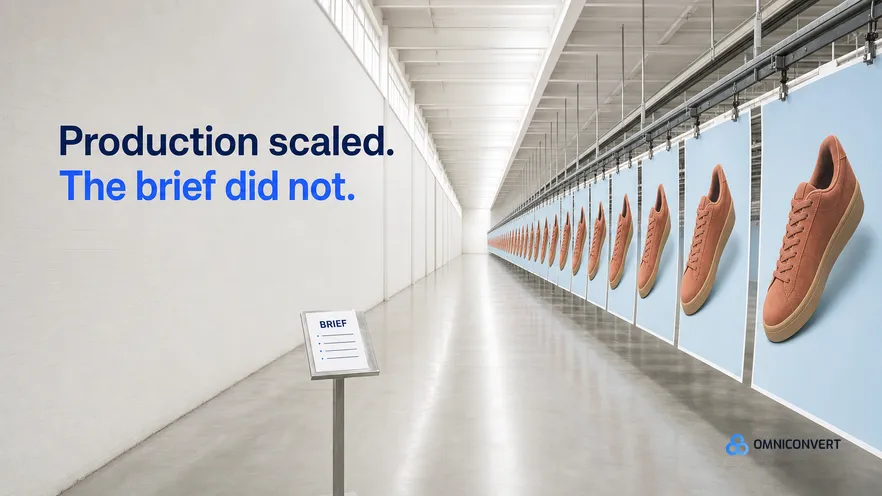
- Once production is cheap, the brief sets the ceiling on how many ads are worth making and how good any of them can be.
- Scaling production without fixing the brief multiplies one angle, and the audience tires of the angle, not the asset.
- Rising volume with a flat win rate is the clearest sign that the brief, not production, is the constraint.
- Brief inputs belong in customer evidence: reviews, RFM segments, lifetime value by angle, and gaps in competitor messaging.
- Measure a brief by the angles it opens and the customer value it buys, not by the ROAS of its first week.
The creative brief bottleneck is what appears once AI makes ad production cheap. For years, production set the limit on how many ads a brand could run, so nobody looked hard at the brief. Now the constraint on ad volume and ad quality has moved upstream, to the decision about which customer, which problem and which angle an ad is for. Last updated: September 2026.
I have spent 13 years in eCommerce, and I keep seeing the same pattern in teams that adopted AI production early. Output went up sharply. The win rate did not move. Fatigue arrived sooner, because the new ads were mostly the old ad in different clothes. For the basic definition, start with what a creative brief is and what it should contain.
It is also the problem behind how we built Nexus by Omniconvert, the AI eCommerce growth engine for Shopify brands: it reads your store, ad and customer data, ranks growth opportunities by profit impact, and builds the campaigns to act on them, and you approve what goes live. Most of this guide works with or without it.
What is the creative brief bottleneck?
A brief makes three decisions. It names a customer. It names the problem that customer is trying to solve. And it picks an angle: the argument for why this product solves that problem better than the alternatives. Everything after those decisions is execution: format, hook, opener, length and cut all deliver an argument already chosen.
When execution was expensive, a weak brief cost you a few ads. When execution is close to free, a weak brief costs you every ad made from it, plus the audience attention those ads burn. This is the theory of constraints applied to creative: speed up any step except the slowest one and you get inventory, not output. In a creative team, that inventory is a folder of variants that all make the same argument.
Many teams use hook, concept and angle as if they meant the same thing. If yours does, settle the difference between a hook, a concept and an angle first. Here, the angle is the unit the brief decides, and the hook is one of the things production varies.
Why cheap production moves the constraint upstream
Before AI, a shoot day forced a conversation about what the ads were for. AI production takes that check away. A generator will make a hundred variants of whatever you point it at, with no view on whether that thing deserves a hundred variants. The brief was always the real decision. Now it is the only step left with friction, and in most teams it has the least process around it.
So teams scale production and get more of the same ad, faster. The variants differ on the surface: a new first frame, a different background, a shorter headline. Underneath, they make the same argument to the same person. The ad account counts them as different ads. The customer does not.
This is why a high-volume account can fatigue sooner, not later. A shopper who has seen your durability argument in four visual wrappers is tired of the durability argument. A fifth wrapper does not reset their attention. Worse, your testing budget only learns which execution of the argument wins, never which argument to make.
Six symptoms of a creative brief bottleneck
- Volume up, win rate flat. You make more ads each month, and the share that beat your control holds steady or falls. More production is buying no more winners.
- Every variant tests the same angle. Write the argument of your last twenty variants in one sentence each. Three sentences or fewer means you test executions, not ideas.
- Briefs written from last month's ROAS. The brief asks for more of what worked, based on a metric that sees recent first purchases and little after them.
- Fatigue arrives sooner as output grows. Refresh cycles get shorter even though every ad is new.
- The brief is a format order. Five statics, three UGC-style videos, one carousel. That is a production plan with no customer, problem or angle in it.
- Nobody can name the customer. Ask who a live ad is for and you hear a demographic, or everyone. A brief that cannot name a segment cannot be judged against one.
If three or more of these describe your account, more production capacity will make things worse before it makes them better.
The Brief-First Creative Loop
It is a loop because the output of the last stage is the input of the first. Most creative processes are lines: a brief goes in, ads come out, a report gets filed, and nothing carries forward.
- Evidence. Collect what customers say and do: reviews, tickets, survey answers, purchase and repeat behaviour, and what competitors already argue.
- Angle ranking. Turn the evidence into candidate angles. Rank them by the lifetime value of the customers each one is likely to attract, not by the click-through rate of the last ad with a similar idea.
- The brief. One customer, one problem, one angle, the proof behind it, and the result that counts as a win. One angle per brief is the rule that keeps the rest of the loop readable.
- Production. Vary execution freely inside the angle: hooks, formats, openers, lengths. Cheap production earns its place here, because it tests the angle thoroughly.
- Read-back. Judge results by angle first and asset second, weighted by the value of the customers acquired. Write what you learned into an angle ledger that the next brief must read.
Two rules hold the loop together. First, one angle per brief: a brief with two angles produces results that cannot tell you which one worked. Second, the read-back is mandatory. A brief that does not cite the ledger is written from memory, and in most creative teams memory means last month's dashboard. Notice also where the volume sits: in stage four, under one angle, the one place volume helps.
Experimentation teams know this discipline. Omniconvert Explore shows a 23.2% average conversion uplift across 70,000+ experiments, and the lesson I take from that history is that a test is only as good as its hypothesis. A creative brief is a hypothesis about a customer. Treat it like one.
Where creative brief inputs should come from
Review mining
Reviews, support tickets and open survey answers are the closest thing you have to customers writing your ads. Mine them for the problem the customer had before buying, the words they use for it, and the objection they nearly did not get past. Code a few hundred by problem and a ranking appears. Compare it with the problems your live ads address. Where the two lists differ, you have briefs.
RFM segments
Recency, frequency and monetary value split customers into groups that behave differently: recent high spenders, lapsed loyal buyers, one-time buyers who never came back. Each group bought for different reasons. An RFM segment gives the brief a customer defined by behaviour, not by age and interests, and a sharper question: what did our best segment believe about us before its first order?
CLV-weighted angles
Some angles recruit customers who buy once on a discount. Others recruit customers who come back. Two angles can show the same first-week ROAS and build very different businesses a year later. The brief is where the CLV-weighted growth model does the most good, because it decides which customers you look for before any money is spent.
Competitor angle white space
Your competitors' ads are public. Read them for the argument, not the design, and classify each by angle, hook and offer. Categories tend to crowd around a few angles, because everyone copies what seems to work. An angle nobody in your category makes, and that your reviews say customers care about, is the strongest candidate a brief can have. Ad saturation versus edge shows how to tell a crowded angle from an open one.
| Input source | What it gives the brief | How it misleads | When to refresh |
|---|---|---|---|
| Review and ticket mining | The customer's problem, in the customer's words | Hears only people who bought and chose to write | Monthly |
| Post-purchase survey | Why buyers chose you over the alternative | Answers come from memory, not the moment of decision | Monthly |
| RFM segments | A customer defined by behaviour | Stale segments describe last year's base | Monthly |
| CLV by acquisition angle | Which arguments bring customers who return | New angles have too little history to judge | Quarterly |
| Competitor angle white space | Arguments nobody in the category makes | An empty angle can be empty because it fails | Continuously, reviewed weekly |
| Last month's ROAS | What recently won first purchases | Blind to repeat buying and margin; pulls briefs toward the past | Read-back only, not a brief source |
No single row is enough. The strongest briefs sit where three rows agree: a valuable segment, a problem it names in its own words, and an angle no competitor is making.
What a brief-first brief contains
- Customer. A named segment, ideally an RFM segment, with one line on what they bought and why.
- Problem. In the customer's words, quoted from reviews, tickets or survey answers.
- Angle. One argument, written as a sentence a customer could repeat.
- Proof. What makes the argument believable: product imagery, reviews, a guarantee you already offer.
- Already said. The angles you and your competitors have run for this segment, taken from the ledger.
- Fixed and free. The angle and the proof are fixed. Hooks, formats, openers and lengths are free.
- Win condition. The metric and the threshold, set before launch, weighted by customer value and not by first-order revenue alone.
- Kill condition. The point at which the angle is retired, not just the asset.
The fixed-and-free field is the one most teams skip, and it is the one that makes high-volume production safe. It tells whoever makes the variants, a person or a model, where their freedom ends. The guide to video ad variations at scale covers the production side of that boundary. Format quotas and asset counts are missing on purpose: those are production decisions.
The operating model: owner, cadence and write-back
The brief owner should not be the person who makes the ads or the person who buys the media. The maker is judged on output and the buyer on efficiency, and both pressures pull the brief toward what already works. The owner is judged on the angle portfolio: enough distinct arguments, for the right customers, with results that feed back. In a small brand that is often the founder or the head of growth. In a larger team it is a creative strategist with direct access to customer data.
That last condition is where most teams fail. Omniconvert puts the time eCommerce managers spend assembling data at about 3 hours a day. A brief owner who has to pull reviews, segments and lifetime value together by hand falls back on the ad account, because it is the only data already in one place.
Then set four tempos:
- Continuously: production and launch of variants inside approved angles.
- Weekly: an angle review with the owner, the maker and the buyer: what each live angle is learning, and which variants to cut.
- Monthly: a portfolio rebalance. Retire angles that hit their kill condition, give more budget to angles that won, and open new ones from the evidence backlog.
- Quarterly: a lifetime value read. Re-rank angles by the value of the customers they brought in, now that those customers have had time to return.
The angle ledger turns the process into a loop. It is a simple record: angle, segment, brief date, variants tested, win or kill decision, and the value of the customers acquired. It needs no special software, only the signing rule.
This is the shift described in from executor to supervisor: when production is cheap, a team's value moves from making the work to deciding which work runs.
How to measure brief quality
Creative reporting is built around the asset. Asset metrics help with production decisions and do little to judge a brief, because a strong angle with weak execution and a weak angle with strong execution can post the same numbers. You need a second layer of measures whose subject is the angle.
- Angle hit rate. The share of briefed angles that produced at least one variant that beat your control. If volume rises and this does not, the brief is the constraint.
- Angle diversity in spend. How many distinct angles carry real budget at the same time. An account where one angle holds most of the spend is one fatigue cycle away from a bad month.
- Customer value per angle. The lifetime value, or True Profit, of the customers each angle acquired. This measure stops a cheap-conversion angle from taking over the portfolio.
- Fatigue per angle. How long an angle stays productive across all its variants, not how long one asset lasts.
- Evidence share. The share of briefs whose angle traces to reviews, segments, lifetime value or competitor white space, rather than to last month's top ad. It moves before the other measures do.
None of these needs precise attribution. They need consistent labels: if every variant carries its angle from the brief at launch, the measures are a spreadsheet exercise. If not, no report will recover that information later.
Customer value per angle is also where creative data and profit data fail to meet. One tells you how an ad did in the auction. The other tells you whether the customers it brought were worth having. The creative-to-profit gap explains why almost nothing connects the two.
Where AI fits in a brief-first team
Most teams adopted AI on the production side first, because that is where the tools were. That is how the bottleneck formed. The fix is not less AI. It is AI pointed at the upstream work as well.
That is the job we built Nexus to do. It unifies store, ad and customer data, builds RFM segments, monitors competitor ad libraries continuously and classifies competitor creative by angle, hook and offer, and ranks angles by CLV. It then generates launch-ready assets from customer data: static and video ad creative, landing pages and email copy, composed with your existing product imagery. Results are measured in True Profit, not ROAS, and you approve what goes live.
In the loop, that covers much of the evidence stage, angle ranking, production and the profit side of the read-back. It does not replace the brief owner: it hands the owner ranked angles with the data behind each. Nexus runs on 840 AI agents, and the design choice I care most about is the approval step.
Nexus leaves the bid and campaign lifecycle to the ad networks, so your media buyer still runs the account. The one-angle rule and the ledger habit stay with your team.
Where to start this month
- Week 1, label. Write one angle sentence for every variant that ran last month, then count distinct angles and their share of spend.
- Week 2, mine. Code a few hundred reviews and tickets by problem. Build or refresh your RFM segments and find the segment with the highest lifetime value.
- Week 3, brief. For that segment, pick one angle the reviews support and your live ads do not make. Write the one-page brief, then produce variants inside it.
- Week 4, read back. Judge the angle, not the assets. Open the ledger with this entry and write the next brief from it.
If the new angle beats your control, the case for the process makes itself. If it does not, you still have a ledger entry and an honest count of how many arguments you were really making. Both are worth more than another month of variants.
FAQ: the creative brief bottleneck
What is a creative brief bottleneck?
It is the point where ad results are limited by the quality of the brief rather than by the capacity to produce ads. It appears when AI makes production cheap. Deciding which customer, which problem and which angle an ad addresses becomes the slowest step, and every asset made from a weak brief inherits its limits.
How do I know if the brief is my bottleneck and not production?
Watch the win rate as volume grows. If you make more ads each month and the share that beat your control stays flat, production is not the limit. Then label your recent variants by angle. If most of them make the same argument, your team is testing executions of one idea, and more production will only repeat it faster.
Why does ad fatigue get worse when we produce more creative?
Because fatigue attaches to the argument, not only to the asset. When every new variant makes the same angle, the audience meets one argument more often in different visual wrappers. The wrappers are new and the argument is not, so refresh cycles shorten even though each ad is fresh. Adding distinct angles helps more than adding variants of one angle.
Who should own the creative brief?
One named person who is judged on the angle portfolio, not on output or media efficiency. In a small brand that is often the founder or the head of growth. In a larger team it is a creative strategist with direct access to customer data. The owner signs every brief and makes sure each one cites what past results say about its angle.
Should creative briefs be based on ROAS?
Not on ROAS alone. ROAS describes recent first purchases and is blind to repeat buying and margin, so briefs written from it pull the account toward past winners. Use ROAS in the read-back, where it describes what happened. Source new angles from reviews, RFM segments, lifetime value by angle and gaps in competitor messaging.
How does Nexus by Omniconvert help with the creative brief bottleneck?
Nexus by Omniconvert works on both sides of the brief. It unifies store, ad and customer data, builds RFM segments, classifies competitor creative by angle, hook and offer, ranks angles by CLV, and generates launch-ready assets from customer data. Results are measured in True Profit, not ROAS. The brief owner still decides, and you approve what goes live.
The bottom line
AI solved the production problem and exposed the one behind it. When an ad costs almost nothing to make, the brief decides how many ads are worth making and how good any of them can be. Teams that scale production without fixing the brief get more of the same ad, faster, and watch it tire sooner. The fix is a brief-first loop. Source angles from what customers say and do. Rank them by the value of the customers they bring. Commit each brief to one angle, let production vary everything else, and write every result back into the next brief. Give the brief one owner and a ledger, and measure it by the angles it opens and the customer value it buys.