What Is a Creative Brief? Definition for eCommerce Ads

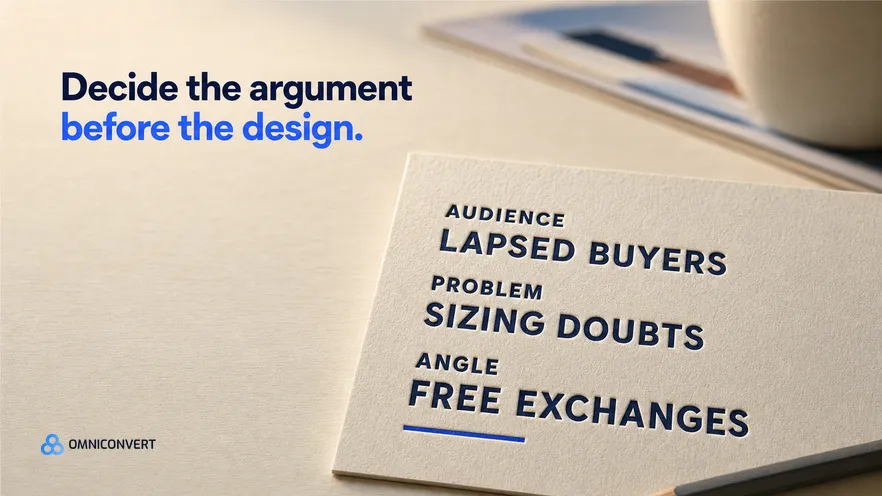
- A creative brief is the written decision behind an ad: who it is for, what it argues and how it gets judged.
- An eCommerce ad brief needs nine fields, from the audience segment to what not to say.
- The brief, the angle, the concept and the creative are different things, and mixing them up makes teams test at the wrong level.
- The best brief inputs are customer reviews, RFM segments, CLV and competitor ad patterns, not team memory.
- When AI makes ad production cheap, the brief sets the ceiling on ad quality.
A creative brief is the short document that tells whoever makes an ad who the ad is for, what problem it solves, what argument it makes and how it will be judged. In eCommerce paid social and search, the brief is the decision that comes before the design. Most weak ads were already weak at the brief. Last updated: September 2026.
I have spent 13 years in eCommerce, and the pattern repeats in teams of every size. The ad account gets the attention and the budget. The brief gets ten minutes in a shared doc, often after the designer has already started.
A brief is only as good as the customer data behind it. Nexus by Omniconvert is the AI eCommerce growth engine for Shopify brands: it reads your store, ad and customer data, ranks growth opportunities by profit impact, and builds the campaigns to act on them, and you approve what goes live.
What is a creative brief?
The term comes from agencies, where a brief often runs to several pages of brand background and tone of voice. An eCommerce ad brief is narrower. It serves one campaign on paid social or search, and a designer, a freelancer or an AI tool must be able to act on it without a meeting.
The test of a good brief is simple. Hand it to two different designers. If they come back with two executions of the same argument, the brief worked. If they come back with two different arguments, the brief did not decide anything.
Paid media can borrow a habit from on-site testing. Across 70,000+ experiments in Omniconvert Explore, the average conversion uplift is 23.2%. A creative brief is the ad-side version of a test hypothesis: it states what should change, for whom and why, before anyone builds anything.
The nine fields of an eCommerce ad brief
- Audience segment. One segment, defined by behaviour and value, not by demographics alone. "Customers who bought twice and have not returned in six months" is a segment. "Women 25 to 45 interested in fitness" is a targeting setting.
- The one customer problem. One problem, in the customer's own words. A brief that lists three problems produces an ad that addresses none of them well.
- Angle. The argument the ad makes about why this product solves that problem. The same product can carry a price angle, a durability angle or a gifting angle, and each one attracts a different customer.
- Hook. The first line or the first seconds that stop the scroll and open the angle. On paid social the hook is visual and verbal. On search it lives mostly in the headline.
- Offer. What the customer gets for acting now: a bundle, free shipping, a trial size, or no discount at all. Write down the margin you can afford next to it.
- Proof. Why the customer should believe the claim: a review quote, a rating, a guarantee, a demonstration. Proof must match the angle. A durability angle needs durability proof.
- Format and placement. Static, video or carousel, and where it runs: feed, stories, reels or search. If you work from your own catalogue images, see how to make ad creative from your real product photos.
- Success metric. The number you will judge the ad on, and the time window. Pick it before launch. A metric chosen after the results arrive is a justification, not a measure. For most stores, True Profit per acquired customer tells you more than platform ROAS.
- What not to say. Claims legal will reject, angles competitors already own, words your customers never use, and promises the product page cannot keep.
Creative brief vs creative, concept and angle
Many ad teams use these words as synonyms. Here is how they differ, using an invented merino running sock brand:
- Brief: the full plan with all nine fields. It exists before any asset does.
- Angle: the argument. For example: one good pair outlasts three cheap pairs, so it costs less per run.
- Concept: an idea that carries the angle. For example: a worn-through cheap sock next to the merino sock after the same distance.
- Creative: the file that runs. A short vertical video, a square static, a set of headlines for a search ad.
The hook is the opening moment of one execution. For more on the vocabulary, see the difference between a hook, a concept and an angle.
Why it matters: teams test at the wrong level. Swapping the background colour on a creative is a creative test, and it tells you about the colour. Swapping a price angle for a durability angle is an angle test, and it tells you something about your customers. Only a brief that names the angle makes the second kind of test possible.
A weak creative brief and a good one, side by side
The weak brief reads like this: new ads for our merino socks, target runners, make it fresh and premium, use the summer sale, five variations by Friday.
Every field is either missing or wrong. "Runners" is an interest, not a segment. There is no customer problem. "Fresh and premium" is a mood, so the designer invents the argument. The offer defaults to the sale. With no success metric, the ads get judged on whatever the dashboard shows first.
The good brief reads like this. Segment: customers who bought one pair in the last 90 days and have not reordered. Problem: suppose their reviews say the socks held up well, but a second pair feels expensive. Angle: one pair outlasts three cheap pairs, so the second pair costs less per run. Hook: a worn-through cheap sock next to ours after the same distance. Offer: a three-pack at a bundle price, no sitewide discount. Proof: durability quotes from verified buyers. Format and placement: a short vertical video for stories and reels, plus one static for the feed. Success metric: reorder rate in this segment and the profit on those orders, over 60 days. What not to say: no medical claims about blisters, no comparisons with named competitor brands.
The good brief is longer, and it is faster to act on. The designer knows what to show, the copywriter knows which reviews to quote, and the media buyer knows which audience to load. After 60 days, everyone knows whether the brief was right.
Where creative brief inputs should come from
| Brief field | What it answers | Where the input comes from |
|---|---|---|
| Audience segment | Who exactly is this ad for? | RFM segments built from order history |
| Customer problem | What stops this segment from buying? | Customer reviews, support tickets and post-purchase surveys |
| Angle | What argument will the ad make? | Review themes, checked against competitor ad patterns |
| Hook | What stops the scroll in the first seconds? | Customer phrases from reviews, and the hooks competitors overuse |
| Offer and proof | Why act now, and why believe the claim? | Margin and CLV by segment; verified reviews and ratings |
| Format and placement | How and where will the ad run? | Past results by format and placement for this segment |
| Success metric | How will we judge it, and by when? | CLV and profit per acquired customer, not ROAS alone |
| What not to say | Which claims and angles are off limits? | Legal and brand rules; angles competitors already saturate |
Customer reviews. Reviews are customers writing your copy. Read the three-star and four-star reviews first: they often name the doubt that five-star reviews skip.
RFM segments. Recency, frequency and monetary value split customers by what they actually did. A brief for your best repeat buyers and a brief for one-time buyers about to lapse should not share an angle.
CLV. Customer lifetime value tells you what a segment is worth over time. That sets how much offer you can afford. A discount that wins cheap first orders from low-value customers can look like a success in the ad account and lose money over the year.
Competitor ad patterns. If every brand in your category runs the same angle, your ad blends in, however good the execution. Look at which angles, hooks and offers competitors run and how long they keep them live, then check whether your angle is saturated or still an edge. When results drop, reading a creative audit for symptom versus cause tells you whether the problem is the creative or the brief behind it.
Most teams still write briefs from memory, and the reason is time. By Omniconvert's count, eCommerce managers spend about 3 hours a day assembling data, and a weekly brief never gets that budget.
This is the part Nexus takes off the team. It unifies store, ad and customer data, builds RFM segments, monitors competitor ad libraries continuously and classifies competitor creative by angle, hook and offer. It ranks angles by CLV and generates launch-ready assets from customer data. You approve what goes live.
Common creative brief mistakes
- Targeting an interest, not a segment. "Runners" or "home decor lovers" describes a platform setting. A segment describes customers by what they bought and what they are worth.
- A mood instead of an angle. "Premium", "bold" and "fresh" are adjectives. An angle is a claim a customer could agree or disagree with.
- Defaulting to the discount. A sale is an offer, not an argument. Without an angle, the discount becomes the angle.
- Briefing the format, not the argument. "We need a UGC video" is a production request. It says nothing about what the video should argue.
- Choosing the metric after launch. Any ad looks good on some metric. Name the metric and the window in the brief, or you learn nothing.
Why the brief is the bottleneck
I make the full argument in the complete guide to the creative brief bottleneck. The short version: when a variant costs almost nothing to make, the expensive decisions move upstream, to who the ad is for and what it argues.
FAQ: creative briefs for eCommerce ads
What should a creative brief include for eCommerce ads?
Nine fields: the audience segment, the one customer problem, the angle, the hook, the offer, the proof, the format and placement, the success metric, and what not to say. Each field closes one decision, so the person who makes the ad does not have to guess it. A brief that leaves a field blank hands that decision to whoever builds the ad.
How long should a creative brief be?
Long enough to fill the nine fields, and usually no longer than one page. A short paragraph per field is enough for most eCommerce ad briefs. If a brief runs to several pages, it probably carries brand background that belongs in a separate brand guideline, not in the brief for one campaign.
Who should write the creative brief?
The person closest to the customer data, usually the growth or performance marketer, with input from whoever reads the reviews and the retention numbers. The designer should not write the brief alone. The brief exists to make the decisions a designer cannot make from inside a design tool.
How do you know whether a creative brief worked?
Judge it on the success metric the brief named before launch, over the time window it named. For eCommerce ads, the useful measure is usually the profit and the lifetime value of the customers the ad brought in, not platform-reported ROAS alone. If you picked the metric after the results arrived, you cannot tell.
When should you write a new creative brief?
Write a new brief when the angle stops working, not only when the creative looks tired. A fresh execution of a saturated angle tends to repeat the old result. Watch for rising costs on the same segment, competitors moving onto your angle, and reviews that name a customer problem your current brief does not address.
How does Nexus by Omniconvert help with creative briefs?
Nexus by Omniconvert assembles the inputs a brief depends on. It unifies store, ad and customer data, builds RFM segments, and classifies competitor creative by angle, hook and offer. It ranks angles by CLV and generates launch-ready assets from customer data, and you approve what goes live.
The bottom line
A creative brief is the decision behind an ad, written down before anyone designs anything. For eCommerce paid social and search, that means nine fields, each one filled from evidence: reviews for the problem and the words, RFM segments for the audience, CLV for the offer and the metric, and competitor patterns for the angles to avoid. A good brief turns every ad into a test you can learn from. On your next campaign, fill the nine fields before the designer opens a file, and judge the result on the metric you wrote down.