In-House vs Agency Ad Creative: The Complete Guide

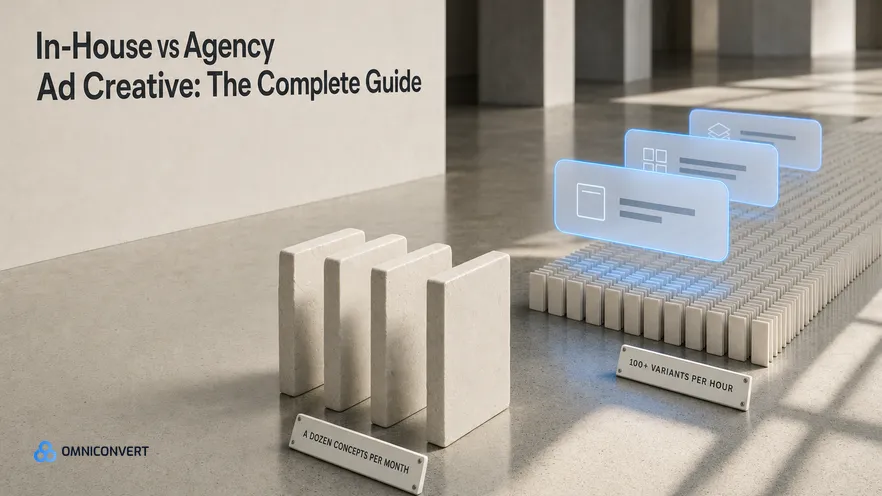
- The deciding variable is sustained monthly concept volume, not cost per asset.
- Count the retainer plus your own briefing and review hours, or you are comparing the wrong numbers.
- Round-trip time from brief to live asset decides what happens when performance drops on a Friday.
- In-house teams fail through sameness and burnout, and agencies fail through slow round trips and brand drift.
- An AI-assisted hybrid moves the constraint from production capacity to review capacity, so plan the review.
The in-house vs agency ad creative question is almost always asked in the wrong currency. Somebody puts a retainer next to a salary, adds a tool subscription, and declares a winner. I have never seen that arithmetic predict which brand ends up with better ads. What predicts it is throughput and latency: how many distinct concepts the model can sustain every month, and how many calendar days pass between deciding you need something and seeing it live. Last updated: September 2026.
I have spent 13 years in eCommerce, and the pattern in the CROBenchmark dataset of 7,000+ websites in 15+ industries, assessed against 248+ audit criteria, matches what I hear in operator calls. Brands stall on creative not because the work is bad but because the supply chain producing it cannot keep pace with what the ad account burns. The org design is the constraint, not the craft.
So this guide is not a pros-and-cons table with a shrug at the end. It is the set of questions I would ask before moving creative production anywhere: what volume each model sustains, where the money really goes, who owns the brand, what happens on a Friday afternoon, and which model is still standing when you double spend. Nexus by Omniconvert is the AI eCommerce growth engine for Shopify brands: it reads your store, ad and customer data, ranks growth opportunities by profit impact, and builds the campaigns to act on them, and you approve what goes live. That matters here only because it changes one variable in the decision, and I will be precise later about which one.
In-house vs agency ad creative: the short answer
Here is the decision in one paragraph. If your creative need is lumpy and low, buy it outside: you cannot keep a good designer interested on four assets a month, and you will pay a salary for idle weeks. If your need is steady and high, the brief has to live inside, because the person writing it needs daily contact with your support inbox, your returns reasons and your repeat-purchase data.
The middle case is the one most brands are actually in, and it is where the argument gets heated. You need volume, you cannot yet justify three hires, and the agency round trip is too slow. That is the case an AI-assisted hybrid was built for, and it is also the case where people oversell it. A generator raises production capacity. It does not raise your capacity to judge what is worth producing.
One more framing before the detail. Every model here is really two jobs bolted together: deciding what to say, and making the thing that says it. Agencies sell you both and charge mostly for the second. In-house teams are hired for the second and quietly become responsible for the first. Most creative failures I see are failures of the first job dressed up as a resourcing problem.
The volume your ad account actually eats
Do the arithmetic with your own figures rather than a benchmark, because creative lifespan varies enormously by category and by how aggressive your frequency caps are. A supplements brand refreshing weekly and a furniture brand refreshing quarterly are not in the same business, and no industry average helps either of them.
Say you run two platforms, three formats each, and your winning concepts hold for about two weeks before performance decays. That is six live slots refreshed twice a month, so twelve fresh concepts, and because most concepts do not win you need to produce several times that to fill twelve slots. Tracking how long your creative stays active is the input that makes this calculation honest, and it is the number most teams have never written down.
Now compare that requirement against capacity. A single freelancer can produce a small, steady stream and nothing more, because their week is finite and you are not their only client. An agency retainer buys a tier, and the tier is a hard ceiling until you renegotiate. An in-house team of two produces more than either and stops when the two of them stop. A generation-led hybrid produces variants far faster than any of them, and its ceiling moves to how much your reviewer can look at.
Notice what the arithmetic exposes. Most brands debating in-house versus agency creative have never quantified the requirement, so they are choosing between suppliers without knowing the order size. Quantify it first, and two of the four options usually eliminate themselves in an afternoon.
Where the cost really sits
Start with in-house. The honest number is salary plus payroll overhead plus software plus recruiting plus the ramp, which is roughly a quarter before a new hire produces work you would run. Add the cost you never see on a spreadsheet: the idle month after a big campaign ships, and the single point of failure when your only editor takes two weeks off in August.
Then the agency side. The retainer is the visible part. The invisible part is your own team's time writing briefs and running review cycles, plus every revision round that exists because the brief was thin, plus the assets you commissioned and shelved. I have watched brands pay for a full slate of deliverables and run a small fraction of it. The ones that never went live were not free, and they never appear in the cost-per-asset comparison anybody presents internally.
Freelancers look cheapest per unit and move the cost to you. You become the project manager, the brand guardian and the QA step, and those hours are real even though nobody invoices for them. That is fine at low volume and does not scale, because your own calendar is the resource consumed.
The metric that makes all four comparable is cost per profitable concept: everything you spent, divided by the concepts that went live and held. It is a harsher number than cost per asset and it is the only one that correlates with results. If that gap between output and outcome is new to you, the creative-to-profit gap is where I have written it up properly, and it pairs with knowing why True Profit rather than ROAS should decide which concept counts as a winner.
The round trip from brief to live asset
Run the Friday test on your current setup. Performance on your best-spending concept drops on a Friday afternoon. Who can have three new hooks live before Monday morning? Answer that truthfully and you have learned more about your creative operation than any capability deck will tell you.
With a retainer, the sequence is a brief on Monday, a kickoff call, a first cut on Thursday, one revision round, and something live the week after. None of those steps is unreasonable. They simply add up, and while they add up your spend keeps buying a decaying asset. The agency is not slow; the round trip is.
In-house, the same request is a conversation in the morning and a first cut in the afternoon, because the brief never had to be written down formally to be understood. That is the real advantage of proximity, and it is also the source of the in-house failure mode I describe further down: briefs that live only in someone's head do not scale past that head.
Before you blame any supplier for latency, check whether the delay is actually upstream. In a lot of teams the constraint is not production at all: it is that nobody has decided what to say. I have written that case up separately, because the creative brief is usually the real bottleneck, and if you are formalising the step for the first time, the definition of a creative brief is the plainest place to start.
The four models side by side
| Dimension | In-house team | Agency or studio | Freelancers | AI-assisted hybrid |
|---|---|---|---|---|
| Sustained monthly volume | Steady, capped by headcount | Capped by the retainer tier | Small, capped by one person's week | 100+ creative variants per hour, ranked by CLV-weighted angle |
| Where the cost sits | Salaries, tools, idle months | Retainer plus your briefing and review time | Per project plus your project management | Subscription plus internal review time |
| Brief to live asset | Same day to two days | One to two weeks with revisions | Days, subject to their queue | Hours, then your approval |
| Brand consistency | Strong by default, sameness is the risk | Strong at first, drifts as the account changes hands | Varies by person, no redundancy | Held by your brand kit and your approvals |
| Friday performance drop | Answered before Monday | Answered next week | Answered when they are free | Answered the same afternoon |
| When ad spend doubles | Hire and wait a quarter | Renegotiate the tier | Breaks | Production scales, review becomes the constraint |
The table is deliberately qualitative, because the only quantities that matter are yours. Fill the volume row with your own replacement rate and the cost row with your fully loaded figures, and the choice stops being a debate.
Who owns brand consistency
In-house teams are consistent almost effortlessly, which is why their risk is the opposite problem. A team that has looked at the same brand for two years starts producing recognisable, competent, slightly interchangeable work. They have internalised your assumptions, including the wrong ones, and nobody in the room is positioned to question them.
Agencies bring the outside eyes that fix exactly that, and they bring a specific drift risk in return. The senior who pitched you moves to a new account, a junior picks up production, and six months later the work is technically on brand and tonally somewhere else. This is not malice. It is staffing economics, predictable enough that you should plan for it.
The fix in both directions is a written reference, and the most useful part of it is not the logo rules. It is a rejection log: the concepts you said no to, with one line on why. That log teaches a new agency producer or a new hire more in an hour than a brand deck does in a week, because it encodes judgment rather than taste. If you want a structured way to see the shape of what you are already running, reading a creative audit is the exercise I recommend before any handover.
Failure modes on both sides
The in-house failures first, because they are the ones brands underestimate when they are excited about hiring. One designer serving four channels burns out inside a year, and when they leave, the brand knowledge leaves with them. A small team has no external benchmark: they see one ad account, so they cannot know whether their work is good or merely familiar. And there is a career ceiling in a two-person creative team, which makes turnover structural rather than unlucky.
The agency failures are different and just as predictable. Round trips stretch. The people who pitched are not the people producing. Brand drift arrives with each staffing change. And the deepest one: the deliverable an agency is paid for is an approved asset, so creative gets written to please the brief and the brand manager rather than the buyer. Polished work no customer asked for still clears the approval meeting.
The incentive version of that point is worth saying plainly. A retainer renews on volume, responsiveness and polish. It does not renew on contribution margin, because the agency usually cannot see your margin. So the work optimises for what is visible to the person renewing, which is rarely the number you care about.
Freelancers fail by disappearing. They take a bigger client, or they get ill, and you have no redundancy and no documentation. That is an acceptable risk at low volume and an unacceptable one once creative is load-bearing for your revenue.
The AI-assisted hybrid, described honestly
This is the model I would build today at most brands between roughly one and twenty million in revenue, and I want to describe it without the usual overclaiming. Two internal people, sometimes one. Their job is not production. Their job is knowing the customer, writing the angle, and saying no to nine things out of ten.
What Nexus contributes on the production side is specific. It unifies store, ad and customer data, builds RFM segments from that, ranks angles by CLV, and generates launch-ready assets from customer data: static and video ad creative, landing pages and email copy. It also watches competitor ad libraries continuously and classifies what it finds by angle, hook and offer, which is the outside perspective an in-house team usually lacks. You approve what goes live, and nothing publishes without that.
Now the boundary, because this is where hybrids get mis-sold. Buying does not disappear either: the ad data comes back in, profit is measured per ad, and you get a recommendation to scale, hold, reduce or kill, but somebody still approves it and runs the accounts. Generation composes with the product imagery you already own, so when you genuinely need a new photograph or new footage, that is a camera job and no software changes it. I have written about where the line falls in AI product photography for eCommerce ads, and if you want cheap raw material before commissioning a shoot, the fastest source is usually what you already published: turn your product pages into video ads first and see what the angles tell you.
The failure mode of a hybrid is worth naming too. Volume without judgment produces two hundred variants of one wrong idea, faster than any agency could have produced five. Nothing about generation repairs a weak offer or a misread customer. If the brief is wrong, you now get the wrong answer at scale, which is why the internal owner of the brief is the non-negotiable hire in this model rather than the software.
Which model survives double the spend
Doubling spend roughly doubles concept demand, because you are filling more placements and burning through each concept faster at higher frequency. That is the stress test, and each model fails it differently.
- Freelancers break. There is no tier to buy and no bench. You start sourcing a second freelancer under time pressure, which is the worst moment to be assessing new suppliers.
- In-house hires and waits. Recruiting plus ramp is about a quarter, and the quarter you need capacity is the quarter you do not have it. Plan hiring against next quarter's spend, not this quarter's.
- Agencies move a tier. This works, it is slower than it sounds because scope discussions take weeks, and your cost per profitable concept usually gets worse rather than better as you buy more volume of the same thing.
- A hybrid moves the bottleneck. Production stops being scarce and review becomes scarce. If one person approves everything, that person is now your ceiling, and you should either add a reviewer or narrow what needs approving.
There is a staging pattern I would recommend to most brands. Start outside, because low volume does not justify a hire. Bring the brief in first, before any production, because that is where the customer knowledge sits. Add generation capacity next, since it lifts volume without a headcount decision. Then hire a producer when review and direction genuinely exceed one person's week. If you need a sense of how much variant volume that unlocks in practice, producing video ad variations at scale covers the mechanics.
And keep buying the outside things deliberately. A shoot, a director, a campaign idea, a fresh read on an account that has gone stale: these are worth paying an agency for at any stage. What stops being worth paying for is volume you can produce internally in an afternoon.
FAQ: in-house vs agency creative
Is in-house or agency ad creative cheaper?
Neither, until you define the unit. Per asset, an agency retainer usually wins at low volume and loses badly at high volume. Per profitable concept that stayed live, an in-house team wins once you need more than a couple of dozen new concepts a month, because the marginal cost of your next concept is close to zero and the marginal cost of the next agency concept is not. Compare cost per profitable concept, and add your own briefing and review hours to both sides.
How much ad creative volume does my brand actually need each month?
Work it out from your own account rather than from a benchmark. Count the distinct concepts that were live and profitable last month, note how many days each one held before performance decayed, and divide the month by that lifespan. Multiply by the number of platforms and formats you run. The answer is your replacement rate, and it is the single number that decides which production model can keep up with you.
When should a growing eCommerce brand bring ad creative in-house?
When the brief has become the bottleneck and the round trip costs you more than the salary would. Two signals matter. First, you reject a large share of what arrives because the producer does not know the customer well enough. Second, a performance drop on a Friday waits until the following week for an answer. Either signal on its own is a reason to own the brief internally, even if you keep an outside team for craft.
What does Nexus by Omniconvert change about this decision?
It changes who produces the assets and how fast, not who holds the taste. Nexus reads your store, ad and customer data, ranks angles by CLV, generates static and video ad creative, landing pages and email copy from that data, and watches competitor ad libraries continuously. It composes with the product imagery you already own. You still need someone internal who can reject an idea and say why, and you approve what goes live.
Can an agency and an in-house team work together without duplicating cost?
Yes, and above a certain spend it is the arrangement I see working most often. Keep the brief, the brand kit and the approval internal. Buy the things that genuinely need outside capability: a shoot, a director, a campaign concept, a fresh read on an account that has gone stale. Pay for craft and perspective, not for volume you could produce yourself in an afternoon.
How do I tell whether my current creative setup is failing?
Look for three symptoms. Your best performing ad is more than a quarter old and nothing new has beaten it. The share of produced assets that never went live is rising. And nobody can name the customer objection that the last five concepts were built to answer. Each symptom points at a different fault, and none of them shows up in a report about output volume.
The bottom line
This is an org-design decision dressed up as a procurement decision, and that is why the usual comparison goes nowhere. Work out your replacement rate first, because volume picks the model and nothing else does. Then price each option honestly, counting your own briefing and review hours and the assets you paid for and never ran, and divide by the concepts that actually went live and held. Run the Friday test and the doubling test, since those two questions expose more than any capability deck. Wherever production ends up, keep three things inside: the brief, the brand reference including a log of what you rejected, and the approval. Buy craft, perspective and a camera from outside when you need them, and buy volume from wherever it is cheapest to produce. The brands that get this right are not the ones with the best designers or the best agency. They are the ones where someone internal knows exactly what the next ad has to say, and nothing stands between that sentence and a live asset.